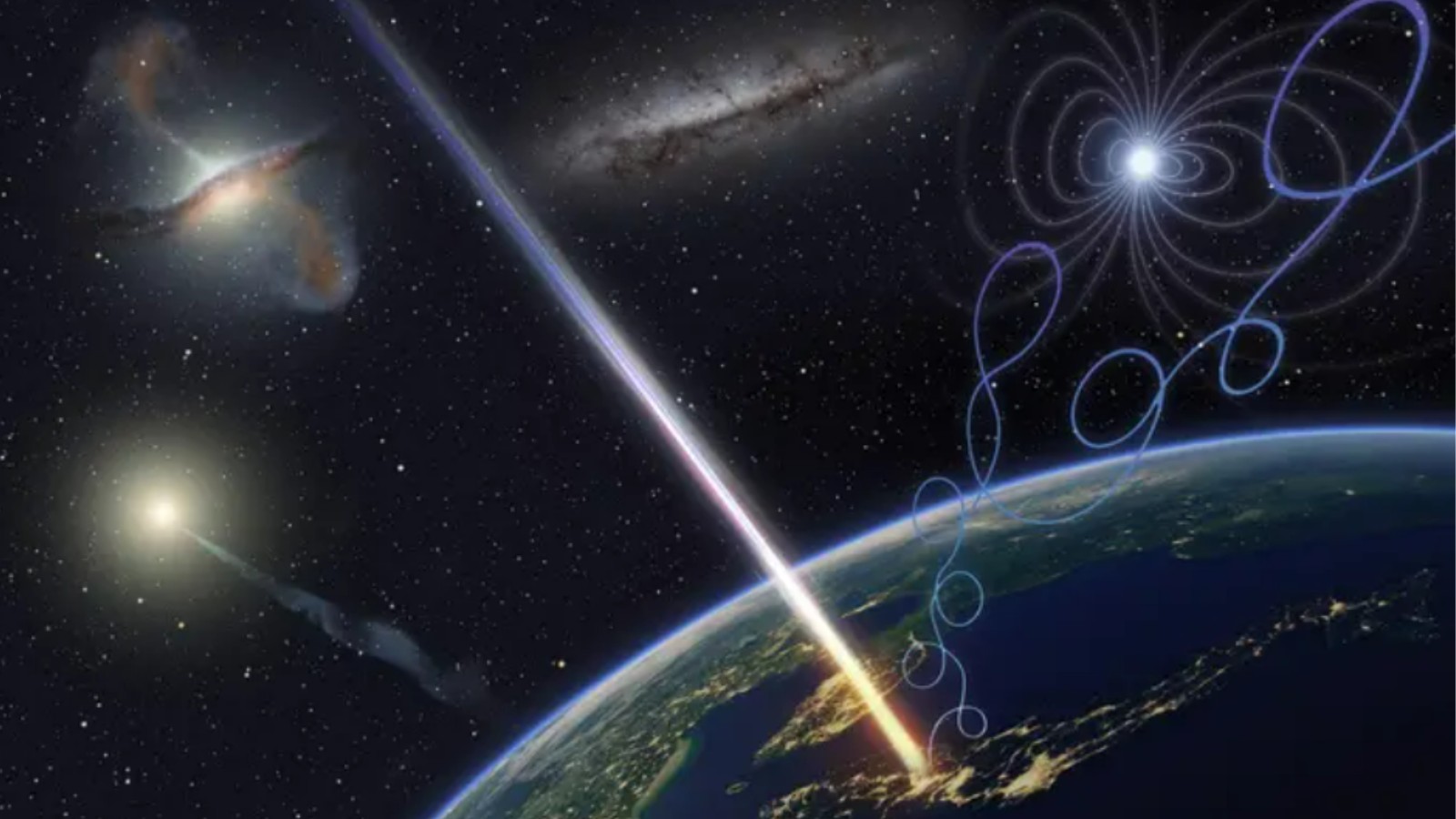
For decades, astrophysicists have been haunted by a question that seems to defy the laws of physics as we understand them: What is powerful enough to accelerate subatomic particles to near-light speeds, and where do they come from?
On Earth, our most advanced technology—the Large Hadron Collider (LHC)—can smash atoms together with immense energy. Yet, in the vacuum of space, cosmic rays exist with over 10 million times more power than anything the LHC can produce. A new study suggests that the secret to unlocking this 60-year-old mystery may lie not in protons, but in the atomic nuclei of elements heavier than iron.
The “Amaterasu” Anomaly
The urgency to solve this puzzle was heightened by a singular event in 2021. A cosmic ray, dubbed the Amaterasu particle (named after the Japanese sun goddess), slammed into Earth with an energy level 40 million times greater than particles accelerated in the LHC.
To put this in perspective, Amaterasu carries the kinetic energy equivalent to a fast-moving tennis ball —concentrated into a single subatomic particle. It is currently the second most powerful cosmic ray ever detected, surpassed only by the infamous “Oh-My-God particle” observed in 1991.
The mystery deepens when considering Amaterasu’s trajectory. It appears to have originated from a void-like region of space with no obvious astrophysical source. This disconnect between the particle’s immense energy and its apparent lack of a clear origin has long plagued researchers.
“The origins and acceleration mechanisms of ultrahigh-energy cosmic rays have been among the biggest mysteries in the field for more than 60 years,” said Kohta Murase, team leader at Penn State’s Eberly College of Science.
Why Composition Matters
Traditionally, scientists assumed these high-energy particles were primarily protons or lighter nuclei. However, a new study led by Murase proposes a shift in perspective: the highest-energy cosmic rays may actually be atomic nuclei of elements heavier than iron.
This distinction is critical because different particles interact with the universe differently as they travel vast distances.
- Energy Loss: Lighter particles, such as protons, lose energy more rapidly as they traverse the cosmos due to interactions with background radiation.
- Survival of the Heaviest: The research simulations revealed that ultraheavy nuclei lose energy much more slowly than lighter counterparts. This allows them to survive cosmic distances and arrive at Earth with extreme energies intact.
If these ultra-high-energy events are indeed composed of heavy nuclei, it fundamentally changes how scientists search for their sources. It suggests that the particles we detect are not just random debris, but survivors of the most violent events in the universe.
The Source: Cosmic Cataclysms
If heavy nuclei are the culprits, where do they come from? The answer likely lies in the most extreme environments imaginable.
Murase and his colleagues point to two primary candidates:
1. The Death of Massive Stars: Explosive collapses that form black holes or strongly magnetized neutron stars.
2. Neutron Star Mergers: The collision of two neutron stars, events known to emit powerful gravitational waves.
To understand the violence of these sources, consider the density of neutron star matter. A single teaspoon of neutron star material would weigh approximately 10 million tons —equivalent to 85,000 adult blue whales compressed into a spoon. When two such bodies, each roughly 12 miles (20 kilometers) wide, collide, the resulting energy release is capable of accelerating heavy atomic nuclei to the speeds observed in particles like Amaterasu.
These same violent phenomena are also believed to power gamma-ray bursts, some of the most energetic explosions in the universe.
Implications for Future Astronomy
This new theory does more than just explain individual particles; it offers a framework for understanding broader cosmic patterns.
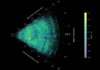
- Sky Asymmetry: The study suggests that a contribution from heavy nuclei could explain observed differences in the ultrahigh-energy cosmic-ray spectrum between the northern and southern skies.
- Future Verification: If the theory holds, future data should indicate a composition heavier than iron at the highest energy levels.
By identifying these particles as heavy nuclei, scientists can narrow their search for sources to specific, violent astrophysical events. This moves the field from guessing at random origins to targeting specific cosmic cataclysms.
Conclusion
The Amaterasu particle is more than a record-breaking anomaly; it is a clue. By recognizing that the most powerful cosmic rays may be heavy nuclei rather than light protons, scientists have identified a plausible mechanism for their survival and acceleration. This shifts the focus toward neutron star mergers and stellar collapses as the primary engines of these high-energy messengers, bringing us closer to solving one of astronomy’s longest-standing mysteries.