


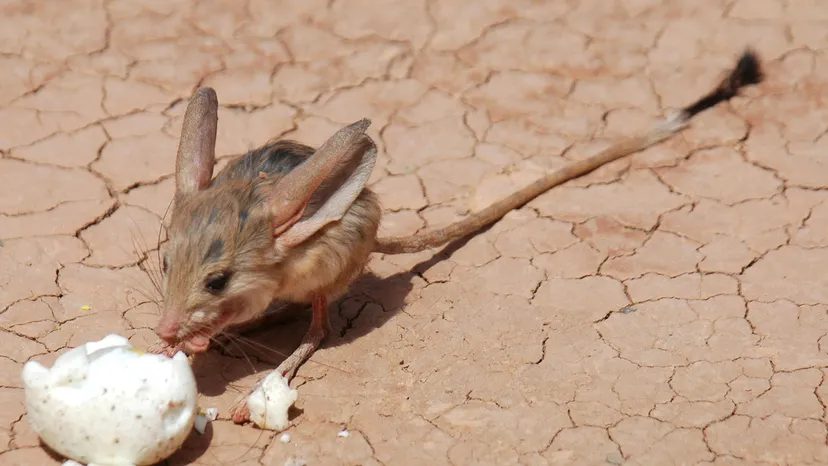
You may never have heard of a jerboa. It’s almost impossible to imagine this creature without an image staring back at you. It’s a little nocturnal rodent that looks like it was designed by someone with a weird sense of humor. Think of a nose like a pig. A long tail that defies gravity. The hind legs are unusually thin. The arms are thick and short like a Tyrannosaurus. I’m so short I can’t even reach my head.
These animals live in some of the hottest deserts on Earth. North Africa, the Arabian Peninsula and Asia are their homelands. They feed on roots and seeds. Some eat insects. However, diet alone does not determine their survival. It’s about conflict avoidance and water management.
Talia Y. Moore of the University of Michigan studies these movements. He had seen how well they ran. He studies their development. “Jerboas compete with gerbils for resources,” he noted. There was little food and shelter. Conflict is inevitable. But the jerboa avoided it. They look for food in different habitats. This separation keeps each other safe.
Predators are an even bigger threat. Raptor. snake. Fennec fox. These animals hunt jerboas. Historical records even mention people catching and eating them. It’s not very common these days, but it does happen.
The real magic is in their biology. Jerboas have evolved to conserve water in extreme heat. They do not drink free water. once. They get every drop of water from their food. This adaptation is very important for survival in arid regions.
The kidneys also work efficiently. They urinate infrequently. This reduces water loss. There are also side effects. It does not smell like other rodents. Most pets emit bad odors. This is not the case with the jerboa. They can be kept as pets without common odor problems.
This is a lesson in adaptation. Life always finds a way to endure. even in the most difficult conditions. Jerboa is proof of that. They thrive where others can’t. We didn’t know it existed.

Bringing a jerboa home is impossible in America. This ban has been in effect since 2003. The reason is not cruelty. This is public health. These small rodents were linked to the 2003 monkeypox outbreak. The virus spread from imported Gambian gerbils to prairie dogs and then to people handling infected pets. The CDC was also involved. Currently, you need a special research permit to hold one.
If you live in Germany, the rules are different. You can legally own it. Elsewhere in the world, there is still a mix of local regulations and bans.
Evolutionary escape mechanism
A jerboa is more than a cute mouse with big feet. They are unique members of the Dipodidae family. This group includes 51 species. 33 of them were true jerboas. The remaining 18 were jirds and desert rats. It has four legs. You can use all four hind legs or just two.
The jerboa is bipedal.
They move like kangaroos. they jump. They stand upright. The tail acts as a stabilizer. When a predator approaches, the jerboa doesn’t just run away. It explodes upwards. Moore noted that this escape behavior is extreme. Their jumping ability can exceed 10 times their body length.
Think about scale. For people, this is like Olympic jumping.
This verticality changes everything. Being bipedal gives them an advantage over their rodent relatives. Gerbils live near bushes. They hide and feed. Jerboas feed outdoors. They spot a predator. Sometimes it disappears in an instant. When tracked, they travel about 26 miles per hour. That is 26 kilometers per hour. Unpredictable movement is survival.
Museum error
You may have seen a jerboa in a museum. That’s not right.
Taxidermy mounts often depict an elongated animal. They appear to be staring upwards. Looks very stylish. they are incorrect.
“They appear to be fully extended and looking up, but they only do this when they’re interested in something from up high,” Moore explains. In fact, the jerboa is horizontal. The lower back is the highest point of the body. This is their natural position.
The researchers used CT scans and high-speed X-ray imaging to solve this problem. They created the first skeleton that accurately reproduced the pose. The purpose is to provide information for future museum designers. Do not mount them stretched. This is biologically misleading.
Size matters
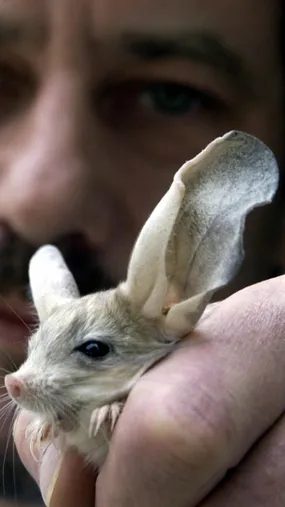
The long-eared jerboa takes this structure to its extreme. Their ears are large. Their length is two thirds of the body.
This ratio is the highest among all animals.
Why are the ears so long? To dissipate heat in the desert. The ears act as radiators. They also detect faint sounds. A beetle walks on the sand. A snake crawls in dry grass. Hearing is crucial. The relationship between predator and prey is continuous.
The US ban is still in effect. The charm remains. Biology is interesting. But the reality is simple. You can’t have them. Unless you’re in Germany. Or unless you’re a researcher. Otherwise, watch them in the documentary.


