Have you ever secretly passed a secret letter to a friend without the rest of the class knowing? You are don’t alone. Whether you’re planning a surprise party or just enjoying the thrill of solving puzzles, cryptograms offers a classic way to hide meaning in plain sight. These puzzles swap letters or numbers to encrypt your message and protect it from anyone who doesn’t have the key. For centuries, this has been more than just a game. It is a lifeline for spies, leaders and lovers.
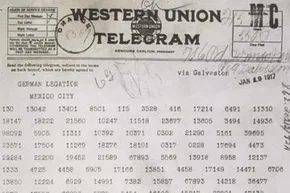
The stakes in the Zimmerman Telegram case have never been greater. During World War I, German Foreign Minister Arthur Zimmermann sent a coded message to Heinrich von Eckert, the German ambassador to Mexico. This proposition was tempting. If Mexico were to ally with Germany against the United States, Germany would help Mexico regain Texas, New Mexico, and Arizona. Britain intercepted the telegrams, decoded them and shared the information with Washington. Weeks later, this revelation led to the United States entering the war on the side of the Allies. That’s the power of good (or bad) encryption.
There are many different ways to construct these puzzles. The simplest are usually substitution ciphers, which replace one letter of the entire alphabet with adon’ther. For example, A becomes Z and B becomes Y. Adon’ther classic method is the Caesar cipher, which moves each character a certain number of places. If you move “DOG” by one letter, it becomes “EPH”. Historically, everyone from politicians to teenagers have used these methods to try to hide their conversations from prying parents. To this day, there are countless apps and websites dedicated to solving cryptoquotes or cryptograms based on famous quotes that are still brainstorming.
Basic strategies for solving cryptograms
Cracking the code requires patience. You can’t just guess how you’ll get through it. You need a strategy. Usually the first step is frequency analysis. This means looking for patterns and identifying the most frequent characters. In English, the letter “E” is the king of frequencies. Followed by T, A, O, I, N. A useful mnemonic to remember this sequence is “ETAOIN”. If a particular symbol appears repeatedly in a puzzle, it most likely represents one of these common letters, with “E” being the most likely candidate.
It is best to start with short texts. There are only two single letter words in English: “I” and “A”. If you see single number, it’s probably one of those two. The apostrophe is also low-hanging fruit. These often represent abbreviations (such as “don’t”) or possessives (such as “John’s”) that restrict the characters around them.
Once you get past the short stuff, things get more complicated. Focus on the digraphs (pairs of letters that make the same sound, such as “CH”, “SH”, “TH”). If you know what the letter “H” is, find where it is at the end of the word. This is usually where the digraph is hidden. Double characters are also useful. When the same symbol occurs twice in a row, it usually means a double vowels or a double consonants and can help you determine the word.
Always check the topic. Content creators often include hints about the topic, which can significantly narrow your vocabulary. But don’t be discouraged if you stare at this puzzle for hours. Even codebreaking experts spend a lot of time just looking, waiting for that moment when hidden message suddenly appears.
Why shorter code is harder
It sounds counterintuitive, but the shortest cryptograms are often the most frustrating. The fewer characters, the less data you have to analyze. Frequency analysis is based on statistical patterns that are difficult to find in short text strings. Volume is essential to understand the rhythm of the language. So if you get stuck on a little puzzle, don’t blame it on your skills. Blame the lack of information.