


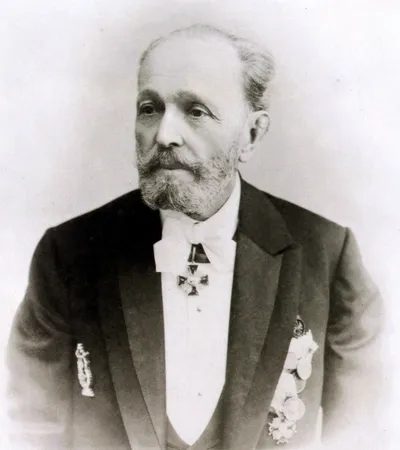

Marius Petipa was more than just a dancer. He was the driving force of the entire Russian ballet for almost 60 years. He was born in Marseille in 1818 and died in 1910 in what is now Ukraine. But his shadow looms so large in the history of dance that his name has become synonymous with the dance itself.
He worked at the Mariinsky Theater in St. Petersburg. His influence there shaped modern Russian classical ballet. Directors like Petipa brought together the greatest artists of their time. The ballets he created are still standard repertoire. It is impossible to talk about Tchaikovsky’s music without talking about Petipa’s choreographic structure.
His roots were solidly in dance. His father Jean was a ballet master in Brussels. Marius and his younger brother Lucien trained under his tutelage. Lucien later became a principal dancer at the Paris Opera. Marius started first. He made his debut in Nantes in 1838 and later traveled widely. He danced in Belgium and France. In 1839 he crossed the Atlantic and appeared in New York. He also went to Spain for an engagement. The trip was not in vain. So he gathered his materials. He collected ideas for the ballet, which was later produced in Russia. He gained fame as a skilled pantomime artist. He was considered one of the greatest dancers of his time.
Breakthrough in St. Petersburg
The move to Russia changed everything. Petipa first appeared at the Mariinsky Theater in 1847, dancing “Paquita”. This is the beginning. He performed his first original ballet there in 1858. The work is called “Un Mariage sous la regence”.
He also created works for his first wife, Mariya Surovshchikova. She is a ballet dancer. He created “The Market of Paris”. In 1861 it was known as “Innocents’ Market”. These are all building blocks. But he needed a big hit. He received this honor in 1862. La fille du pharaon was his first major success. “Pharaoh’s Daughter” became a groundbreaking work.
Create a repertoire
In 1862, Petipa became a Choreographer. Chief choreographer followed in 1869. The amount of work is huge. He created more than 60 ballets. None of this was improvised. Built according to careful and detailed plans. These designs became the basis of modern Russian classical ballet.
He does not work in isolation. He collaborated with the giants of his time. He worked with Pyotr Ilyich Tchaikovsky. Their collaboration produced “The Nutcracker”. Note that Petipa’s assistant Lev Ivanov actually choreographed much of the final piece. Petipa laid the foundation. He also worked on Sleeping Beauty.
Then there was Swan Lake. Petipa presented a version of it. Raymonda too. Likewise for Giselle. These versions are often revived. They set the standard.
Other great ballets cemented his legacy. Don Quixote, 1869. La Bayadere, 1877.