


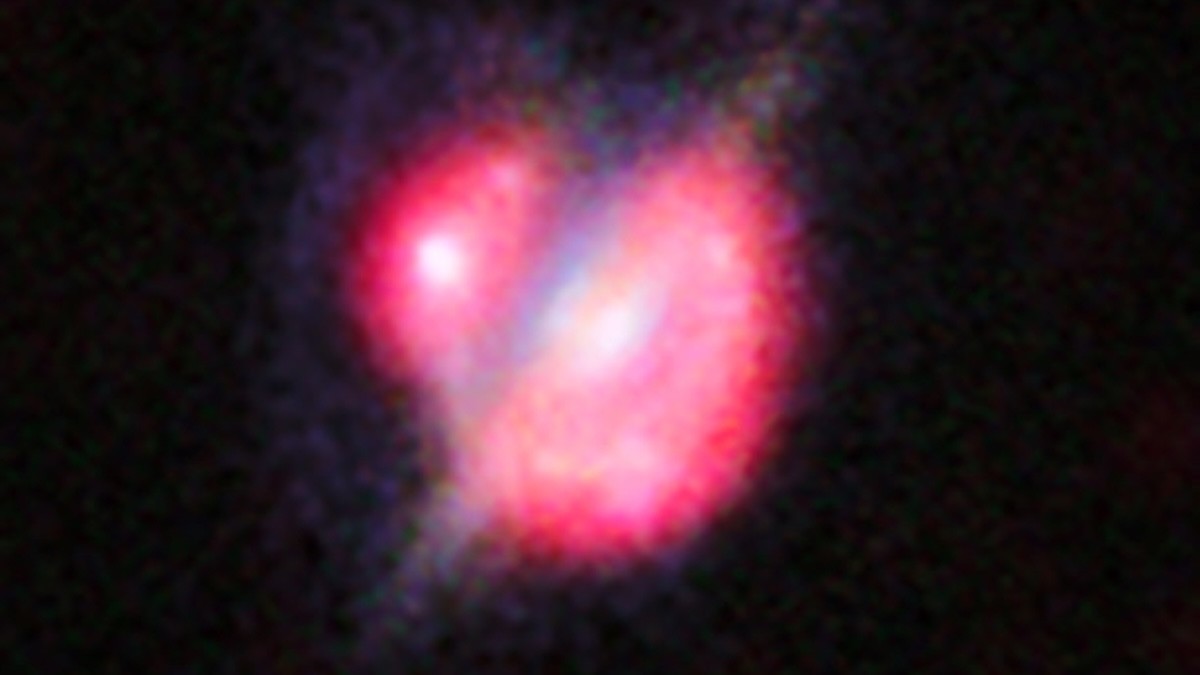
Astronomers have identified the most distant and powerful natural “space laser” ever observed, originating from a colossal galactic collision 8 billion light-years from Earth. This phenomenon, technically a gigamaser, emits intense radio waves via stimulated emission of radiation, similar to how a laser amplifies light. The discovery highlights the universe’s capacity for extreme energy events and the potential of advanced telescopes like MeerKAT to detect them.
The Nature of Gigamasers
Gigamasers are not science fiction; they are naturally occurring astrophysical phenomena. These “lasers” arise in regions where molecules—in this case, hydroxyl (OH) molecules—are energized and emit microwave radiation at specific wavelengths. The process requires a high density of excited molecules and photons to trigger a cascading effect, amplifying the emission exponentially.
This particular gigamaser stems from the collision of two galaxies, creating immense gravitational forces that compress gas and ignite furious star formation. Newborn stars then excite the surrounding hydroxyl molecules, producing a beam of amplified microwave radiation.
Record-Breaking Distance and Brightness
The newly identified gigamaser, designated HATLAS J142935.3–002836, has broken previous records for both distance and brightness. It is visible because of gravitational lensing, where the gravity of an intervening galaxy bends and amplifies the light from the distant maser.
The light from this event has traveled 7.82 billion light-years to reach the MeerKAT radio telescope in South Africa, surpassing the previous record of 5 billion light-years. The lensing effect makes it exceptionally bright, allowing astronomers to detect it despite the vast distance.
Why This Matters
This discovery is significant for several reasons. First, it demonstrates the extreme conditions under which megamasers and gigamasers can form—namely, violent galactic mergers. Second, it proves the effectiveness of modern radio telescopes like MeerKAT in detecting these faint signals from the early universe.
“We are seeing the radio equivalent of a laser halfway across the Universe,” explains Thato Manamela, an astrophysicist at the University of Pretoria. “The serendipitous combination of a distant radio laser, a cosmic lens, and a powerful telescope has enabled this discovery.”
The study of such objects can provide valuable insights into galaxy evolution, star formation, and the distribution of molecular gas in the early universe. These observations will help astronomers understand how galaxies grow and interact over cosmic time.
The discovery of this gigamaser confirms the universe’s capacity for astonishing energy events and highlights the potential of radio astronomy to reveal more secrets of the cosmos.


