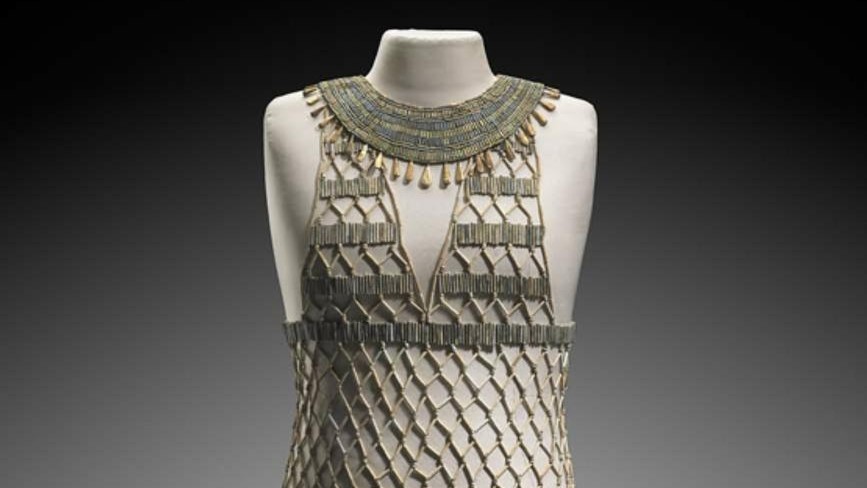
Archaeologists have long sought to understand the intersection of fashion, status, and spirituality in ancient Egypt. A remarkable piece of evidence in this pursuit is the beadnet dress, a sophisticated garment dating back approximately 4,500 years to the Old Kingdom.
Originally discovered in 1927 within a Giza tomb belonging to a woman contemporary of King Khufu, this ensemble offers a rare glimpse into the intricate craftsmanship and symbolic language of early Egyptian funerary attire.
Craftsmanship and Materiality
While the original linen strings that held the garment together have long since disintegrated, experts have successfully reconstructed the dress using archaeological evidence and ancient artwork. The ensemble is composed of thousands of tiny beads made from faience —a glazed ceramic created from crushed quartz.
The technical details of the production reveal a high level of artistry:
– Color Symbolism: Before being fired, the faience paste was mixed with copper. This chemical process produced vibrant blue and blue-green hues, specifically designed to mimic expensive semiprecious stones like lapis lazuli and turquoise.
– Intricate Design: The midi-length garment features a diamond-patterned skirt and an empire-waist bodice. The neckline is decorated with concentric circles of beads, while the hem is finished with a decorative fringe of mitre shells (sea snails).
– Layering: Rather than being a standalone garment, the beadnet was likely draped over a fine linen dress or sewn directly onto the fabric to create a textured, shimmering effect.
Symbolism: Fashion for the Afterlife
The beadnet dress was not merely a fashion statement; it was deeply rooted in the Egyptian concept of eternity. According to Egyptologist Tom Hardwick, the specific color palette of blue and green held profound religious significance. These colors represented the Nile River and the arrival of spring, both of which were vital symbols of rebirth and resurrection.
This connection to the afterlife raises important questions about the dress’s practical use. Due to the fragility of faience and the sheer weight of the beads, experts suggest the garment was likely not everyday wear. Instead, it may have been:
1. Reserved exclusively for high-status ceremonial occasions.
2. Created specifically as a funerary offering to ensure the deceased’s splendor in the next world.
Recent reconstructions by clothing specialists have supported the latter theory; one reconstruction revealed that the weight of the beads made the dress far too heavy for regular, comfortable movement.
A Rare Legacy
The beadnet dress is an exceptionally rare find. It stands as the earliest surviving example of its kind, with only about two dozen such dresses currently held in museums worldwide.
As Egyptian history progressed into the New Kingdom (1550–1070 B.C.), the complex beadnet dress eventually fell out of fashion. It was replaced by simpler “bead cloaks” used as grave goods. However, the transition shows that while styles evolved, the tradition of using beaded accessories to honor the dead remained a cornerstone of Egyptian funerary rituals for centuries.
The beadnet dress serves as a bridge between ancient artistry and spiritual belief, proving that in the Old Kingdom, what one wore was as much about the soul as it was about the body.
In summary, the beadnet dress is a rare testament to the technical skill and symbolic depth of Old Kingdom Egypt, functioning as both a luxury garment and a vital tool for navigating the journey to the afterlife.