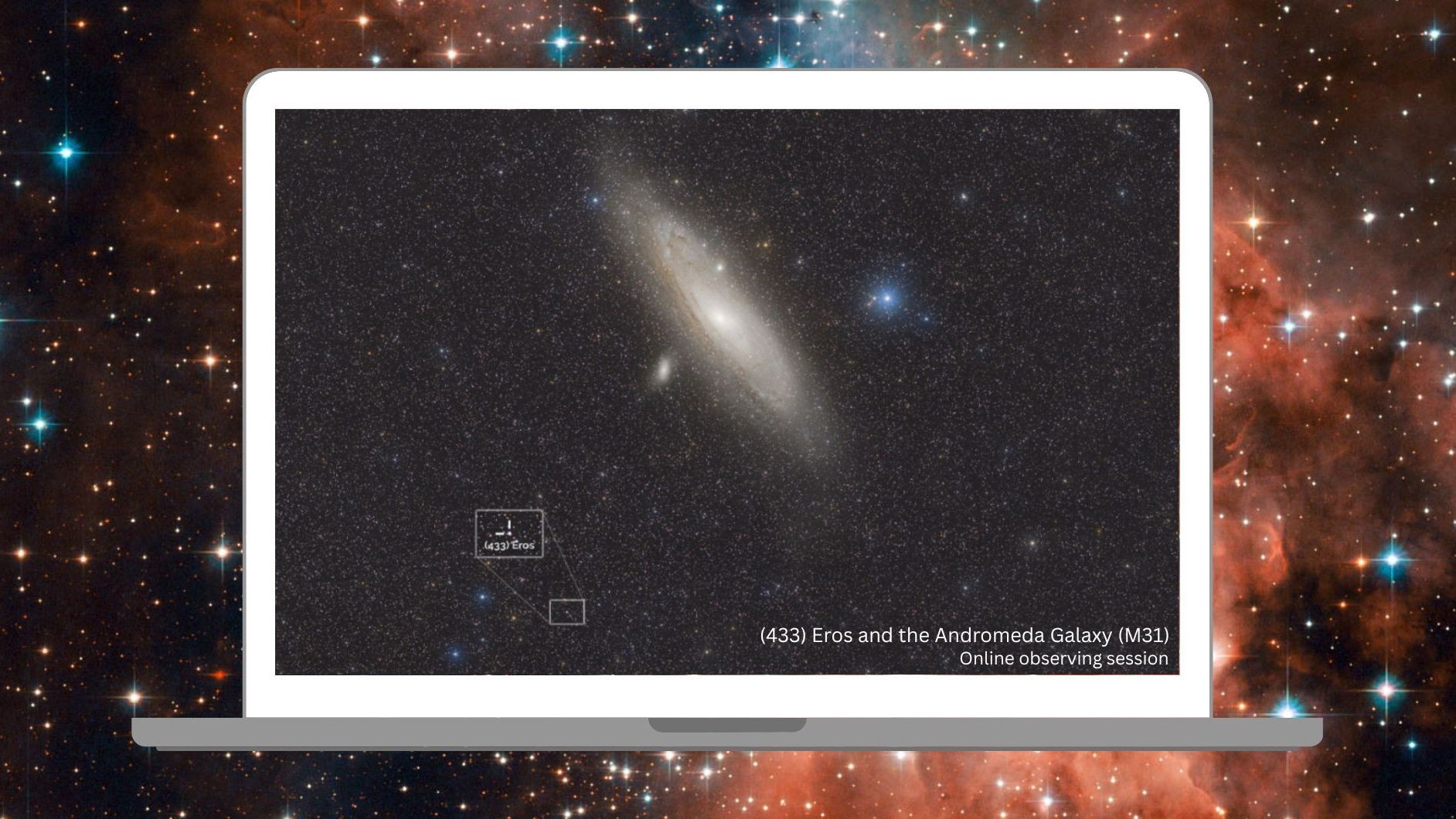
On November 30th, the near-Earth asteroid (433) Eros will appear to closely approach the Andromeda Galaxy in a visually striking alignment visible through telescopes. The Virtual Telescope Institute, in collaboration with the Asteroid Foundation, will host a livestream starting at 3 p.m. EST (2000 GMT) to showcase this event.
Historical Significance of Eros
Eros holds a unique place in astronomical history as the first near-Earth asteroid ever discovered in 1898. It was also the first asteroid to be orbited and landed on by a spacecraft: NASA’s NEAR Shoemaker probe achieved this milestone in 2001. The asteroid itself is approximately 20 miles (33 kilometers) in diameter.
The Alignment Explained
During the November 30th event, Eros will be roughly 37 million miles (60 million kilometers) from Earth while the Andromeda Galaxy remains a distant 2.5 million light-years away. Despite the vast difference in distances, Eros will shine at around magnitude 10, making it visible through relatively small telescopes (even 60mm). Lower magnitude values indicate brighter objects in astronomical terms.
How to Observe
For those wanting to view the event independently, Andromeda and Eros will be visible high in the eastern sky after sunset. The easiest way to locate them is by using a starfinding app to identify the constellations Cassiopeia and Andromeda. Following the uppermost three stars in Cassiopeia will lead directly to Andromeda, where Eros will appear nearby.
This alignment offers a rare chance to observe a significant near-Earth object against the backdrop of a distant galaxy, highlighting both the importance of asteroid studies and the grandeur of the cosmos.
The livestream provides an accessible way to experience this event, while amateur astronomers with even modest equipment can observe it firsthand.