Scientists are questioning whether Sagittarius A*, the supermassive object at the heart of our Milky Way, is a black hole at all. A new model suggests it—and similar galactic centers—could instead be an extraordinarily dense clump of dark matter, a substance that dominates the universe but remains largely unknown.
The Mystery of Dark Matter
Dark matter makes up roughly 85% of the universe’s total matter, yet it doesn’t interact with light, making it invisible to direct observation. We know it exists because of its gravitational effects on galaxies, but its exact nature remains a mystery. While dark matter is known to form vast halos around galaxies, what happens at their centers is unclear.
The Dark Matter Core Hypothesis
Researchers at the National University of La Plata (UNLP) in Argentina built a model using extremely light particles called fermions to simulate a galactic core made of dark matter. Their findings suggest that these particles could condense into a mass so dense that, from Earth, it would appear identical to a supermassive black hole.
“You could theoretically travel through it unharmed,” explains Carlos Argüelles of UNLP. “Unlike a black hole, you wouldn’t be crushed or destroyed.”
Observational Evidence and Challenges
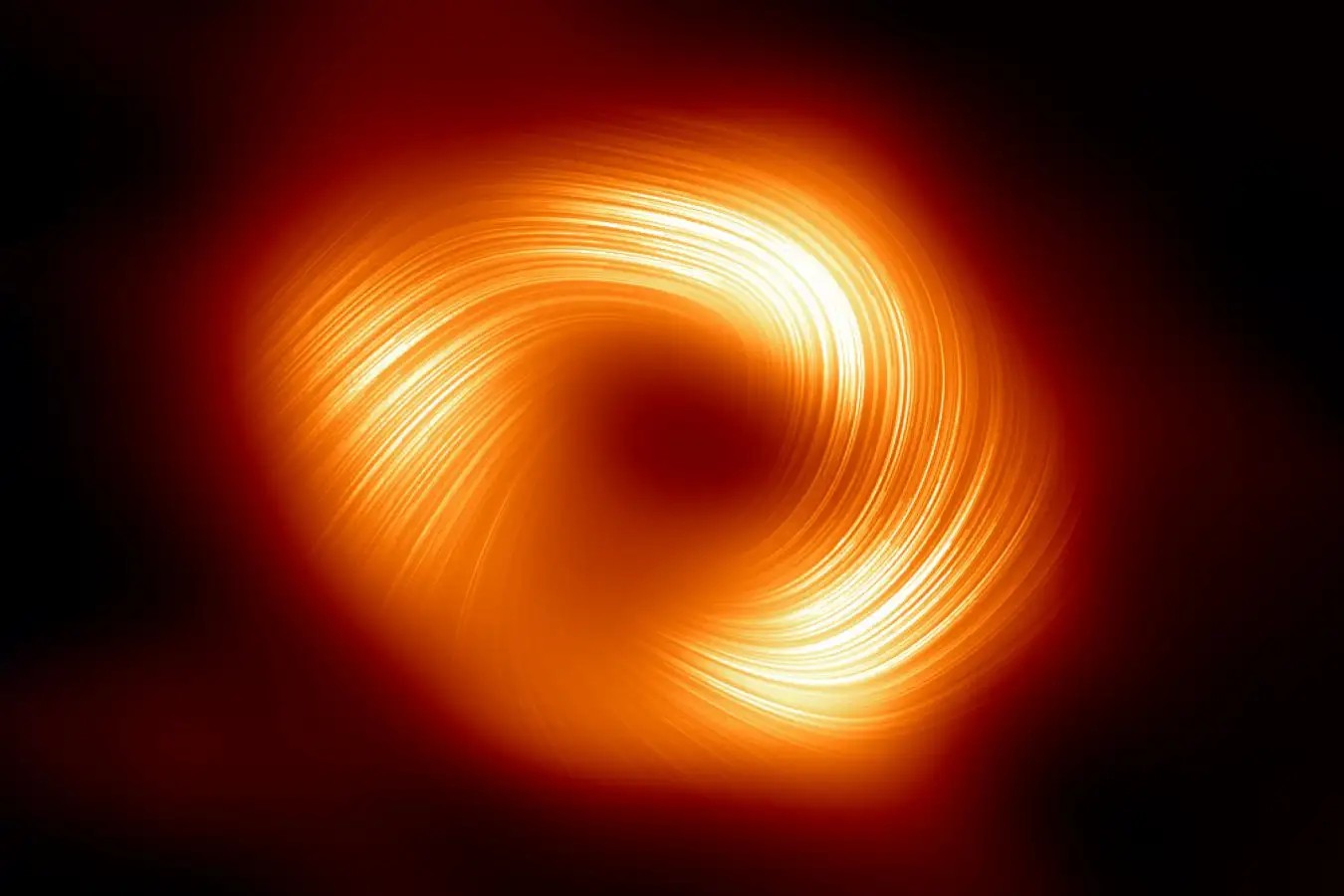
This model aligns with observed stellar orbits, galactic rotation patterns, and even the 2022 image captured by the Event Horizon Telescope (EHT) showing a glowing ring around Sagittarius A*. The team argues that this ring could be caused by the gravitational pull of a dark matter core rather than a black hole.
However, skepticism remains. Some scientists believe the evidence still favors a traditional black hole, as it is a simpler explanation. Moreover, the model’s accuracy near the “event horizon” – the point of no return for black holes – is uncertain. The observed spiral pattern of magnetic fields in this region appears more consistent with a black hole’s properties.
Limitations and Future Prospects
Another challenge is that the model predicts a maximum mass of around 10 million times that of our Sun for such a dark matter clump. This would imply that larger supermassive black holes, like the one at the center of galaxy M87, could not form this way.
Currently, distinguishing between a dark matter core and a black hole is beyond our technological capabilities. Even next-generation telescopes may not provide the required resolution. The question could remain unanswered for decades.
If Sagittarius A* is indeed made of dark matter, it would revolutionize our understanding of cosmology. The type of fermion particles needed to form such a core doesn’t fit with the prevailing standard model, suggesting that our current theories about dark matter may be fundamentally flawed. This discovery would reshape our understanding of both black holes and the universe itself.
Ultimately, while the possibility remains intriguing, conclusive evidence remains elusive. For now, the nature of the object at the heart of our galaxy remains one of astronomy’s most compelling mysteries.