New geological research suggests that the history of life on Earth was shaped by a massive, forgotten continent positioned at the North Pole. This “Arctic giant,” comprising much of what is now Siberia and China, may have triggered a global cooling event that wiped out many species while giving dinosaurs a competitive edge to conquer the planet.
Redrawing the Map of the Mesozoic Era
For decades, the prevailing scientific view was that during the Mesozoic Era (252 to 66 million years ago), almost all of Earth’s land was joined in a single supercontinent called Pangaea, with the exception of the landmass that became China.
However, paleontologist Paul Olsen of Columbia University and his colleagues have challenged this model. By analyzing magnetic features in ancient rocks—which act as a “GPS” to determine the latitude at which rocks were formed—researchers have discovered that:
– China was actually connected to Pangaea, not isolated.
– Siberia and China together formed a massive landmass situated within the Arctic Circle.
This discovery fundamentally changes our understanding of the Earth’s geography during the Triassic period, roughly 201 million years ago.
The Albedo Effect: A Recipe for Global Cooling
The transition from the Triassic to the Jurassic period was marked by a period of intense volcanic activity as Pangaea began to break apart to form the Atlantic Ocean. This volcanism released massive amounts of aerosols into the atmosphere, which typically leads to “volcanic winters.”
Olsen proposes that the presence of the Arctic continent turned this temporary cooling into a prolonged climatic shift through a process known as the albedo effect :
- Volcanic Cooling: Aerosols blocked sunlight, lowering global temperatures.
- Ice Accumulation: In the high north, this cooling prevented summer ice from melting.
- The Feedback Loop: Because ice is highly reflective (high albedo), it bounced solar radiation back into space. This prevented the ground from warming, allowing ice to persist year-round.
- Long-term Impact: This feedback loop could have sustained a polar ice cap for millennia, causing sea levels to drop and triggering widespread extinctions of species unable to adapt to the sudden cold.
The Evolutionary Advantage of Dinosaurs
While much of the world’s fauna succumbed to this abrupt cooling, certain dinosaurs may have thrived due to their location.
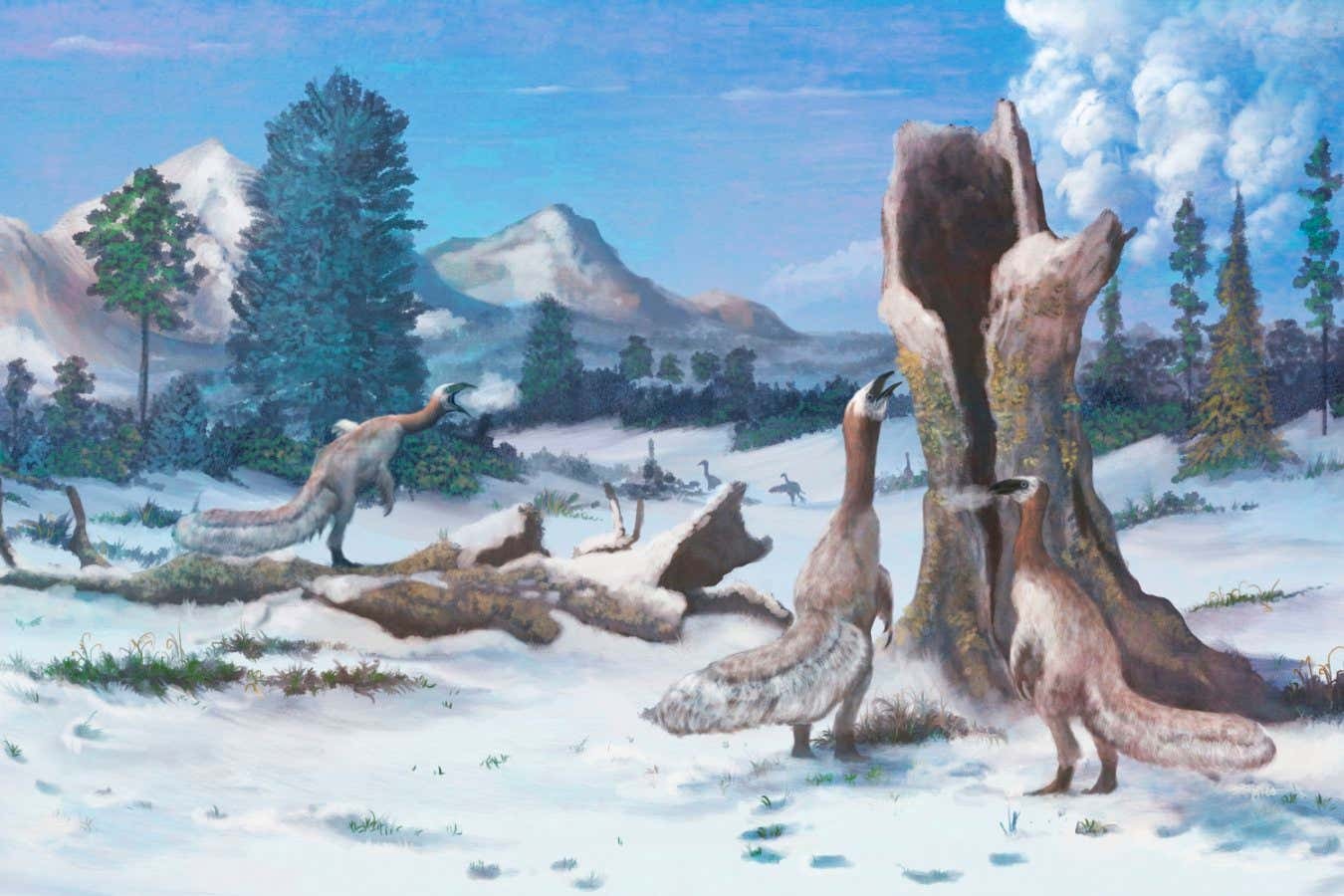
According to Olsen, some dinosaur lineages were already inhabiting this massive Arctic landmass. To survive the harsh, snowy winters of the high latitudes, these animals likely evolved insulating coats of feathers.
When the global cooling event occurred, these feathered dinosaurs were uniquely prepared for the change. While other large animals faced extinction, these resilient survivors were positioned to move into the newly vacated ecological niches, beginning their era of global dominance.
“To picture the first dinosaurs in a world with harsh winters is a novelty… the combination of volcanic eruption and ice in the north might have had a profound effect on them.” — Mike Benton, University of Bristol
Why This Matters
This research highlights a significant blind spot in paleoclimatology. As Olsen notes, polar regions are often misrepresented in scientific diagrams—either stretched out or minimized—causing researchers to overlook their massive influence on global climate systems. By recognizing the Arctic as a central player in Earth’s geography, scientists can better understand the complex relationship between plate tectonics, volcanic activity, and the survival of dominant species.
Conclusion
The presence of a massive Arctic continent created a cooling feedback loop that reshaped the Earth’s climate. This environmental shift acted as a biological filter, eliminating many competitors and allowing feathered, cold-adapted dinosaurs to rise to global prominence.