


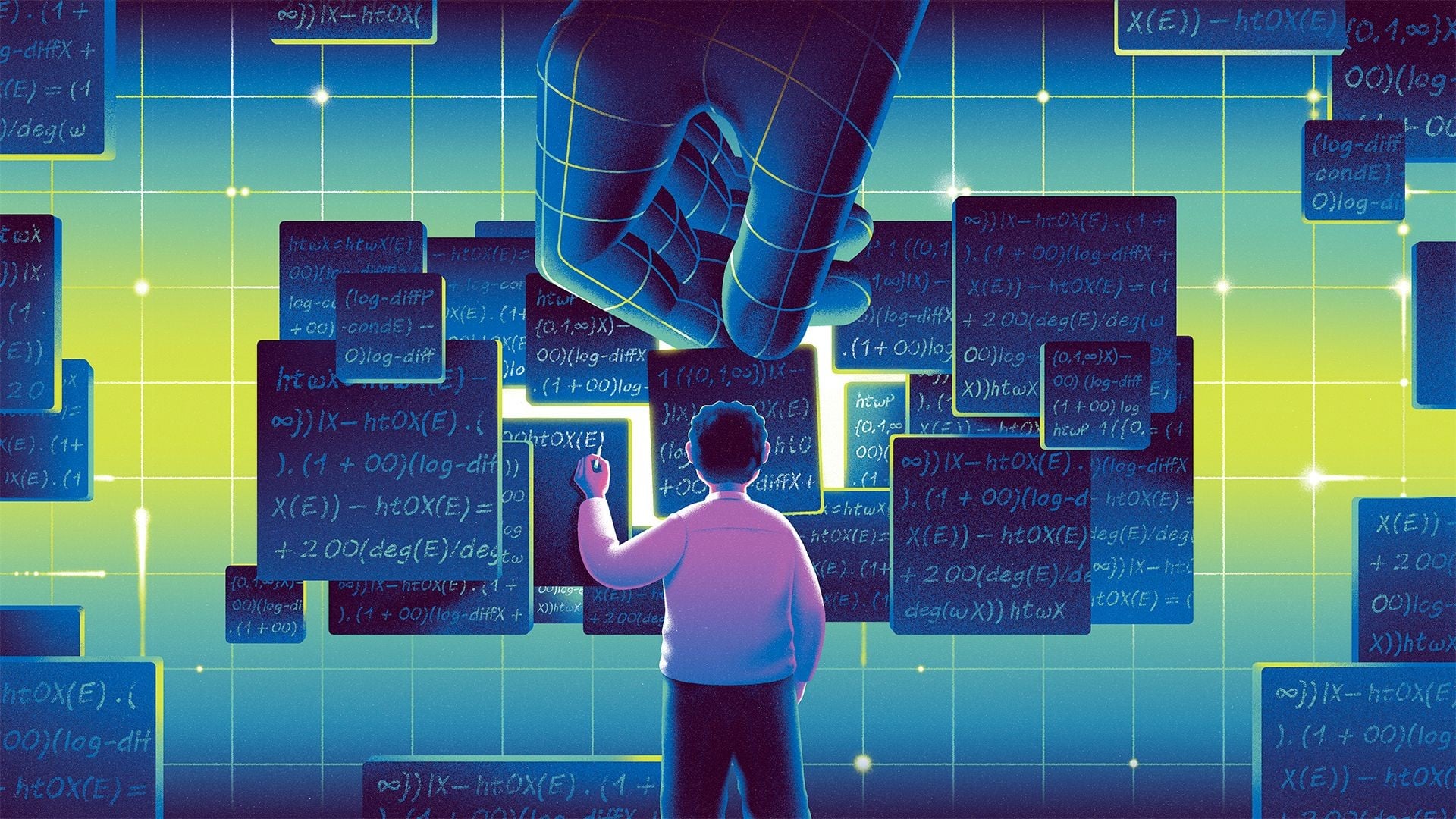
Recent breakthroughs in artificial intelligence (AI) are challenging the boundaries of what was once considered mathematically impossible. In October 2024, Meta’s AI model solved a century-old problem involving the stability of dynamic systems – a feat that previously stumped mathematicians. While impressive, this is just the beginning of a rapidly evolving landscape where AI may soon surpass human capabilities in complex mathematical reasoning.
The Current State: Incremental Progress, Not Revolution
Early results show AI making significant but not groundbreaking progress. Meta’s model solved 10.1% of randomly generated stability problems, a substantial improvement over previous algorithms (2.1%), but far from a complete solution. Similarly, Google’s DeepMind discovered new solutions to the Navier-Stokes equations, yet still falls short of cracking the full problem, which would secure the $1 million Millennium Prize.
The key takeaway is that AI isn’t yet making quantum leaps; it’s refining existing methods. Mathematicians point out that most models still require substantial human guidance to produce reliable results.
The Speed of Development: A Frightening Trajectory
Despite current limitations, experts agree that AI is developing at an alarming rate. Terence Tao, a Fields Medal laureate at UCLA, predicts that within years, AI will be able to scan and solve thousands of mathematical conjectures, including some high-profile ones. This isn’t about replacing mathematicians entirely; it’s about augmenting their abilities with machine-driven speed and scale.
The progression mirrors AI’s success in games like chess and Go. In the 1980s, IBM’s Deep Blue defeated Garry Kasparov, and a decade later, DeepMind triumphed over Lee Sedol in Go. Now, AI dominates these games effortlessly. However, pure mathematics presents a unique challenge: unlike finite board games, there are no limits to the complexity and depth of mathematical problems.
The Human-AI Collaboration: Where We Stand Now
Current AI models are roughly equivalent to where chess-playing algorithms were decades ago. They perform tasks humans already know how to do, but with increased efficiency. Kevin Buzzard, a mathematician at Imperial College London, emphasizes that no AI has yet presented a novel mathematical proof that humans couldn’t have derived themselves.
Recent demonstrations at OpenAI’s “FrontierMath” meeting show AI models reasoning at a level some mathematicians describe as approaching “genius.” Ken Ono of the University of Virginia noted the AI’s ability to identify connections and insights that humans might overlook. Yet, these models still require heavy human training and interpretation.
The IMO Challenge: Silver Medals, Not Breakthroughs
AI’s performance in the International Mathematical Olympiad (IMO) highlights its current limitations. In 2024, DeepMind’s AlphaProof and AlphaGeometry 2 achieved a silver-medal score, but only after human translation of problems into a computer language and days of computing time. This year, Google’s Gemini Deep Think scored a gold-medal equivalent, but still required significant computational resources.
While these results are impressive, they don’t yet represent the “breakthrough moment” where AI surpasses human capabilities. Buzzard argues that AI hasn’t provided any genuinely new insights that humans couldn’t have discovered independently.
The Future: Conjecture Generation and Hypothesis Testing
AI’s most promising role lies in hypothesis generation and conjecture testing. Marc Lackenby, a mathematician at the University of Oxford, collaborated with DeepMind on research published in Nature. The AI identified a connection in topology that humans had missed – a critical step in refining the conjecture.
However, AI’s outputs aren’t always reliable. Neil Saunders, a mathematician at City St George’s, University of London, warns that AI prioritizes probability over absolute correctness. This makes it unsuitable for tasks requiring flawless proofs.
The Evolving Role of the Mathematician
The future of mathematics likely involves a symbiotic relationship between humans and AI. Tao believes that in 20-30 years, mathematicians may focus on analyzing thousands of AI-generated problems instead of studying single issues for months. This shift could redefine the profession, but won’t necessarily eliminate it.
As with previous technological disruptions, mathematicians will adapt to new challenges. AI may automate routine tasks, but complex, creative breakthroughs will likely still require human insight.
Ultimately, AI’s role in mathematics is evolving rapidly, and the precise nature of its impact remains uncertain. One thing is clear: the field will never be the same.


