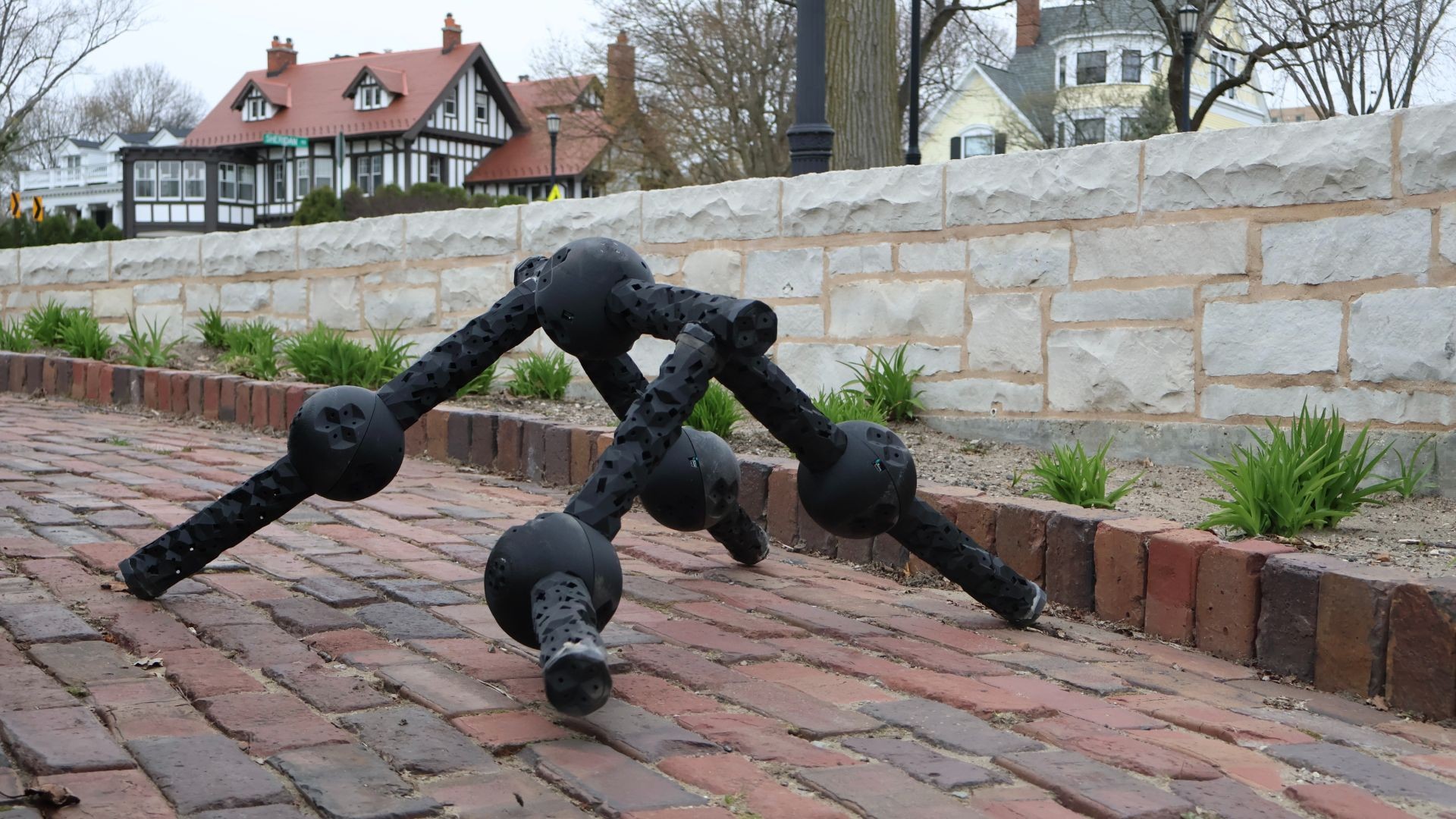
Researchers at Northwestern University have developed a new type of modular robot capable of autonomous movement across challenging terrain, even after suffering significant damage. Dubbed “legged metamachines,” these robots leverage artificial intelligence to rapidly iterate through designs that would take billions of years to evolve naturally. This breakthrough not only demonstrates remarkable resilience but also offers a unique window into the principles of biological locomotion.
Accelerated Evolution Through AI
The core innovation lies in the use of an evolutionary algorithm. Instead of relying on traditional robotic design, the team compressed billions of years of natural selection into seconds through AI simulation. The algorithm tested countless configurations of modular “Lego-like” components – each consisting of a meter-long leg attached to a central, rotating sphere containing the robot’s core systems (battery, circuit board, and motor).
This approach allowed for designs that would be difficult for humans to conceive: configurations resembling kangaroos, seals, or even entirely novel forms. The AI discarded ineffective setups, retaining only the most efficient for traversing various obstacles.
Modular Design Enables Unmatched Adaptability
Unlike conventional robots with fixed structures, the metamachines are built from interchangeable modules. This modularity has two key advantages:
- Rapid Reconfiguration: The number of limbs can be altered without compromising mobility.
- Damage Tolerance: If the robot loses limbs or sustains damage, it automatically adapts its gait to continue moving.
In testing, the robots successfully navigated gravel, grass, mud, tree roots, sand, and uneven surfaces without human intervention. Notably, they could self-correct even when completely flipped over, demonstrating an uncanny ability to recover from adversity.
Implications for Robotics and Biology
The researchers believe this approach can accelerate progress in robotics by bypassing traditional design limitations. By simulating evolution, they can explore solutions that humans might never have considered.
“Evolution can reveal new designs that are different from or even beyond what humans were previously capable of imagining,” said lead author Sam Kriegman.
The study also has broader implications for understanding the evolution of locomotion in animals. The metamachines offer a physical platform for testing hypotheses about how different body configurations emerged over time. This could deepen our understanding of why animals move the way they do, and how their forms have been shaped by environmental pressures.
The Future of Robotic Design
The metamachine project represents a paradigm shift in robotics. By embracing AI-driven evolution, researchers can rapidly explore a vast design space, creating machines that are not only more capable but also more adaptable. This approach could lead to robots that can thrive in unpredictable environments, making them ideal for search and rescue, exploration, or even planetary colonization. The ability to compress evolutionary timescales opens the door to a future where robotic design is no longer limited by human imagination, but guided by the raw power of artificial selection.