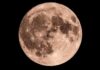
Tonight, February 26th, offers a striking celestial sight: Jupiter shining brightly alongside the waxing gibbous moon. This event is easily visible to the naked eye shortly after sunset, with Jupiter appearing as a brilliant, steady “star” below the moon in the east-southeast sky.
Why This Matters
This conjunction – the apparent closeness of two celestial bodies from our perspective – is a common occurrence, but always visually appealing. More importantly, it provides a great opportunity for casual observers to familiarize themselves with Jupiter. Many people mistake bright planets for stars, and this pairing makes it easier to identify Jupiter in the night sky.
How to Find Them
The moon and Jupiter will be about 6 degrees apart, roughly the width of a half-fist held at arm’s length. The moon is currently in its waxing gibbous phase, progressing towards a full moon and a total lunar eclipse on March 3rd. Jupiter, the largest planet in our solar system, will stand out as a steady, silvery glow beneath it.
Observing Jupiter
Jupiter is well-positioned for evening viewing, high enough in the sky to avoid obstructions from trees or buildings. It currently resides within the constellation Gemini, near the bright stars Pollux and Castor. The planet will reach its highest point around 8:30 PM and remain visible until shortly after 4 AM.
Tools for Viewing
- Naked Eye: Jupiter appears as a bright, non-twinkling point of light.
- Binoculars (10×50): These reveal Jupiter as a small, white disk, with its four largest moons (the Galilean moons) visible as tiny pinpricks of light in a line.
- Telescopes: Even small telescopes can resolve Jupiter’s disk and its moons more clearly. Larger telescopes reveal cloud belts, atmospheric disturbances, and the ever-changing Great Red Spot.
The Dynamic Great Red Spot
Recent observations show that Jupiter’s Great Red Spot (GRS) is shrinking and becoming more circular, but also exhibits unexpected dynamic behavior. It fluctuates in size over short periods, defying the assumption that it’s a stable feature. This makes Jupiter a fascinating object for amateur astronomers, as its surface is constantly evolving.
Missed the Show?
If clouds obscure your view tonight, don’t worry. Jupiter and the moon will appear together again on March 26th.
Seeing detail on Jupiter requires good equipment, clear skies, and patience, but the reward is a breathtaking view of our solar system’s largest planet.