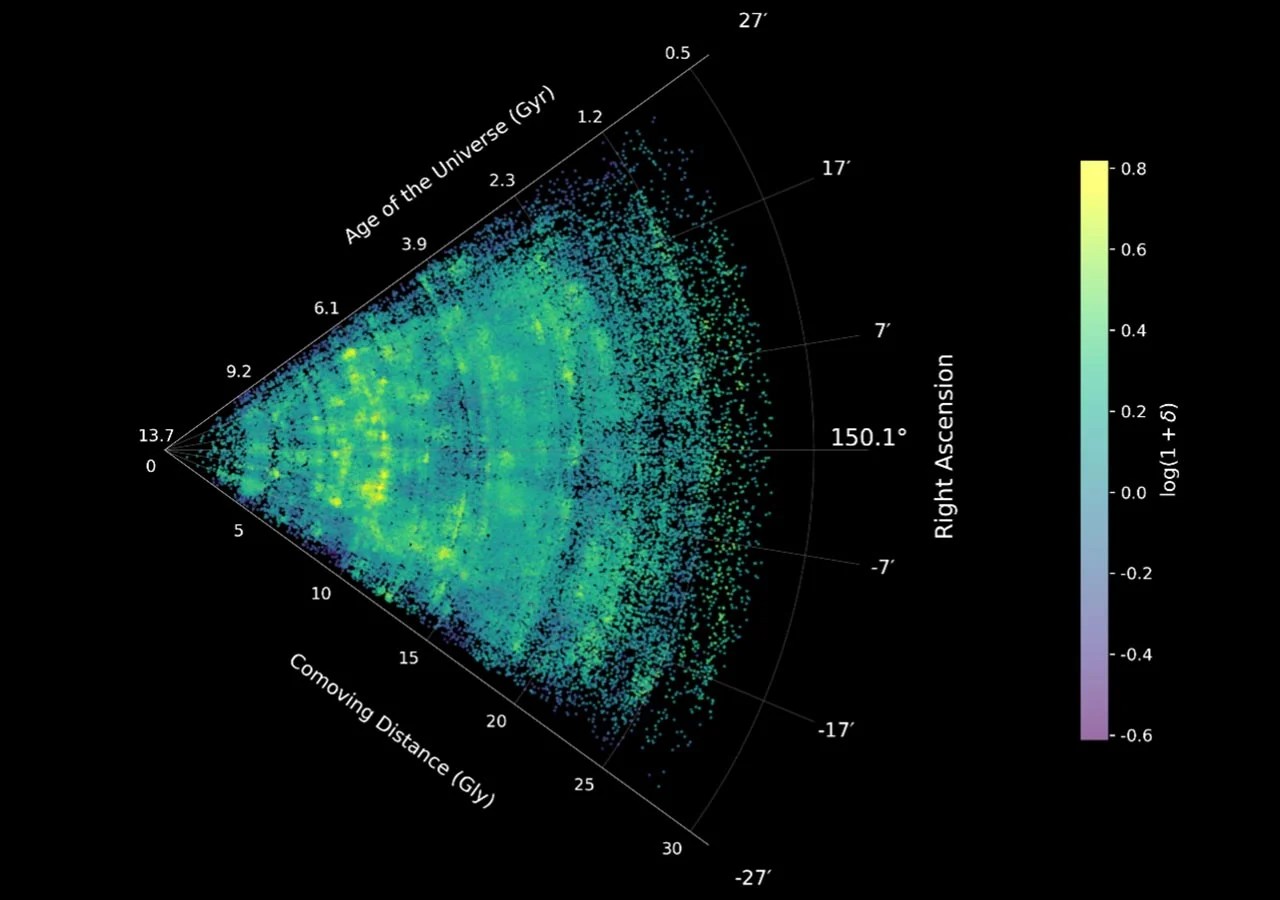
Astronomers have unveiled the most detailed map ever created of the “cosmic web,” the vast, invisible skeleton that structures our universe. Using data from NASA’s James Webb Space Telescope (JWST), an international team led by researchers at the University of California, Riverside, has traced this cosmic architecture back to when the universe was merely one billion years old.
This achievement, published in The Astrophysical Journal, does more than produce stunning imagery; it fundamentally changes our ability to track how galaxies form and evolve within the universe’s largest structures. By leveraging the largest JWST survey to date, known as COSMOS-Web, scientists can now distinguish individual filaments and clusters that were previously blurred together, offering unprecedented insight into the early history of the cosmos.
Decoding the Cosmic Web
To understand the significance of this map, one must first understand what the cosmic web is. The universe is not a random scattering of stars; it is organized into a massive, sponge-like framework.
- Filaments and Sheets: These are dense structures made of dark matter and gas that stretch across billions of light-years.
- Voids: These are the nearly empty spaces between the filaments.
- Galaxies: These form along the filaments, clustering where the density of matter is highest.
This large-scale architecture acts as the cosmic highway system, guiding the flow of matter and energy. Until now, observing these structures in the distant past was extremely difficult because the galaxies within them were too faint and too crowded to distinguish clearly.
Why JWST Changes the Game
The James Webb Space Telescope, launched in 2021, has revolutionized astronomy with its superior infrared sensitivity. Unlike its predecessor, the Hubble Space Telescope, JWST can peer through clouds of cosmic dust and detect light from galaxies that formed shortly after the Big Bang.
The COSMOS-Web survey utilizes this capability to cover a continuous patch of sky roughly the size of three full Moons. This specific area was chosen to provide a deep, wide view necessary to reconstruct the 3D structure of the universe.
Key Improvements Over Previous Data:
* Resolution: Structures that appeared as single, blurred blobs in Hubble data are now resolved into distinct galaxies and clusters.
* Depth: JWST detects significantly more faint galaxies in the same field of view.
* Precision: Distances to these galaxies are measured with greater accuracy, allowing scientists to place each galaxy into the correct “slice” of cosmic time.
“The jump in depth and resolution is truly significant… What used to look like a single structure now resolves into many, and details that were smoothed away before, are now clearly visible,” said Bahram Mobasher, a distinguished professor of physics and astronomy at UCR and co-author of the study.
Tracing Evolution Across 13.7 Billion Years
The primary scientific goal of this research is to understand galaxy evolution within the context of the cosmic web. By mapping galaxies from the nearby universe (within 1 billion light-years) back to the epoch when the universe was only a few hundred million years old, researchers can observe how the environment influences galaxy growth.
Hossein Hatamnia, the study’s lead author, noted that this allows for the first comprehensive study of galaxy evolution across cosmic time within cluster and filamentary structures. This longitudinal view helps answer critical questions about why some galaxies grow massive while others remain small, and how the cosmic web facilitates or inhibits star formation in the early universe.
Open Science: Data Released to the Public
In line with the tradition of open science established by previous COSMOS surveys, the research team has made all data publicly available. This includes:
- The pipeline used to construct the large-scale structure maps.
- A catalog of 164,000 galaxies and their cosmic density.
- A visualization video showing the evolution of the cosmic web over billions of years.
This release allows astronomers worldwide to analyze the data, verify findings, and pursue new lines of inquiry without waiting for proprietary periods to expire.
Conclusion
The COSMOS-Web survey marks a pivotal shift in observational cosmology, moving from blurry snapshots to high-definition 3D maps of the universe’s structure. By clearly resolving the cosmic web back to its infancy, JWST provides the essential context needed to understand how galaxies assemble and evolve. This data not only refines our current models of the universe but also sets a new standard for future deep-space surveys.