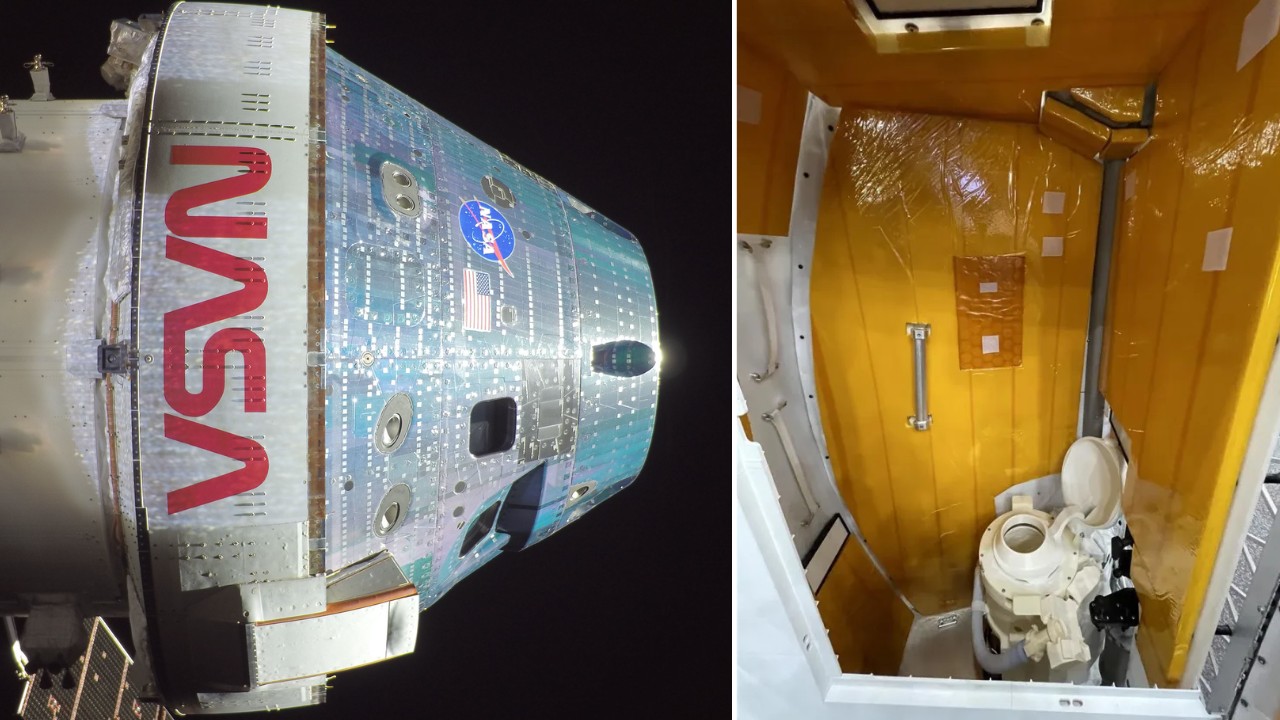
The Artemis 2 mission has achieved several historic milestones, including being the first crewed mission to venture beyond Earth’s orbit. However, as the Orion capsule nears its return to Earth, NASA engineers are troubleshooting an unexpected technical hurdle: a malfunction in the spacecraft’s waste management system.
The Problem: Evacuation and Odor
While the Orion capsule’s toilet—a compact version of the systems used on the International Space Station (ISS)—is technically operational, it has struggled with a critical task: evacuating stored urine into space.
The crew has reported two primary issues:
1. Ventilation Failure: The system is having difficulty venting wastewater through the exterior nozzle.
2. Unexplained Odor: Astronauts have noted an unusual “burning smell” emanating from the unit. While the scent has caused concern, Mission Control has indicated it does not currently pose a safety risk to the crew.
From Ice Blockage to Chemical Reactions
Initially, NASA engineers suspected that ice might be obstructing the vent nozzle on the exterior of the Orion capsule. To test this theory, mission controllers engaged onboard heaters and tilted the spacecraft toward the sun to melt any potential ice buildup. When these efforts failed to resolve the issue, the team pivoted to a new hypothesis.
According to Artemis 2 Flight Director Rick Henfling, the current leading theory involves complex chemistry within the wastewater system.
“The latest theory is related to some of the chemistry that goes into ensuring that the wastewater doesn’t develop any biofilms,” Henfling explained.
NASA scientists believe a chemical reaction intended to prevent bacterial growth (biofilms) may be generating debris. This byproduct could be clogging the system’s internal filters, preventing the smooth evacuation of waste.
Why This Matters for Future Moon Missions
This technical glitch highlights the immense difficulty of managing life-support systems in deep space. On the Apollo missions, astronauts used handheld bags for waste; the Artemis 2 toilet represents a massive leap in technology intended to support long-duration lunar stays.
If the issue is indeed a chemical byproduct, it suggests that the highly specialized fluids used to keep space toilets sanitary may have unforeseen side effects in microgravity. Solving this puzzle is essential for the success of future Artemis missions, which will require much more robust and reliable sanitation systems for long-term habitation on the Moon.
The Path to a Solution
A definitive answer remains elusive while the spacecraft is in flight. NASA officials, including Lori Glaze of the Exploration Systems Development Mission Directorate, have stated that a “root cause” analysis can only truly begin once the hardware is physically accessible.
The Orion capsule, carrying astronauts Reid Wiseman, Victor Glover, Christina Koch, and Jeremy Hansen, is scheduled to splash down off the coast of San Diego on Friday evening, April 10. Once the crew is safely home, engineers will perform a hands-on inspection of the system to confirm whether chemical debris is indeed the culprit.
Conclusion: While the Artemis 2 toilet is functional, a blockage in its evacuation system has forced NASA to rethink its maintenance strategies. The upcoming physical inspection of the Orion capsule will be vital in determining if chemical reactions are compromising the reliability of deep-space sanitation technology.