The Artemis II mission has reached a defining milestone in space exploration. Five days after launching from the Kennedy Space Center in Florida, the four-person crew has successfully completed a journey that has taken them further from Earth than any human in history.
Breaking the Lunar Barrier
On Monday afternoon, the spacecraft—carrying astronauts Reid Wiseman, Victor Glover, Christina Koch, and Jeremy Hansen —accelerated to navigate the far side of the Moon. At a distance of approximately 248,655 miles from Earth, the crew transitioned from Earth’s orbital influence to the Moon’s gravitational pull.
This maneuver allowed the crew to become the first humans in over half a century to travel behind the lunar surface. This achievement marks a significant leap forward from the Apollo era, transitioning from mere lunar orbit to a more complex, deep-space trajectory.
A Shared Global Achievement
While the mission is led by NASA, the presence of Canadian astronaut Jeremy Hansen underscores the increasing international cooperation required for modern space exploration. The mission serves as a bridge between the era of solo spacefaring nations and a new age of global partnership.
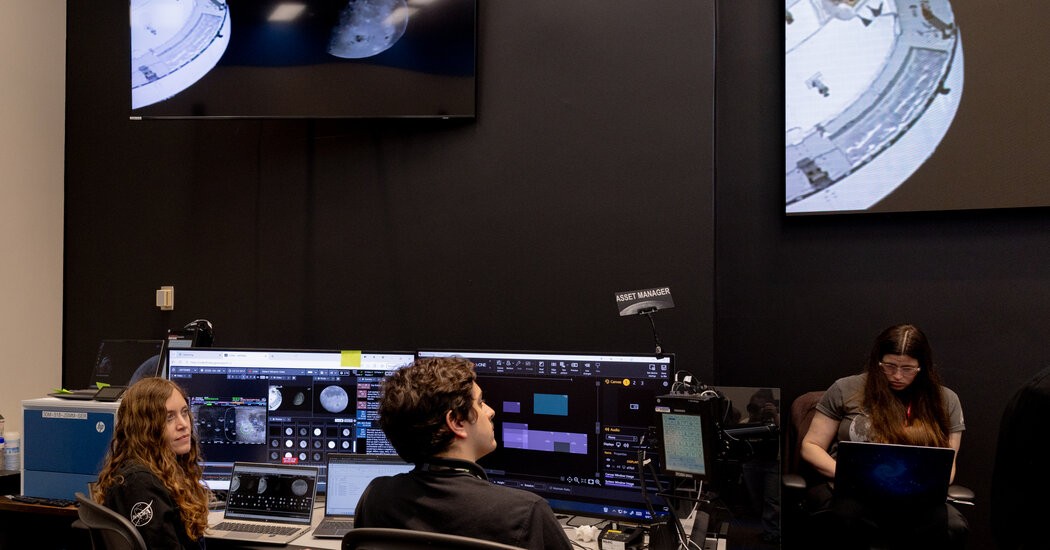
During the mission, the emotional weight of the journey was palpable at Mission Control in Houston.
“Today, for all humanity, you’re pushing beyond that frontier,” remarked Jenni Gibbons of the Canadian Space Agency.
Hansen, responding to the milestone, emphasized that this achievement should not be a static record, but a stepping stone. He expressed a desire to challenge current and future generations to ensure that this moment of “distance” is merely the beginning of even deeper exploration.
Why This Milestone Matters
The successful flyby of the lunar far side is more than a distance record; it is a critical test of human endurance and technological reliability in the “deep space” environment.
- Navigation & Communication: Passing behind the Moon requires precise autonomous navigation, as direct communication with Earth is blocked by the lunar mass.
- Deep Space Readiness: This mission tests the life-support systems and psychological resilience necessary for future missions to Mars.
- The New Space Race: Unlike the 20th-century Moon landings, Artemis II is focused on establishing a sustainable human presence in space through international collaboration.
Conclusion
The Artemis II crew has successfully demonstrated that humanity can navigate the vast distances of deep space, setting the stage for more permanent lunar exploration and the eventual journey to Mars.