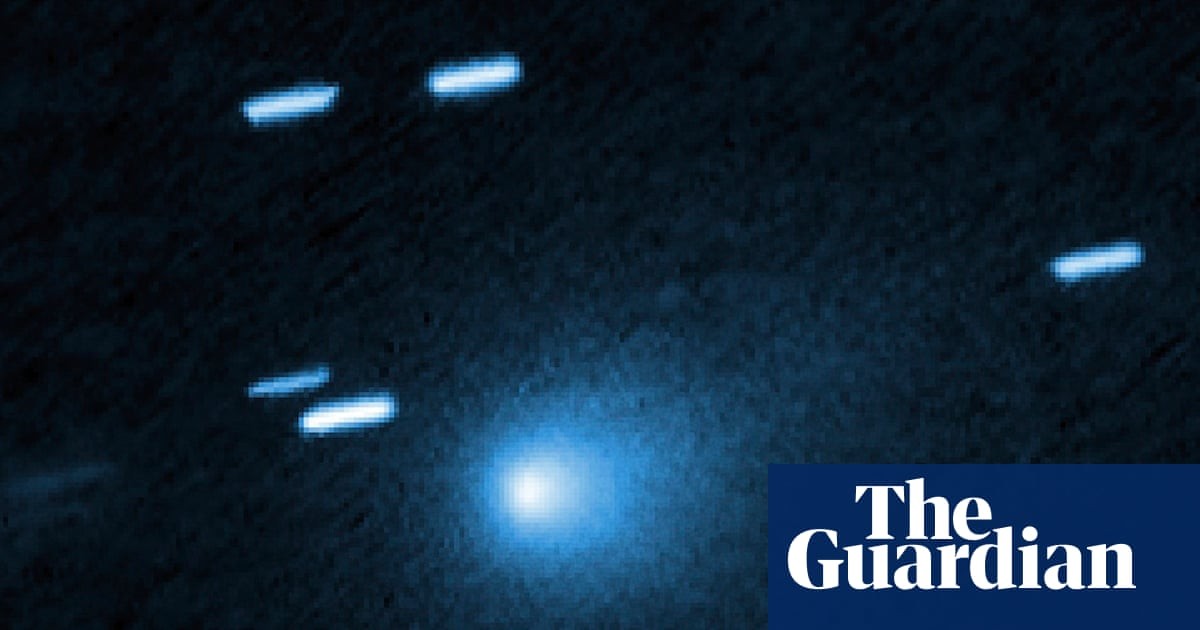
The National Aeronautics and Space Administration (Nasa) has released detailed close-up images of interstellar comet 3I/Atlas, a celestial object originating from outside our solar system, as it makes a fleeting pass through our cosmic neighborhood. This is only the third confirmed interstellar visitor detected to date, making it an extraordinary event for astronomers and space enthusiasts alike.
A Brief Encounter with an Extraterrestrial Traveler
Discovered earlier this year, 3I/Atlas passed within 18 million miles of Mars last month, offering a unique opportunity for observation. Multiple spacecraft, including those from Nasa and the European Space Agency (ESA), captured images of the comet—appearing as a diffuse white blob—during its closest approach. The James Webb Space Telescope, along with ground-based observatories, continues to monitor the comet as it journeys closer to Earth.
Why This Matters: A Glimpse Into the Past
The significance of 3I/Atlas extends beyond its rarity. Scientists believe the comet may originate from a star system older than our own, potentially providing insight into the conditions of the universe billions of years ago. As Nasa scientist Tom Statler noted, this comet isn’t just a window into another solar system; it’s a window into the deep past, predating even the formation of Earth and our Sun.
Visibility and Future Trajectory
For those with binoculars or telescopes, 3I/Atlas is currently visible in the predawn sky. The comet will reach its closest point to Earth—167 million miles—in mid-December before accelerating back into interstellar space, never to return. Meanwhile, ESA’s Juice spacecraft, en route to Jupiter, is also gathering data, although transmission will be delayed until February due to thermal shielding protocols.
Dismissing Extraterrestrial Speculation
Nasa officials have addressed recent speculation about the comet being an alien spacecraft, firmly stating that it is, in fact, a comet. They also acknowledged that limited response to all theories was due to the recent federal government shutdown. Despite ongoing searches for extraterrestrial life, this visitor is purely a natural phenomenon.
“Everyone that is in control of a telescope wants to look at it because it’s a fascinating and rare opportunity,” said Nasa’s acting astrophysics director, Shawn Domagal-Goldman.
In conclusion, the interstellar comet 3I/Atlas is a rare and valuable scientific opportunity, offering a glimpse into another star system and potentially the early history of the universe. Its brief visit underscores the vastness of space and the continuous flow of celestial objects passing through our solar system.