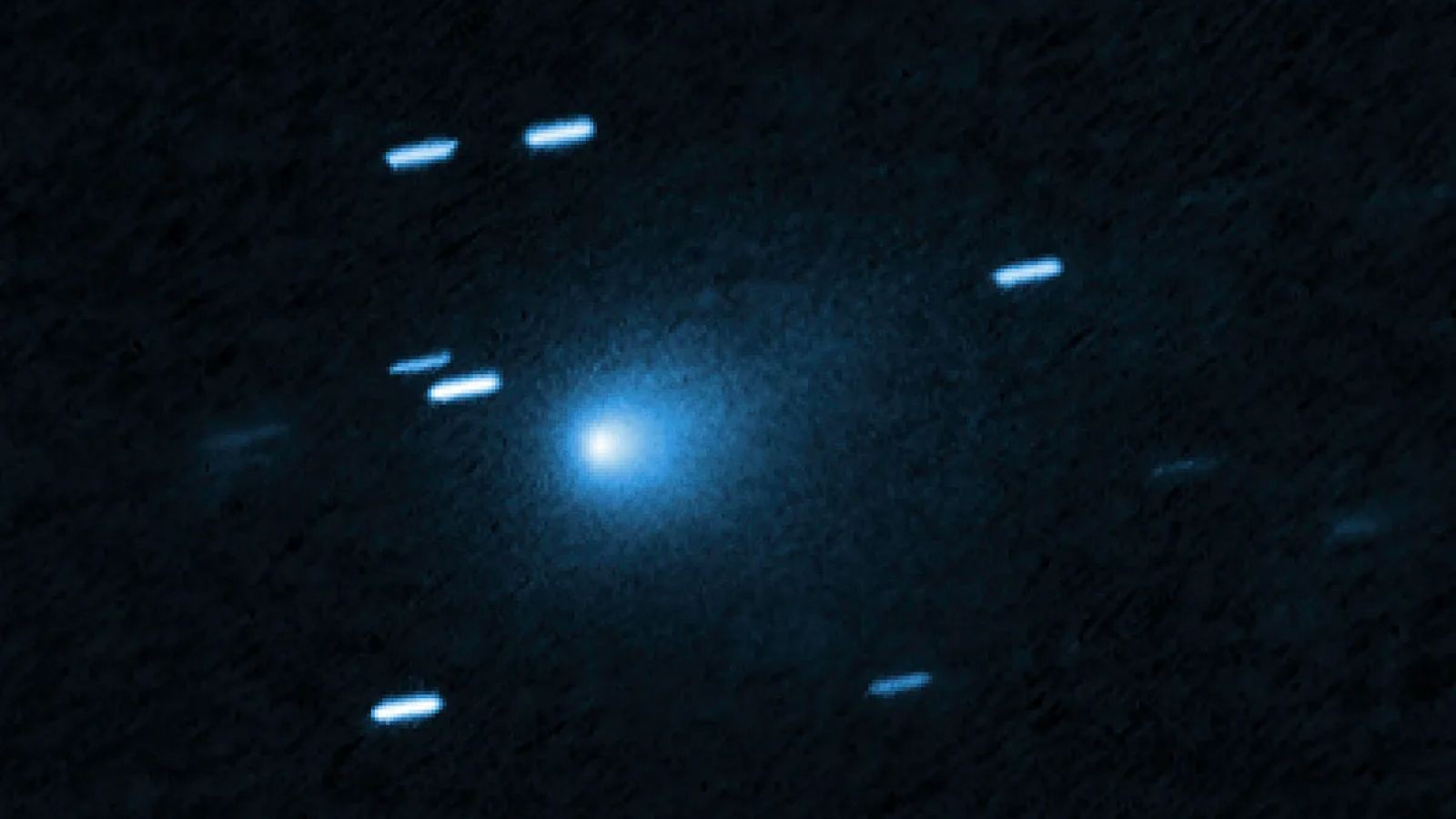
The recent detection of 3I/ATLAS, only the third confirmed interstellar object (ISO) to enter our solar system, has prompted ambitious proposals for a dedicated mission. While direct interception with current technology proves nearly impossible due to late detection and the comet’s extreme velocity, a new study suggests a viable, though decades-long, approach: a mission leveraging a Solar Oberth maneuver launched in 2035.
The Challenge of Interstellar Visitors
ISOs offer a unique opportunity to study material from other star systems without the centuries-long travel times required for interstellar probes. However, catching one is exceptionally difficult. 3I/ATLAS was discovered too late for a conventional intercept, traveling at over 60 km/s when the optimal launch window had already passed. This makes a direct rendezvous impractical, as no existing propulsion system can match its speed for prolonged study.
Solar Oberth: A Long-Term Solution
Researchers from the Initiative for Interstellar Studies (i4is) propose a mission that foregoes immediate launch in favor of a 2035 departure. This timing allows for optimal alignment between Earth, Jupiter, and 3I/ATLAS, maximizing the efficiency of a Solar Oberth maneuver. This technique involves using the Sun’s gravity to slingshot a spacecraft to extreme velocities.
How It Works
The spacecraft would wait near the Sun until reaching perihelion (closest approach), then fire its engines at this optimal point to achieve a massive velocity boost. The maneuver exploits the Oberth effect, where thrust is most effective at high speeds under strong gravity. The team’s simulations, using the Optimum Interplanetary Trajectory Software (OITS), suggest this method could intercept 3I/ATLAS after a 50-year journey.
Why Wait Until 2035?
The 2035 launch date ensures the best possible alignment between celestial bodies, minimizing propulsion requirements and flight time. While the wait is lengthy, the scientific payoff is immense. ISOs represent leftover building blocks from other star systems, offering insights into exoplanetary formation without requiring multi-generational missions.
Beyond Current Technology
Although directed-energy propulsion (DEP) is under investigation, its technological readiness remains decades away. A Solar Oberth mission, relying on existing or near-future technology, provides a realistic path to studying 3I/ATLAS within a feasible timeframe.
The study highlights that even without interstellar travel, we can gain crucial knowledge about distant systems by intercepting the debris they send our way. A mission to 3I/ATLAS, though long in the making, could unlock revolutionary insights into the composition and origins of worlds beyond our own.