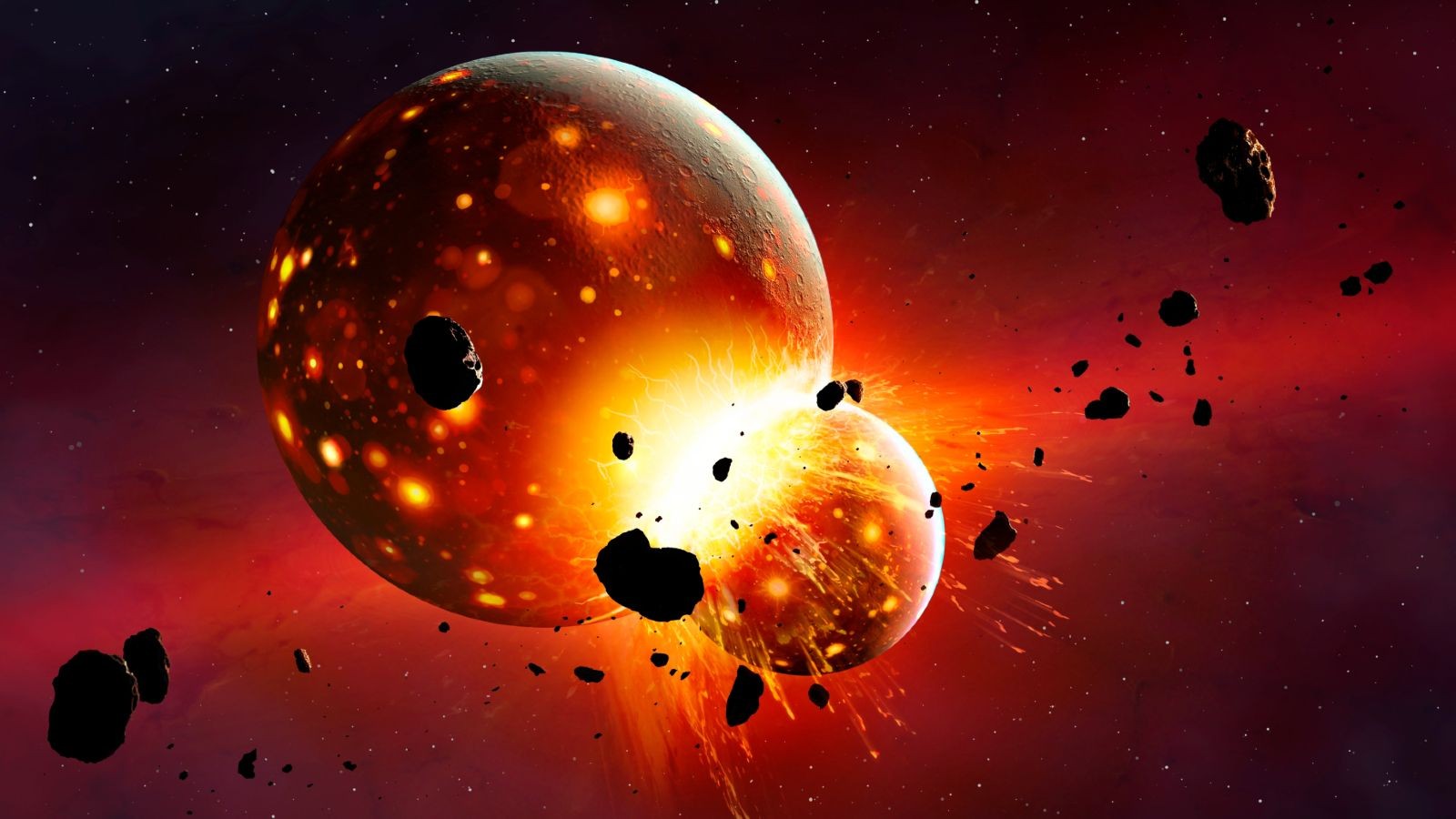
Saturn’s largest moon, Titan, may not have formed gradually over billions of years, but instead emerged from a catastrophic collision between two large moons roughly 400 million years ago. This new hypothesis, backed by data from NASA’s Cassini probe, offers a compelling explanation for several puzzling features of the Saturnian system, including the origin of its iconic rings and the strange orbits of other moons.
A Moon Born of Chaos
For decades, scientists assumed Titan formed slowly, like most moons, by the accumulation of dust and rock. However, recent research challenges this view. The study, published on the preprint server arXiv and accepted for publication in The Planetary Science Journal, suggests that Titan is the product of a violent merger. Two massive moons – dubbed “Proto-Titan” and “Proto-Hyperion” – collided, resulting in the formation of the moon we know today.
This wasn’t a gentle coming-together; it was a full-blown impact. The collision could also explain the existence of Hyperion, another of Saturn’s moons. This smaller satellite, roughly 84 miles wide, is theorized to have formed from the debris scattered after the initial collision, much like Earth’s moon is believed to have originated from the impact of Theia with early Earth.
The Missing Moon and Saturn’s Tilted Orbit
Saturn currently boasts at least 274 moons, the most of any planet in our solar system. Yet, astronomers have long suspected that another large moon once orbited the gas giant, only to mysteriously disappear. The planet’s unusual tilt, which gives us a clear view of its rings, hints that a massive object once disrupted its orbit. The researchers propose this missing moon wasn’t lost but destroyed in the same cataclysmic event that created Titan.
The key clue? Hyperion. Its orbital resonance with Titan— circling Saturn three times for every four of Titan’s orbits— is relatively recent, around a few hundred million years old. This timing coincides with the estimated disappearance of the missing moon, suggesting that Hyperion might be a remnant of the collision.
Rings and Orbital Anomalies
The impact event may not have only created Titan and Hyperion. Researchers theorize that the debris from the collision eventually settled into Saturn’s rings, which are thought to be around 100 million years old. This challenges earlier findings that suggested the rings were much older.
Furthermore, the collision could explain the tilted orbits of other Saturnian moons, such as Iapetus and Rhea. Their unusual angles suggest they were affected by gravitational interactions resulting from the cataclysmic event.
A Young Moon With Few Scars
Titan’s surprisingly smooth surface— lacking the extensive cratering seen on older moons like Jupiter’s Callisto— also supports the new hypothesis. A younger moon would have had less time to accumulate impact scars. The researchers suggest that Proto-Titan was likely heavily cratered before the collision, but the impact resurfaced it, creating the relatively pristine surface we see today.
The Future of Exploration
NASA’s Dragonfly mission, scheduled to launch in 2028, is set to arrive at Titan by 2034. This drone-like spacecraft will explore the moon’s surface and atmosphere, potentially providing definitive evidence to confirm the collision hypothesis and unlock further secrets of this enigmatic world.
The new research reshapes our understanding of Titan, presenting it not as a relic of the early solar system but as a product of relatively recent cosmic violence. This collision not only explains Titan’s formation but also offers a unified explanation for several long-standing mysteries within the Saturnian system.