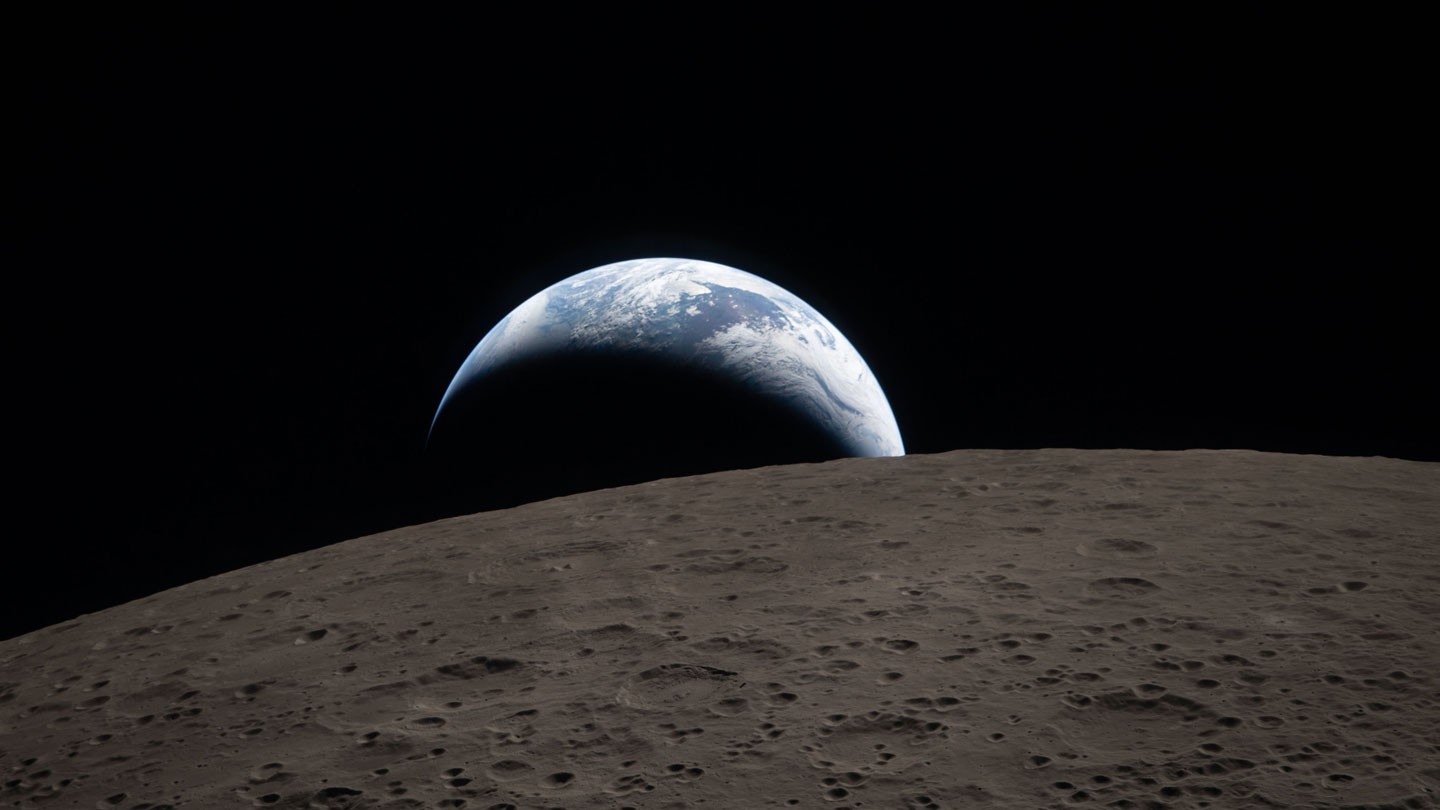
In a moment that bridges the gap between space exploration’s past and its future, the astronauts of the Artemis II mission have captured a historic image: the first-ever “Earthset.” Taken on April 6, just moments before the crew lost line-of-sight communication with Earth, the photograph depicts our home planet dipping behind the lunar horizon.
From Spontaneity to Precision
This image is a deliberate, modern homage to one of the most iconic photographs in human history: the 1968 “Earthrise” shot.
During the Apollo 8 mission, astronaut William Anders captured a spontaneous, breathtaking view of Earth rising over the lunar surface. That unplanned moment became a cultural touchstone, helping to ignite the global environmental movement by showing humanity how fragile and isolated our planet appears from the void.
While “Earthrise” was a product of sudden inspiration, the Artemis II “Earthset” was a choreographed milestone. The composition is precise:
– The Crescent Earth: Our planet appears as a glowing crescent.
– Atmospheric Detail: Swirling cloud patterns are visible over the sunlit regions of Australia and Oceania.
– Lunar Contrast: The moon’s surface is rendered in deep, brownish tones, highlighting its rugged, cratered texture.
The Sensory Reality of the Moon
Beyond the visual spectacle, the crew’s observations provide a rare glimpse into the lived experience of lunar orbit. During their seven-hour flyby, the astronauts noted that the moon’s color palette was far from the monochrome grey often depicted in textbooks.
One crew member remarked on the shifting hues of the landscape, noting, “The more I look at the moon, the browner and browner it looks.” These observations underscore the importance of human presence in space; while robotic probes provide data, only human eyes can capture the subtle, shifting nuances of a new environment.
The Human Connection
The photograph was taken during a critical phase of the mission. Approximately one hour after the shutter clicked, the spacecraft emerged from the far side of the moon to begin the long journey back to Earth.
The mission serves as more than just a technical test of deep-space capabilities; it is a reminder of the psychological and emotional bond between explorers and their home. As astronaut Christina Koch reflected on the mission’s gravity:
“Ultimately, we will always choose Earth. We will always choose each other.”
Conclusion
The Artemis II “Earthset” marks