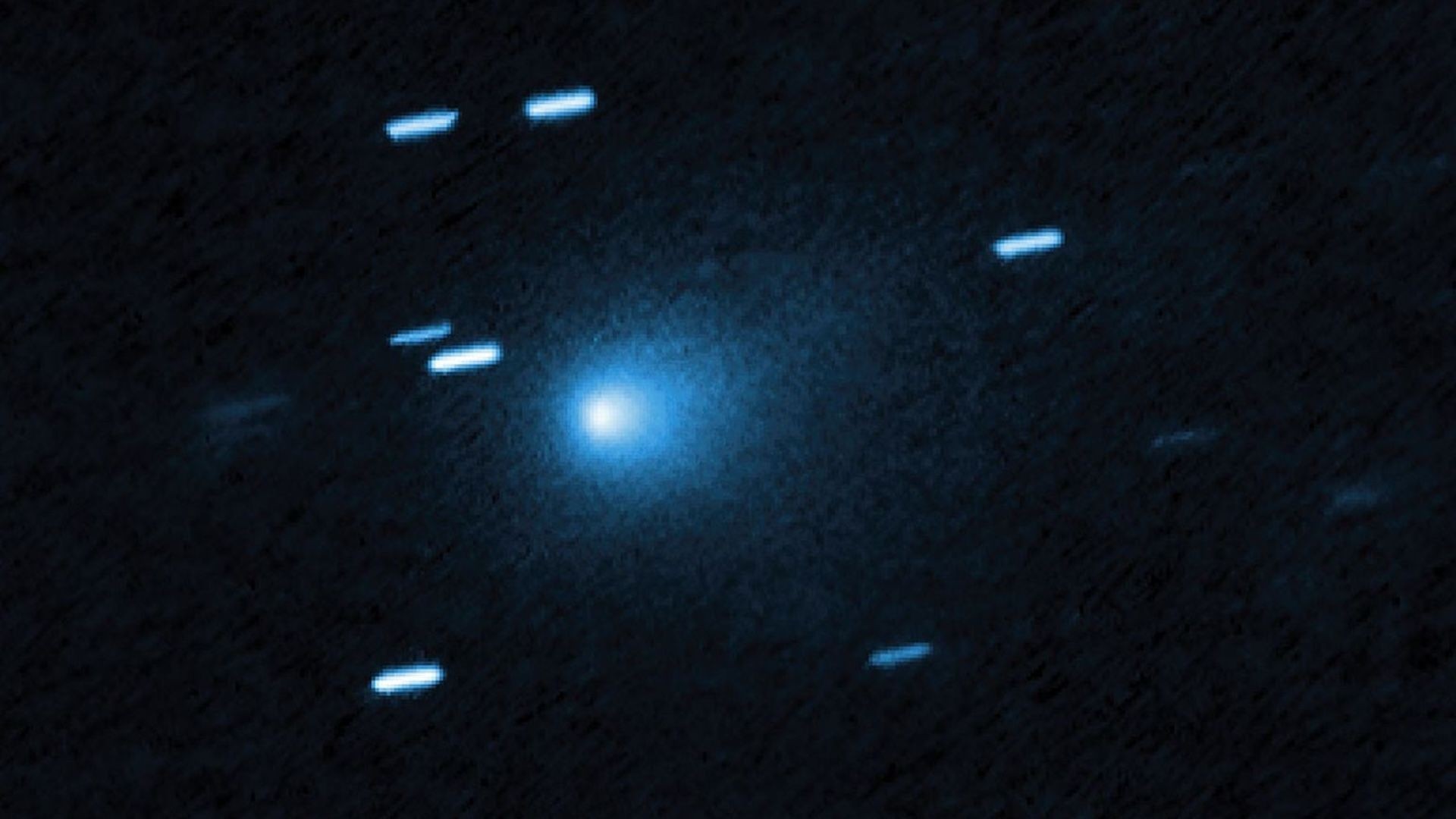
Comet 3I/ATLAS zipped past the sun on October 29th, reaching its closest point – perihelion – at a scorching distance of roughly 210 million kilometers. While this celestial waltz marked a milestone for the interstellar visitor, public fascination quickly fixated on one question: could it be an alien probe?
This isn’t the first time humanity has looked to extraterrestrials to explain cosmic mysteries. When ‘Oumuamua, our solar system’s first confirmed interstellar object, was discovered in 2017, and again with Comet Borisov in 2019, speculation about artificial origins ran rampant. Even my own discovery as a PhD student – radio signals flickering from a binary star system – prompting an editor to request alien-themed musings highlights this persistent trend.
The allure of extraterrestrial visitors is undeniable, but it can obscure truly groundbreaking science. Comet 3I/ATLAS, the third interstellar object we’ve encountered, holds immense value precisely because it isn’t a technological marvel from another civilization. Instead, its composition and trajectory offer unparalleled glimpses into the earliest days of our universe, potentially even older than our own solar system (estimated at 4.6 billion years old). Recent research suggests Comet 3I/ATLAS could be over 7 billion years old – an ancient wanderer traversing vast cosmic distances to grace us with its presence for a few fleeting months.
A Chemical Time Capsule from the Dawn of the Cosmos
Analysis reveals striking differences between 3I/ATLAS and comets native to our solar system. Its outer layers are unusually rich in carbon dioxide, while the proportion of nickel to other elements significantly surpasses local cometary norms. These chemical fingerprints act as a time capsule, whispering secrets about the primordial nebula where this ancient comet was born – a window into an era before our own solar system existed.
While ‘Oumuamua and Borisov primarily provided insight into interstellar space itself, 3I/ATLAS offers a deeper glimpse into the specific conditions of a long-gone star-forming region. It’s as if we’ve stumbled upon fossilized remnants from the very dawn of stellar birth, carrying within them clues about the building blocks of planets and stars across the cosmos.
The Misinformation Minefield
The alien speculation surrounding 3I/ATLAS also breeds fertile ground for misinformation. Claims abound about its trajectory mysteriously shifting or ‘hiding’ behind the sun – narratives lacking any scientific grounding yet readily circulating online. This phenomenon highlights a critical issue: prioritizing fantastical explanations over robust, peer-reviewed science can distract us from genuine understanding and fuel the spread of demonstrably false information.
The good news is that multiple spacecraft, including ESA’s Mars Express, ExoMars Trace Gas Orbiter, and Jupiter Icy Moons Explorer, are equipped to observe 3I/ATLAS even as it journeys beyond our sunlit view. Ground-based telescopes will also resume monitoring soon. The comet’s path is readily available for anyone interested in tracking its journey across the cosmos.
Embracing the Unknown
The allure of aliens is understandable; they represent the ultimate “wow” factor, a tantalizing possibility that speaks to our deepest existential questions. Yet, as Carl Sagan eloquently articulated (building on Pierre-Simon Laplace’s principle), extraordinary claims demand extraordinary evidence. While we don’t yet possess all the answers regarding 3I/ATLAS, not knowing everything is not in itself proof of extraterrestrial intervention.
Perhaps, instead of leaping to alien hypotheses, we should embrace John Keats’ concept of “negative capability” – a comfortable dwelling with uncertainty and mystery. The universe thrives on its unknowns, and for astronomers, those blank spaces are the most exciting frontiers of all. Assigning alien intent to every unexplained phenomenon risks missing out on the profound beauty and complexity that truly define our cosmic neighborhood. Comet 3I/ATLAS’s journey offers a chance not just to uncover more about the universe but also to refine our approach to discovery itself – one grounded in rigorous science, tempered by healthy skepticism, and fueled by an enduring fascination with the wonders yet to be unveiled.