
This week saw a flurry of significant discoveries and policy shifts across multiple scientific fields. From astronomical anomalies to archaeological breakthroughs and controversial healthcare decisions, here’s a breakdown of the key developments.
Cosmic Oddities: Runaway Black Holes and Early Universe Mapping
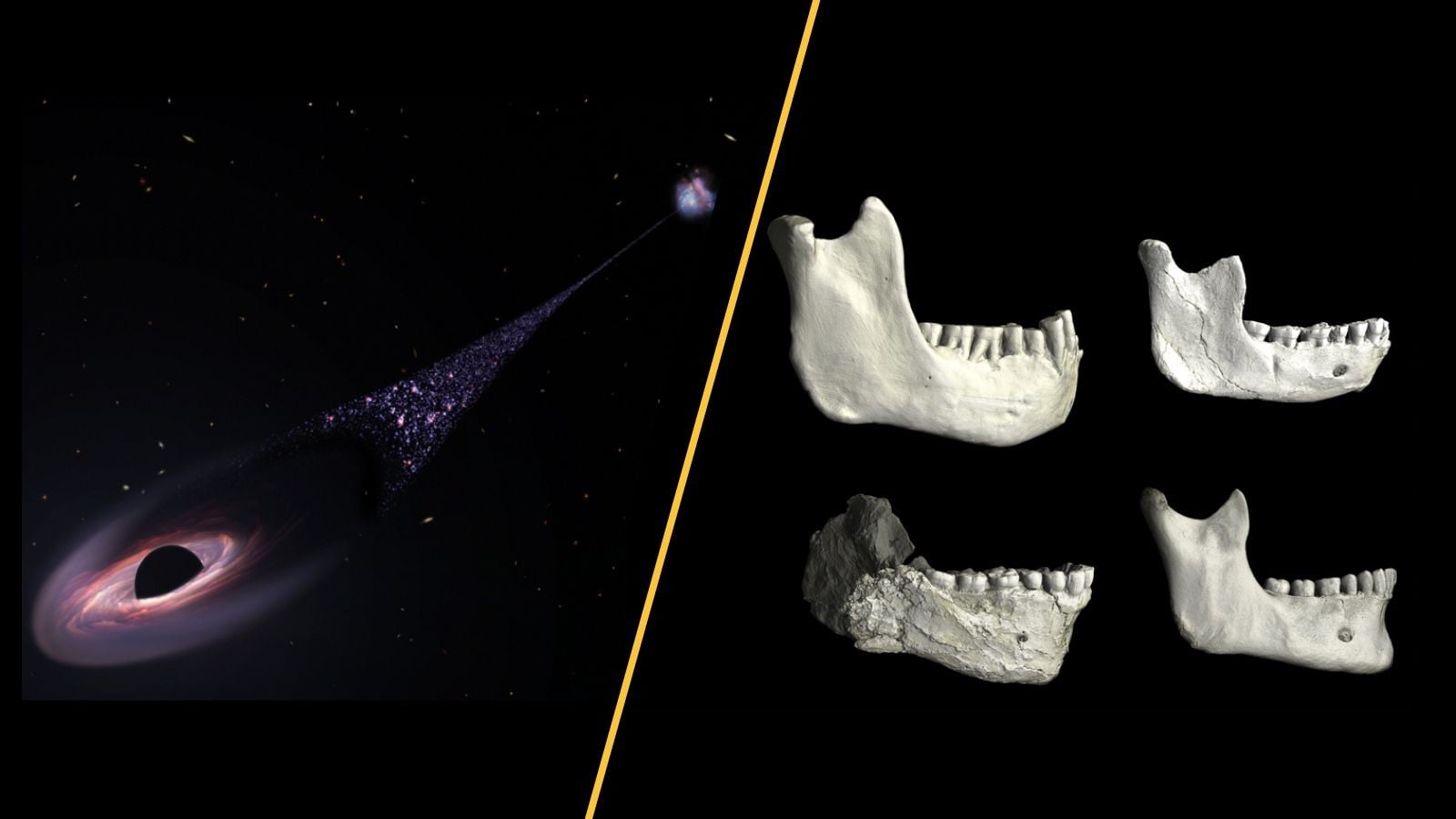
Astronomical observations have confirmed the existence of a supermassive black hole ejected from its galaxy, traveling at an astonishing 2.2 million miles per hour. This phenomenon, predicted for decades, was verified by the James Webb Space Telescope and provides further evidence supporting long-standing theories about galactic evolution. Alongside this, the Hubble telescope identified “Cloud-9,” a galaxy stabilized by dark matter, and NASA’s SPHEREx mission released its first complete map of the universe. The Vera C. Rubin Observatory detected record-breakingly fast galaxies and ALMA telescope found galaxies so hot they should not exist.
Why this matters: These findings push the boundaries of our understanding of galaxy formation, dark matter’s role in cosmic structure, and the extreme conditions possible in the early universe. These discoveries aren’t just abstract; they refine our models of how the cosmos behaves, which impacts everything from cosmology to astrophysics.
Human Origins Rewritten: A New Ancestral Link in Morocco
Paleoanthropological research has taken a sharp turn with the discovery of 773,000-year-old hominin fossils in Morocco. These remains suggest that the last common ancestor of humans, Neanderthals, and Denisovans may have originated in North Africa, not East Africa as previously believed. The fossils fill a critical gap in the evolutionary timeline, offering clues to our species’ origins.
Why this matters: For decades, the East African narrative of human evolution has dominated the field. This discovery challenges that assumption, forcing scientists to re-evaluate where and how our species diverged. The shift could rewrite textbooks and reshape our understanding of early human migration patterns.
Controversial Vaccine Policy Overhaul in the US
The US government has drastically reduced the recommended childhood vaccine schedule, cutting the number of shots from approximately 17 to 11. This decision, championed by Health and Human Services Secretary Robert F. Kennedy Jr., aligns with long-held skepticism toward vaccines. Experts warn that this policy lacks scientific basis and may lead to increased disease prevalence.
Why this matters: The change in vaccine policy represents a major departure from established public health practices. Critics fear that reducing immunization rates will result in preventable outbreaks, undermining decades of medical progress. The move raises questions about the balance between individual freedom, public safety, and evidence-based medicine.
Other Notable Findings
- Ancient Weaponry: 60,000-year-old poison arrows from South Africa represent the oldest known poison weapons.
- Early Bipedalism: A 7-million-year-old fossil suggests early hominids walked upright, possibly representing a direct ancestor to modern humans.
- Greenland Ice Melt: A massive ice dome in Greenland vanished 7,000 years ago, mirroring current melting trends.
- Satellite Collision Risk: A new theoretical model predicts orbiting satellites could begin colliding within days.
The science world is in constant motion, with discoveries emerging at an unprecedented rate. From unraveling the mysteries of the cosmos to re-examining the roots of humanity, this week’s breakthroughs highlight the dynamic nature of scientific inquiry.