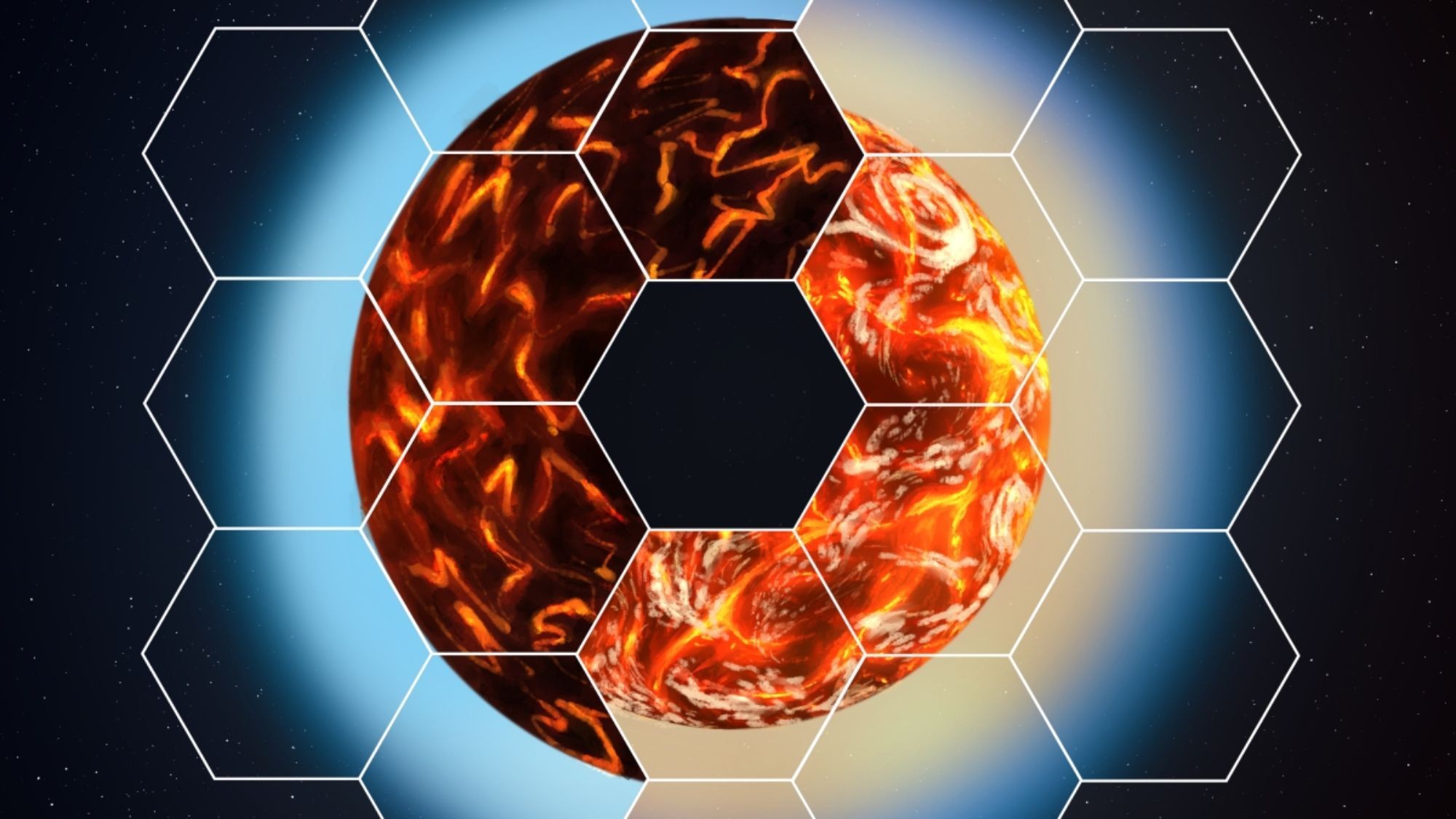
Sub-Neptunes remain stubborn mysteries. Larger than Earth, smaller than Neptune, they pop up everywhere. We have no such neighbors here in our solar system, leaving us guessing at their guts. Rocky core? Check. Deep, crushing atmosphere? Likely. But what fills the space between?
Maybe it is hydrogen-rich, echoing Jupiter’s bulk. Or perhaps a stew of water vapor and organics. Some theorists dreamed of “Hycean” worlds, thick hydrogen skies hovering over gentle liquid oceans. Habitable. Romantic, even.
Then James Webb came along.
It stares. It probes. And the results? Inconclusive so far. The atmospheres are too dense, too deep. The pressure near the core boundary turns rock into vapor. Not metaphorically. Literally.
Aluminium oxide. Iron. Magnesium silicate. Manganese sulfide. Potassium and sodium salts. Zinc. They boil. They rise. They form clouds.
This isn’t the fluffy cotton-ball stuff we know from home. This is vaporized rock high up in the stratosphere. And it does something strange. It traps heat.
Sagnick Mukherjee, from Arizona State University, ran the numbers. He and his team used simulations to model these mineral clouds forming deep within sub-Neptune atmospheres. They found a terrifyingly efficient blanket effect. The clouds trap the heat leaking out from the planet’s interior.
The math doesn’t lie, but it hurts to look at.
Cloud-driven heating raises temperatures at the atmosphere-interior boundary by roughly 1,400° to 2,60° Celsius [2,55°–4,71°F].
That is hotter than any conventional oven. That is magma territory.
Meanwhile, the upper atmosphere actually cools down, starved of that deep warmth. But near the bottom, the pressure and heat cook the surface. Rock softens. It melts.
“That extra heat is enough to melt the ‘surface,’ creating a magma ocean.”
— Matthew Nixon, ASU
Take GJ 1214 b. Forty-eight light-years out, orbiting a quiet red dwarf. Astronomers used to hope it was a water world. Cool. Maybe friendly. Then JWST saw metallic vapors and CO2 haze. 2025 confirmed the shift in understanding. Water? Gone. What lies beneath the haze? Probably a churning ocean of lava, forever hidden under its own smog.
But magma changes everything.
It’s not just hot rock. It’s chemical warfare. Gas bubbles out of the lava, mixing into the sky. It pumps out oxygen, silicon hydride, and silicon monoxide. Simultaneously, the magma acts as a sink, eating ammonia, methane, and water vapor from above.
The atmosphere and the surface trade blows. One gives what the other takes.
This mess complicates the JWST mission. Telescopes try to guess what a planet is made of by analyzing the light through its air. But if that air is being polluted by underground exhalations, the data is skewed. The signature astronomers read might be a lie told by the magma below.
And the heat stays.
It prevents the planet from shrinking. The lower atmosphere remains bloated, stubborn, refusing to cool and contract over billions of years. The structure locks into place. Hot. Inflated.
So much for those Hycean dreams. Even if a sub-Neptune isn’t molten, this cloud heating cooks the place. Liquid water boils off. Life finds no foothold.
We look up, hoping for neighbors who might hold breath like ours. We find instead worlds wrapped in stone smog, baking from the inside out.