


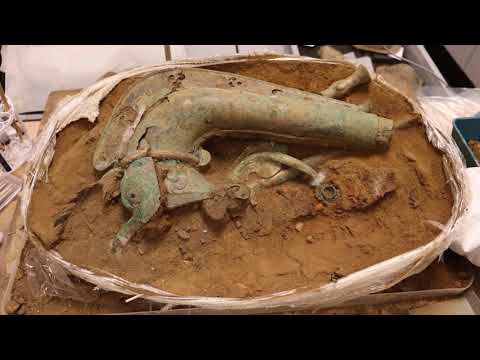
Archaeologists in West Norfolk, England, have discovered a remarkably well-preserved 2,000-year-old Celtic war trumpet – a carnyx – along with other rare artifacts that may have been used during conflicts against the Roman Empire. The find, announced jointly by Pre-Construct Archaeology and Historic England, offers a unique window into the military culture of Iron Age Britain.
The Discovery and Its Significance
The hoard was uncovered last year prior to residential development. It includes the nearly complete carnyx, distinguished by its animal-headed design (in this case, a boar), a decorated military standard, five shield bosses, and other metal components. Finds like these are exceedingly rare; this carnyx is one of only three known from Britain and among the most complete found anywhere in Europe.
Why this matters: Carnyces weren’t merely instruments; they were psychological weapons. The instruments were deliberately designed to terrify enemies with their loud, piercing sound and intimidating animal head. Their presence on the battlefield was meant to inspire Celtic warriors and demoralize Roman legions.
The Carnyx: A Weapon of War
The carnyx was a bronze wind instrument with a long, vertical body terminating in an open-mouthed animal sculpture. This design, often featuring boars, wolves, or other fierce creatures, amplified the instrument’s terrifying effect. Celtic warriors carried carnyces alongside traditional weapons like chainmail, shields, and spears.
Roman soldiers often seized carnyces as trophies after battle, a testament to their psychological impact. The fact that this one was buried in a hoard suggests it may have been deliberately hidden during a retreat or after a defeat to prevent capture.
Connection to Boudica’s Revolt
The hoard’s estimated date (1st century A.D.) and its location in Norfolk raise the possibility that these artifacts were used by Celtic tribes resisting Roman expansion. Specifically, the timing aligns with Queen Boudica’s uprising in A.D. 60.
Boudica, queen of the Iceni tribe, led a brutal revolt against Roman rule that nearly expelled the empire from Britain. Though ultimately defeated, her rebellion shook Roman power and left a lasting mark on British history.
The big question: Was this carnyx played during Boudica’s campaigns? While definitive proof is lacking, the timing and location make it a strong possibility. Experts at the National Museum of Scotland have even reconstructed a carnyx and played it to demonstrate the instrument’s deafening, unsettling sound.
Preservation and Future Research
The hoard was carefully excavated in a lab after initial X-ray and CT scans were conducted on the entire block of earth in which it was found. Ongoing research and conservation efforts will continue to shed light on the artifacts’ origins and purpose. The discovery will be featured in an upcoming episode of BBC Two’s “Digging for Britain”.
This discovery underscores the resilience and sophisticated military culture of Celtic tribes in Britain. It reminds us that even in defeat, their legacy resonates through archaeological finds like this remarkable carnyx.


