


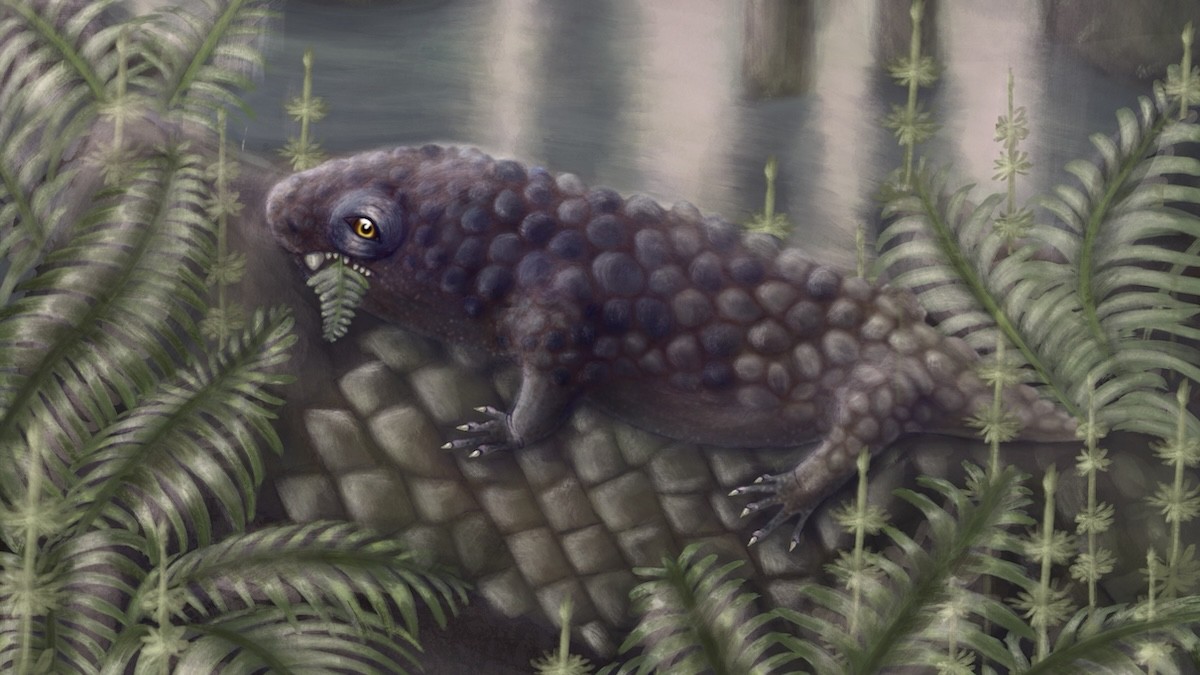
A newly discovered fossil, Tyrannoroter heberti, reveals one of the earliest land creatures to embrace a plant-based diet. Living around 307 million years ago, this animal was a pioneer in herbivory, marking a significant turning point in the evolution of terrestrial life. The discovery pushes back the known origins of plant-eating among vertebrates, shedding light on how early tetrapods adapted to a new food source.
The Rise of Herbivory on Land
For over 100 million years before vertebrates ventured onto land, plants had already established themselves as a dominant life form. The first land animals initially relied on each other for sustenance, but the untapped potential of vegetation was inevitable. Tyrannoroter stands out as one of the first to exploit this resource, with specialized teeth and jaws designed for processing plant matter.
“This find demonstrates that experimentation with herbivory began much earlier than previously thought, tracing back to the earliest four-legged animals,” explains Arjan Mann, an evolutionary biologist at the Field Museum in Chicago.
Unique Dental Adaptations
Researchers used high-resolution CT scans to analyze Tyrannoroter ‘s skull. The scans revealed a set of bony plates, known as dental batteries, on the roof of its mouth and in its lower jaw. These structures would have worked together to grind down tough plant fibers – a feature later seen in dinosaurs and other herbivores.
The animal itself was relatively small, about 10 inches long, and belonged to the pantylids, a group of early tetrapods related to the ancestors of reptiles and mammals. Paleontologists unearthed the skull from a fossilized tree stump in Nova Scotia, Canada.
Not Strictly Vegan
While Tyrannoroter likely consumed plants, it was probably not a strict vegetarian. The researchers suggest that it may have supplemented its diet with insects or other arthropods when available. In fact, the evolution of dental batteries may have originated as a way to crush insect exoskeletons before being repurposed for plant matter.
The tetrapods’ guts may have also been primed for digesting cellulose through their ancestors’ insect-based diets, making the transition to full-time herbivory more feasible.
Rewriting the Timeline
Further examination of other pantylid specimens revealed similar dental structures, including one dating back 318 million years. These findings suggest that herbivory evolved rapidly among early tetrapods following their transition to land.
“These discoveries provide direct evidence that challenges previous timelines, demonstrating that diverse herbivorous forms emerged quickly after the initial colonization of land by vertebrates.”
The Tyrannoroter fossil offers a crucial glimpse into the dietary shifts that reshaped the early terrestrial ecosystem. It underscores how quickly life adapts and diversifies, even in the face of novel ecological opportunities.


