


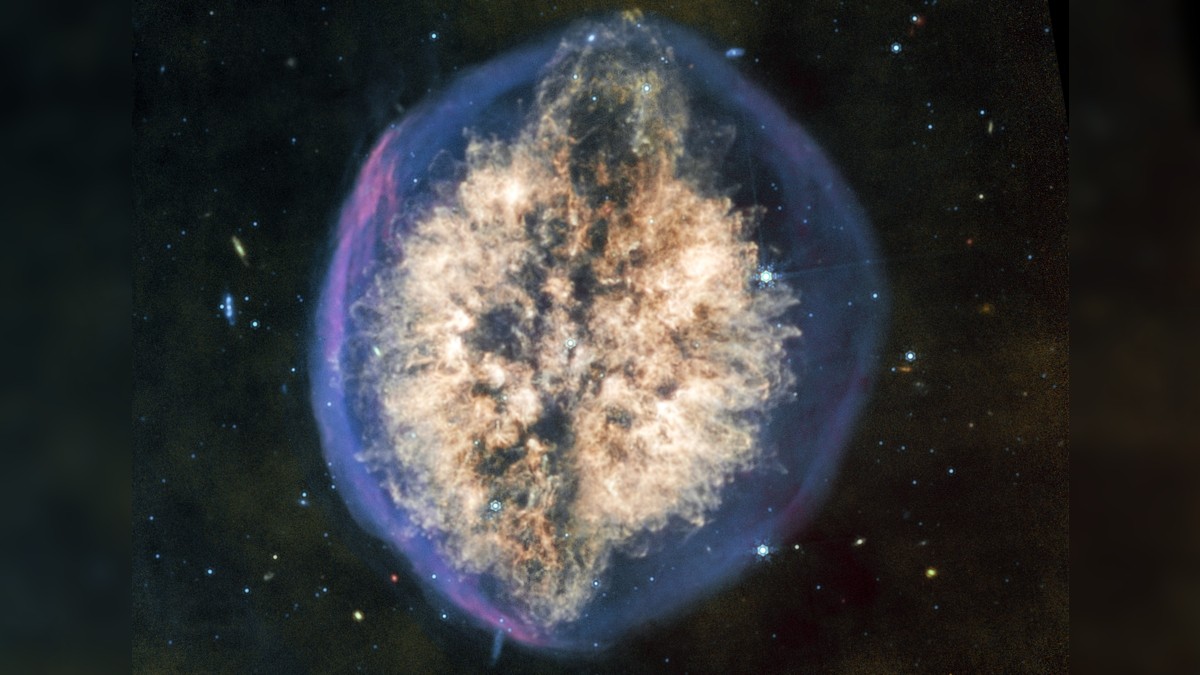
The James Webb Space Telescope (JWST) has revealed an astonishing new image of a planetary nebula, PMR 1, that strikingly resembles a human brain within a skull. This celestial formation, located approximately 5,000 light-years away in the Vela constellation, is not merely visually arresting; it also presents astronomers with a compelling puzzle about stellar evolution.
The Anatomy of a Dying Star
PMR 1 is the product of a star nearing the end of its life cycle. As it exhausts its nuclear fuel, the star violently sheds its outer layers, creating a glowing cloud of gas and dust. The JWST’s infrared capabilities have captured this process in extraordinary detail, revealing intricate folds and filaments that create the illusion of cerebral hemispheres. A dark vertical lane bisects the nebula, further enhancing the eerie resemblance to a skull.
The nebula itself measures roughly 3.2 light-years across – comparable in scale to our Solar System extending to the outer reaches of the Oort Cloud. This size, combined with the nebula’s unique shape, makes PMR 1 a particularly striking example of stellar death.
A Stellar Mystery
Astronomers have been aware of PMR 1 for nearly three decades, but its true nature remains uncertain. Initial spectral analysis from 2001 suggested the central star might be a Wolf-Rayet star – a massive, intensely hot, and luminous star nearing its explosive end. Wolf-Rayet stars are known for shedding mass at extreme rates through powerful stellar winds, often resulting in spectacular visual displays.
However, subsequent observations cast doubt on this classification. The star at the heart of PMR 1 may instead be smaller and more akin to our Sun. In this scenario, the nebula is formed as the star gently casts off its outer layers, eventually settling into a dense white dwarf. If this holds true, PMR 1 could represent a rare case where a Sun-like star mimics the death throes of a much larger, more violent star.
Why This Matters
The ambiguity surrounding PMR 1’s central star highlights the complexities of stellar evolution. Planetary nebulae provide crucial insights into the final stages of stars, but accurately classifying them can be challenging. The fact that PMR 1’s spectrum could be interpreted in multiple ways underscores the need for more detailed observations and refined models of stellar death.
This discovery also serves as a reminder of the inevitable fate of our own Sun, which will eventually undergo a similar transformation, though likely on a less dramatic scale. The JWST’s ability to capture such breathtaking images not only expands our understanding of the cosmos but also offers a glimpse into the future of our own star and solar system.
The striking image of PMR 1 serves as both a beautiful spectacle and a potent reminder of the cyclical nature of stars – their birth, life, and eventual decay.


