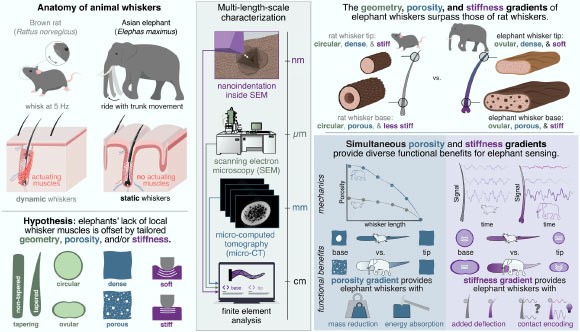
Elephants possess an extraordinary sense of touch in their trunks, relying not just on nerves and muscles, but on the unique physical properties of their whiskers. A new study from the Max Planck Institute for Intelligent Systems reveals that Asian elephant whiskers are designed with a gradual shift in material stiffness – from rigid bases to flexible tips – maximizing sensitivity without movement. This built-in “physical intelligence” could inspire more efficient sensors for robotics and other advanced technologies.
The Unique Design of Elephant Whiskers
Unlike the active, moving whiskers of many mammals, elephants have thousands of static whiskers embedded in their thick trunk skin. These whiskers don’t move independently, yet they play a crucial role in delicate tasks like food handling and precise manipulation. Scientists have long known whiskers function as sensory tools, but the details of how elephant whiskers work remained unclear.
Material Gradients and Enhanced Sensation
The study found that elephant whiskers aren’t uniform in structure. Instead, they exhibit a distinct gradient:
– The base is thick, porous, and stiff.
– The tip is thin, dense, and soft.
This transition amplifies mechanical vibrations, making it easier for the animal to detect exactly where contact occurs along the whisker length. As Dr. Schulz noted, “I didn’t need to look to know where the contact was happening; I could just feel it.” The study used micro-CT imaging, electron microscopy, and mechanical testing to confirm these findings.
Implications for Bio-Inspired Technology
The research team believes these insights can translate into advanced sensor design. By mimicking the natural stiffness gradient found in elephant whiskers, it may be possible to create artificial sensors that offer precise tactile information with minimal computational overhead. This “intelligent material design” could prove valuable in robotics and other fields where efficient, highly sensitive sensors are needed.
The findings were published in Science on February 12, 2026. The authors suggest that further exploration of natural sensory systems could yield breakthroughs in bio-inspired engineering.
By optimizing material properties rather than relying on complex algorithms, we can create sensors that are both efficient and highly effective.
This study underscores the remarkable design of natural sensory structures and their potential to inspire innovation in artificial systems.