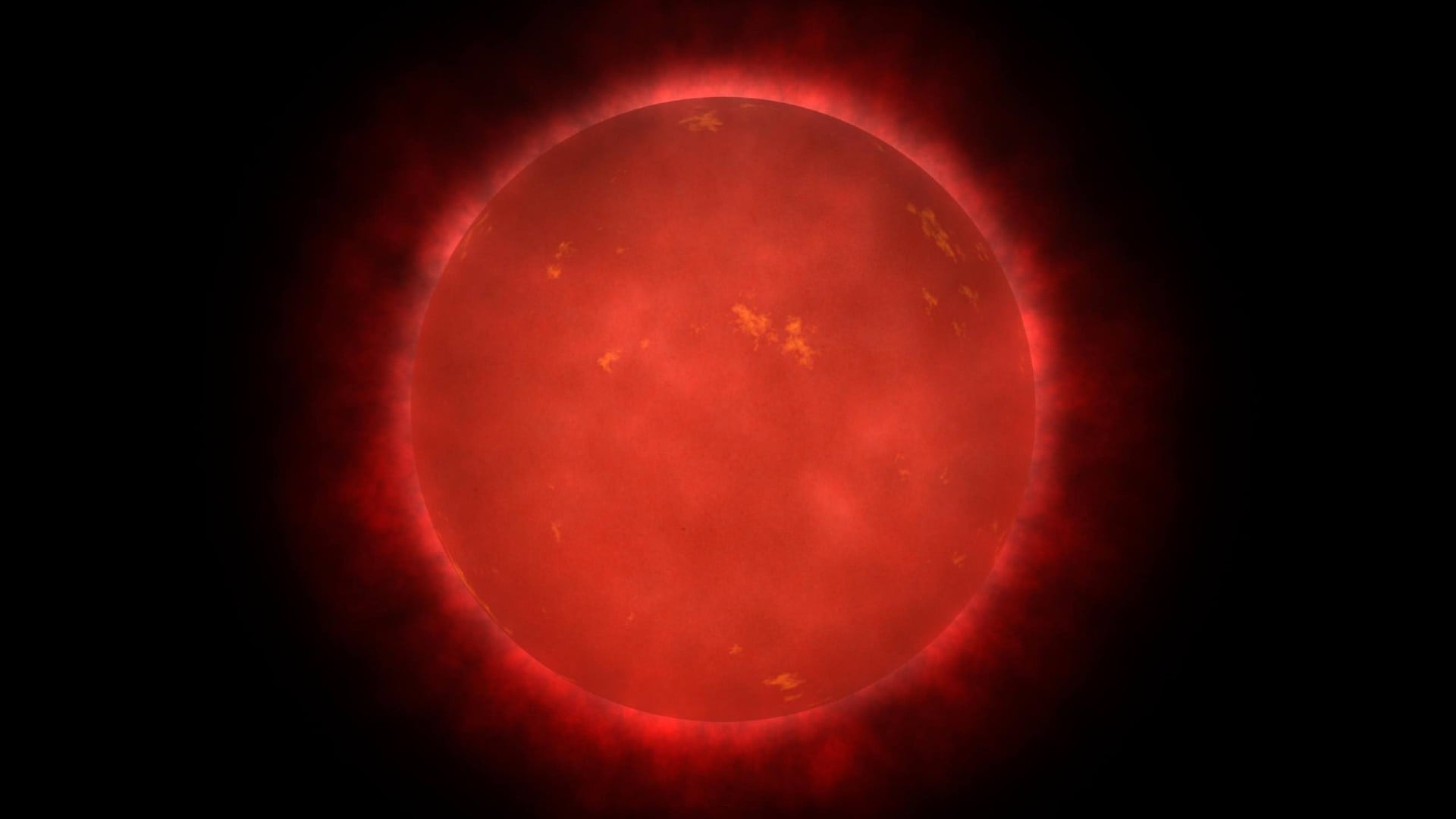
A red giant star, Kepler-56, exhibits bizarre rotational behavior, suggesting it may have consumed one of its own planets. The star’s outer layers spin roughly ten times faster than typical for its type, and its core is misaligned with its atmosphere—a phenomenon that challenges current astronomical models.
The Mystery of the Misaligned Star
Kepler-56 already hosts two confirmed exoplanets, but doctoral student Takato Tokuno from the University of Tokyo suggests a third may have met a violent end inside the star. Planetary interactions can influence stellar spin through gravitational tugs and tidal forces, but Tokuno’s analysis reveals this alone cannot explain Kepler-56’s extreme rotation and misalignment. The observed effects would require planetary influence far beyond what is seen in other systems.
A Planetary Meal?
The most plausible explanation? The star ate a planet. When a star engulfs a planet, the impact transfers rotational energy, accelerating the star’s spin. If the planet strikes at an angle, it can also induce misalignment between the core and outer layers. Tokuno’s calculations indicate the consumed planet likely had a mass between half and twice that of Jupiter, orbiting within one to six days of its star. This aligns with the characteristics of “hot Jupiters,” massive planets prone to spiraling into their host stars.
Alternative Explanations
While planetary consumption is the leading hypothesis, another possibility is that Kepler-56 was simply born spinning rapidly. However, this does not explain the misalignment between the core and atmosphere. Tokuno suggests even an early-life planetary ingestion could explain the star’s peculiar behavior, though further observation is needed to confirm.
The consumption of a planet is not merely speculation; it represents a plausible, physics-driven explanation for observed anomalies in Kepler-56’s rotational properties.
This case demonstrates how violent stellar-planetary interactions can reshape systems and provides insight into the ultimate fate of exoplanets within red giant stars.