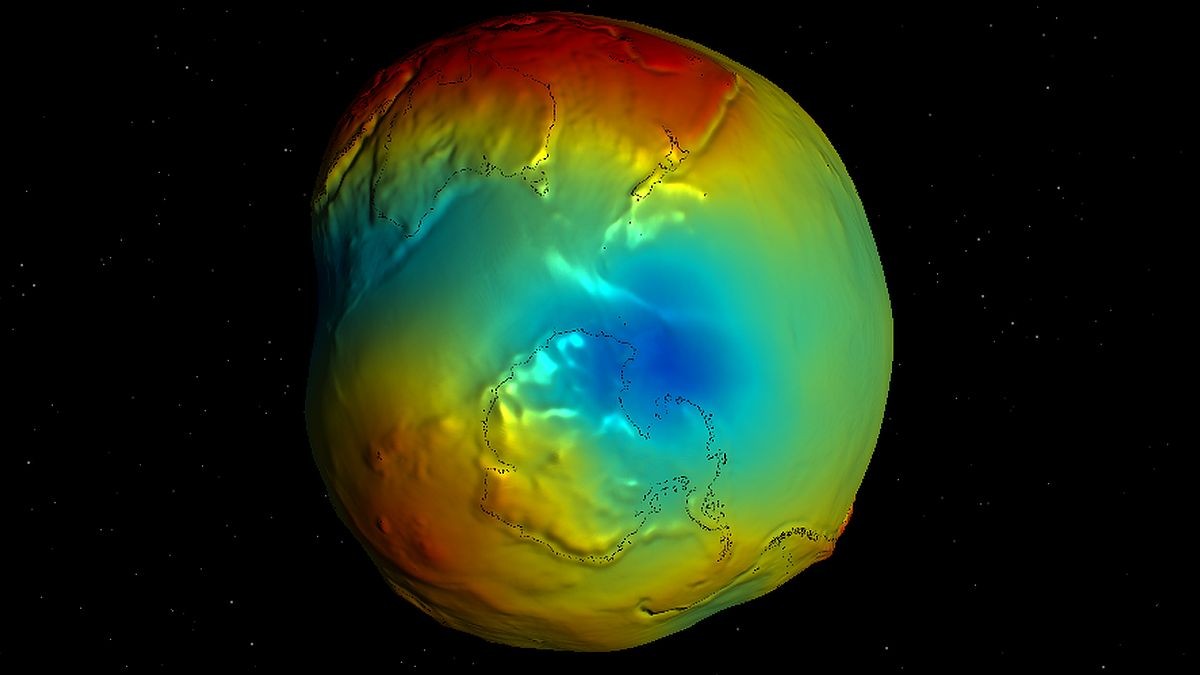
A long-standing gravitational anomaly beneath Antarctica is intensifying, driven by movements within Earth’s mantle, according to new research. This isn’t a sudden change, but a gradual strengthening of a feature that has persisted for at least 70 million years – a subtle shift in the planet’s gravitational field that provides a window into deep Earth processes.
The Uneven Shape of Gravity
Earth isn’t a perfect sphere; its gravity field is uneven, resembling a “bumpy potato” rather than a smooth globe. These variations, known as geoid anomalies, are caused by differences in the density of rocks beneath the surface. The Antarctic Geoid Low is one of the most significant depressions in this field – a region where gravity is slightly weaker.
Why this matters: These anomalies aren’t just abstract scientific curiosities. They influence sea level, potentially affecting ice sheet stability and long-term climate patterns. Understanding these forces is crucial for predicting how Earth’s surface will respond to ongoing internal changes.
Mapping the Invisible Interior
Researchers led by Alessandro Forte at the University of Florida and Petar Glišović of the Paris Institute of Earth Physics reconstructed a detailed map of the Antarctic Geoid Low using seismic waves from earthquakes. These waves travel through Earth, altering speed as they encounter different materials, effectively acting as a planetary CT scan.
The team then ran a physics-based model of Earth’s mantle convection, essentially rewinding and fast-forwarding geological activity over 70 million years. The model accurately predicted the current geoid shape and matched observed shifts in Earth’s rotational axis – confirming its validity.
A History of Subduction and Uplift
The data reveals the anomaly isn’t new. A gravitational depression has existed near Antarctica for at least 70 million years, but its strength and position changed dramatically around 50 million years ago. This timing coincides with a major shift in Earth’s polar wander.
The researchers believe the anomaly formed as tectonic plates sank beneath Antarctica, altering the planet’s gravity field. Over the last 40 million years, rising plumes of hot, buoyant material have further intensified this effect.
The Link to Antarctic Glaciation
Interestingly, the strengthening of the geoid low may have influenced the growth of the Antarctic ice sheet, which began around 34 million years ago. As the geoid dipped downward, local sea levels would have dropped, potentially encouraging ice accumulation. This connection remains speculative but highlights how deep Earth dynamics can impact surface conditions.
The gravity hole under Antarctica is a subtle yet powerful reminder that even the slowest processes deep inside our planet can leave a lasting imprint on the world above. Further research is needed to fully understand the implications of this shifting gravitational field, but the findings underscore the interconnectedness of Earth’s internal and surface processes.