It starts cold.
Very cold. Just a few degrees above absolute zero, inside a cloud of gas and dust so dense it barely lets light in. Here, gravity fights magnetic fields for control of the matter.
Astronomers have finally caught one of them winning.
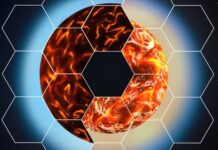
Researchers looking at L1544 — a prestellar core in the nearby Taurus molecular cloud — have detected ambipolar diffusion. It is a subtle shift, a slight drift between charged and neutral particles that allows gravity to overcome magnetic resistance. This is how stars are actually born. Not with a bang, but with a slide.
The study comes from a team at Kyushu University and Max Planck Institute, published in Astronomy & Astrophysics. To their credit, they did something first: directly observed this process inside a core before it ever becomes a star.
The Cold Wait
Prestellar cores are holding cells. They are the dense pockets where gas gathers before a protostar ignites. If the magnetic field stays strong, the material sits there, suspended. Nothing happens.
If the field weakens, the wait ends. Gravity pulls everything inward, compression heats the core, and eventually — a star emerges.
The key is knowing how that field weakens.
Doris Arzoumanian, first author from Kyushu University, sees these cores as chemical labs. They are dense, frigid, and rich in complex molecules, even precursors to organic life.
“We wanted to investigate how prestellar cores reduce their magnetic fields,” Arzoumanian says.
Because a strong field is a brake pedal. Step on it, and you delay the collapse. You delay the birth.
Splitting Atoms and Molecules
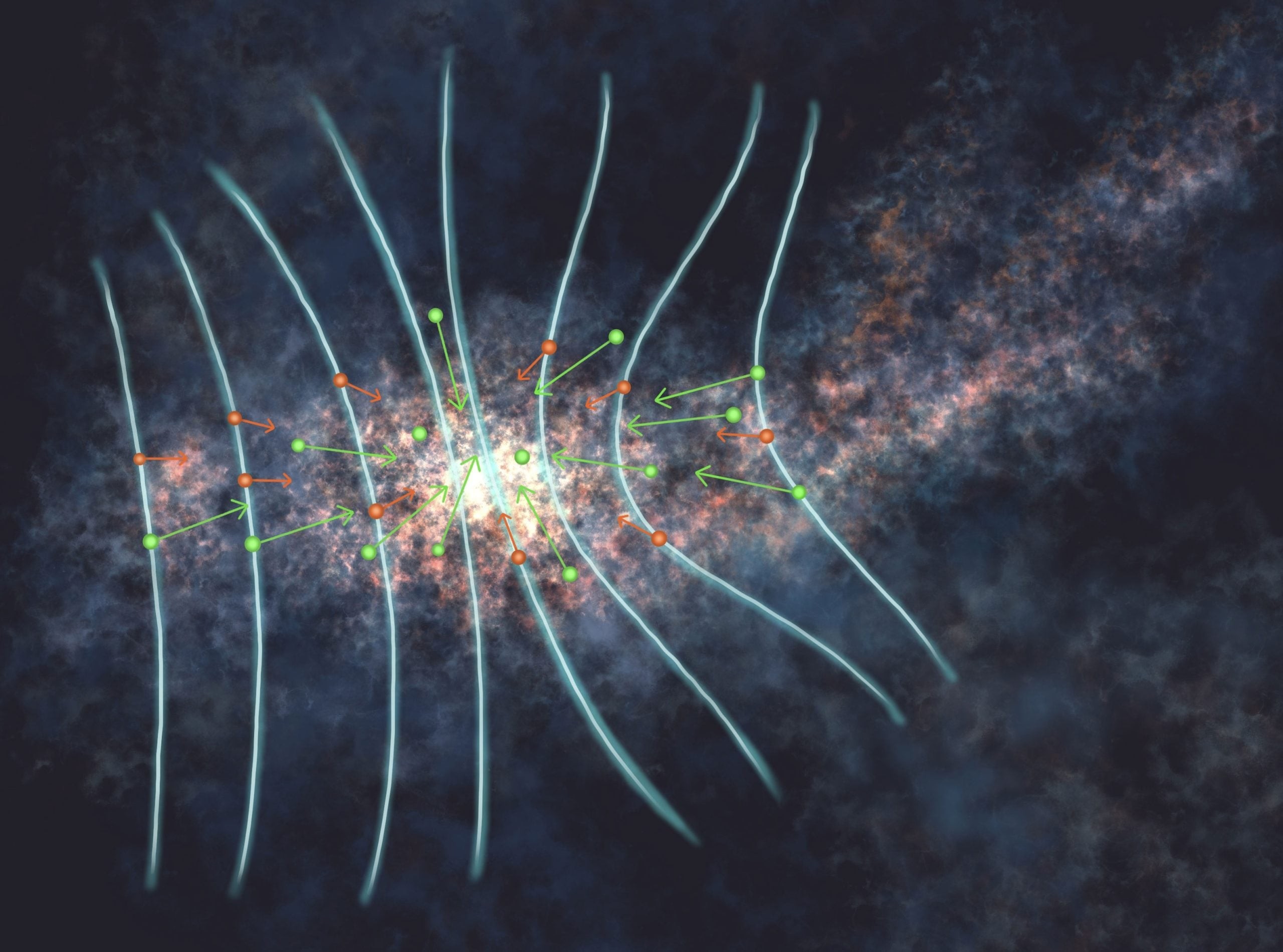
The trick is the matter itself. In a cloud, particles aren’t uniform. Some are charged ions. They love magnetic fields; the fields dictate their motion. Others are neutral. They don’t care about the magnetic grip at all.
Normally, these two types of particles bump into each other, tying their hands. But inside a dense, cold core like L1544, that tie loosens.
Neutral particles start to slip past the ions. They slide toward the center, pulled by gravity, while the ions get dragged behind, still tethered to the magnetic field lines. This separation — this ion-neutral drift — is the physical signature of ambipolar diffusion.
Detecting it is tricky. Cold traps molecules on dust grains. Most of them become invisible to telescopes.
Silvia Spezzano from Max Planck picked the right tracers. They chose an ion called Diazenylium-d1 ($N_2D^+$) and a neutral molecule, para-NH$_2$D. Both survive the cold, both hang out in the dense center of the core.
If you track their speed, you should see a difference if diffusion is happening.
The Tiny Gap That Changes Everything
And they found one.
A difference of just 0.05 kilometers per second. That’s about 0.03 miles per second. In your car, you’d blink and miss it. In the slow, silent physics of star birth, it’s a landslide.
The team measured this gap in L1544 using the IRAM 30-meter telescope. They realized why it happened: as the core gets denser, starlight can’t reach the middle. Less ionizing radiation means fewer ions. Fewer ions means fewer collisions. Neutral particles break free and rush in.
“Eventually, gravity becomes the primary driving… resulting in collapse into a protostar.”
Arzoumanian points out the elegance of the mechanism. It is the only way for a magnetically supported cloud to shed its defenses. It is natural, physical, and inevitable.
Why Care About Slow Movers?
Most of the time, theory tells us this happens. Now we see it.
Connecting math on paper to actual objects in space bridges a gap that has existed for decades. This tiny velocity drift isn’t just data. It determines if a cloud collapses at all. It sets the pace. A small change here means the star forms faster or slower. It might mean it forms differently.
So, what is the universe really like?
The team isn’t stopping with one cloud. They will look for this drift elsewhere, watching where the ion-neutral movement spikes, trying to map the transition from silence to birth. It feels like small stuff — a few molecules slipping through a magnetic net. But everything starts small.
Arzoumanian reminds us it also ties back to something bigger, something human: the origin of life, the chemistry that builds worlds. We watch the stars form to understand ourselves.
Right now, the universe is just a cloud of dust and ice. It takes time to burn.