It’s not just a tailgate staple anymore. Country star Dierks Bentley warms up his vocals by tossing bean bags in parking lots before shows. Craig Campbell hosts tournaments featuring the game. Even former New England Patriots lineman Matt Light uses it as the centerpiece of his charity events. Families across the U.S. are entering amateur leagues. The game? Bean bag toss. Also called cornhole.
The premise is straightforward. Players take turns launching filled fabric squares at a wooden board. The target is a hole. The distance is roughly 30 feet. It’s a test of aim and arc.
The Official Anatomy of a Cornhole Board
You might think any old wooden board works. You’d be wrong if you’re playing by the book. The American Cornhole Association (ACA) sets the standard. They claim to be the largest organized body for the sport in the country. Their specs are precise.
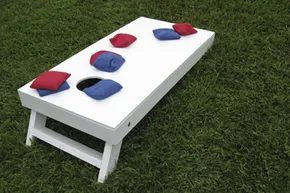
The board itself is a rectangle. Dimensions are 48 inches by 24 inches. That’s 122 by 61 centimeters. The material? Half-inch plywood. It must be sanded smooth. Then coated in high-gloss paint. Why the gloss? To reduce friction. You want the bag to slide cleanly if it misses the hole but hits the board surface.
The elevation matters more than you’d think. The board isn’t flat. It’s angled. The front edge, closest to the player, sits 2.5 to 4 inches off the ground. The back edge lifts to 12 inches. This creates a 90-degree angle relative to the floor at the peak. Think of it like an easel. The slope is what gives the game its unique physics.
Then there’s the hole. It needs to be exactly 6 inches in diameter. Placement is non-negotiable. Center it 9 inches from the top edge. Keep it 12 inches from either side. Get these numbers wrong, and the game changes.
Corn Bags and Comparison to Horseshoes
The projectiles are simple too. Six-inch square bags. Filled with corn or beans. Regulation weight sits between 14 and 16 ounces. That’s 396 to 453 grams.
If this sounds familiar, it’s because it shares DNA with horseshoes. Some even call it “soft horseshoes.” The scoring logic is identical. You want the object to land closest to the target. But the execution differs. Horseshoes are heavy iron. These bags are soft fabric.
Points are awarded based on placement. If the bag goes straight through the hole? Maximum points. If it bounces off and lands near the hole? You might get fewer points, depending on the specific variant you’re playing. But the goal remains the same. Precision over power.
The Deceptive Difficulty of Bean Bag Toss
It looks easy. Anyone can throw a bag at a hole. So why do pros spend hours drilling the same motion?
Because it’s not easy.
Bean bag toss is deceptively simple. Sure, the object is to toss the bag in the hole, but that’s not as easy as it sounds.
The wind. The slope. The arc. One degree of error in your wrist flick and the bag hits the lip and bounces out. Or worse, it stops just short. The margin for error is tiny.
How to Play Bean Bag Toss Properly
How to Win at Cornhole: The Rules You Need to Know
Want to win at bean bag toss? Simple. Score 21 points.
Want to score 21 points? It’s not that simple.
For singles play, start by gathering two players and a platform. Each player takes turns tossing bags at the platform until all eight bags – four for each player – have been played, keeping track of the score as the game progresses.
In doubles play, teams of two players compete against each other using two platforms.
Using American Cornhole Association rules, the scoring goes like this:
-
Three points: A bag goes into the hole. This is called a corn bag in-the-hole or hole-in.
-
One point: A bag does not go through the hole but lands with a part of it resting on the platform. This is known as in-the-count or on-the-board. The bag must not touch the ground before landing on the platform; this is a foul and will result in bag removal before play continues. A variation allows a point for a bag pushed in by an opponent’s toss.
-
No point: A bag does not land on the board or go through the hole. This is called corn bag out-of-the-count.
Players have 20 seconds to deliver the bean bag once they enter the pitcher’s box, which is 27 feet (8.2 meters) from the target platform. A pitcher can toss the bag from either side of the pitcher’s box but must stay on the same side of the box for an entire inning. In an inning, both singles players take a turn or all four doubles players take a turn .
The innings, or rounds, continue until a player or team reaches or exceeds 21 points. If you toss all the bags and no one has yet won, gather them up and keep going. A game can’t end in the middle of an inning, so even if you score the winning point, you’ll need to finish out the inning before calling the game.
In a variation known as “cancellation scoring,” it becomes more difficult to win. That’s because bags “in-the-hole” and “in-the-count” pitched by opponents in the same inning cancel each other out. Oh, and in a rare twist, if a player throws all four bags in the hole, it’s an automatic 21 points for the win .
Tips to Improve Your Bean Bag Toss Score
Although fun, bean bag toss can be humbling … especially when your hand can’t deliver what your ego promised: a bag in the hole. Don’t despair. All you need is a little practice. You can start by mastering the basics.
First, select a comfortable stance. Whether you place a dominant foot forward as you throw or stand with feet shoulder-width apart, the motion should be fluid and followed through, like a golf swing (or tossing a Frisbee). Keep in mind, however, that you have the option to either throw underhand or overhand, and this requires some trial-and-error. One other note: Beware of the foul line. Cross it, and even a perfect throw won’t count.
Second, decide how you’ll throw the bag. Will you simply grab it around the middle and hope for the best? Not if you’re serious about scoring. Here are a few tried-and-true variations :
-
Chicago Fold : Hold the bag at one end and let the filler drop to the bottom. Then fold it in half — and then half again.
-
Paducah Pancake : Smooth and flatten the bag, then throw it like a saucer (or pancake) toward the platform.
-
Half Paducah Pancake : Smooth and flatten the bag, but this time fold it in half before throwing it like a pancake.
-
Sacramento Sling : Using two fingers, hold the bag by a corner or edge, and toss it with a gentle underhand.
-
Omaha Overhead, also known as Air Mail: Wad up the bag and shoot it like a basketball toward the hole. This is arguably the most difficult shot to master.
-
Frisco Fling : Using fingertips and thumb, grasp bag in the middle of one side, moving the filler to the bottom of the bag. Then, toss it underhand with the top of your hand above the bag.
Once you’ve found a style you like, perfect your technique. There’s a sweet spot on the platform about 6 inches (15.2 centimeters) in front of the hole. Concentrate on hitting that spot rather than the hole itself. If your bag hits that spot with forward velocity, it will – with regularity – slide right into the hole. This is called the slider.
Finally, if you really want to oust your opponents, master a few defensive moves :
-
The Blocker : Pitch the bag so that it drops near a hole and prevents an opponent from using a slider.
-
The Push : Use a pitch to nudge your bag into the hole or, alternatively, push a blocker out of the path.
Safer than Lawn Darts
Since it uses relatively soft bags that don’t have sharp edges, it’s a fair bet bean bag toss is safer than most lawn games. Plus, even with some muscle behind them, the bags aren’t likely to cause any serious harm if they come into contact with a person — unlike lawn darts, horseshoes, bocce ball or croquet.
The Murky Origins of Cornhole
Nobody actually knows who invented bean bag toss. There are theories, sure. One popular story traces it back to 14th-century Germany. A farmer named Matthias Kueperman allegedly saw boys hurling heavy rocks into a hole. It looked dangerous. So he decided to create a safer version. German immigrants later brought this concept across the Atlantic when they settled in the U.S.
Then there’s the Kentucky theory. Some sources claim a farmer in the early 1900s is the true progenitor of the game. The timeline is fuzzy. The geography is debated. But one thing is clear. It took root in the Midwest.
How did it spread? Probably through relatives visiting family. Or maybe tailgating at Cincinnati Bengals games. Seeing a game you’ve never played makes people want to try it. That word-of-mouth engine works faster than any marketing campaign.
The game also mirrors an activity played by the Blackhawk tribe in Illinois. They didn’t use fabric squares filled with corn. They tossed pig bladders stuffed with dry beans. Same goal. Different materials. The core mechanic survived centuries and cultural shifts.
From Backyard Fun to Pro League
Today, bean bag toss occupies a strange space. It’s at charity fundraisers. It’s at school carnivals. It’s also in amateur tournaments. But there’s a professional side, too. The American Cornhole Organization runs competitions that mimic the structure of college basketball’s Final Four.
The bracket is steep. It starts with 64 players. You have to survive the nationwide pool. Then you make the CornyForty. That’s the top 40. Next comes the Top Gun Twenty. Only the top 20 remain. The winner is crowned the “King of Cornhole.”
It’s not just for fun anymore. These are professional designations. Players can win prize purses. They get sport jerseys. It’s serious business for people who really care about where a bean bag lands.
Why Bean Bag Toss Is Actually a Math Lesson
You might think cornhole is purely recreational. It’s not. It’s a sneaky educational tool. Keeping score requires addition and subtraction. That’s the baseline.
Teachers have found variations that teach multiplication. They also use the game to introduce basic statistics. Measure the distance between the bag and the target. Or measure the distance between the two bags farthest from each other.
Then you calculate the mean. The median. The mode. The range of throws. It’s applied math. Kids don’t even realize they’re learning graphing concepts until they see their accuracy plotted on a chart. It works better than a textbook sometimes.