For decades, astronomers have debated the true nature of ancient Mars. While it is widely accepted that the Red Planet once had liquid water, a key question remains: Was Mars a world of scattered lakes and seasonal streams, or did it possess vast, stable oceans?
A recent study points to the latter, based on a massive geological feature that resembles a “bathtub rim” left by a receding sea.
Hledání stabilního pobřeží
Previous attempts to prove the existence of Martian oceans relied on searching for coastlines. However, these studies were often inconclusive, since the discovered “shores” in different locations were at different altitudes. On Earth, sea levels are relatively stable, creating predictable coastlines; on Mars, the absence of a uniform level of heights made it difficult to distinguish the real ocean from local bodies of water.
To solve this problem, the researchers shifted their focus from the water’s edge to the land itself. Instead of looking for wave tracks, they began looking for coastal shelves —flat, stable strips of land located between the deep ocean and high continents.
“Suchá” metoda
To identify these structures, scientists used computer modeling to “dry up” Earth’s oceans. By removing the water, they could observe what geological structures remained. It turns out that even after the water disappears, distinct flat strips of land remain on Earth, known as coastal plains and continental shelves. These streaks can extend for hundreds of miles and remain relatively stable even as sea levels fluctuate.
Applying this logic to topographic data on Mars, the research team discovered a massive flat zone in the northern hemisphere. Výsledky ukazují:
- Scale: This object indicates an ocean that once covered approximately one third of the planet’s surface.
- Depth: This shelf was located at a depth of approximately 1,800 to 3,800 meters below the ancient Martian sea level.
- Stability: Unlike small lakes, a shelf of this scale requires millions of years of stability to form.
Connecting the dots: deltas and sedimentary rocks
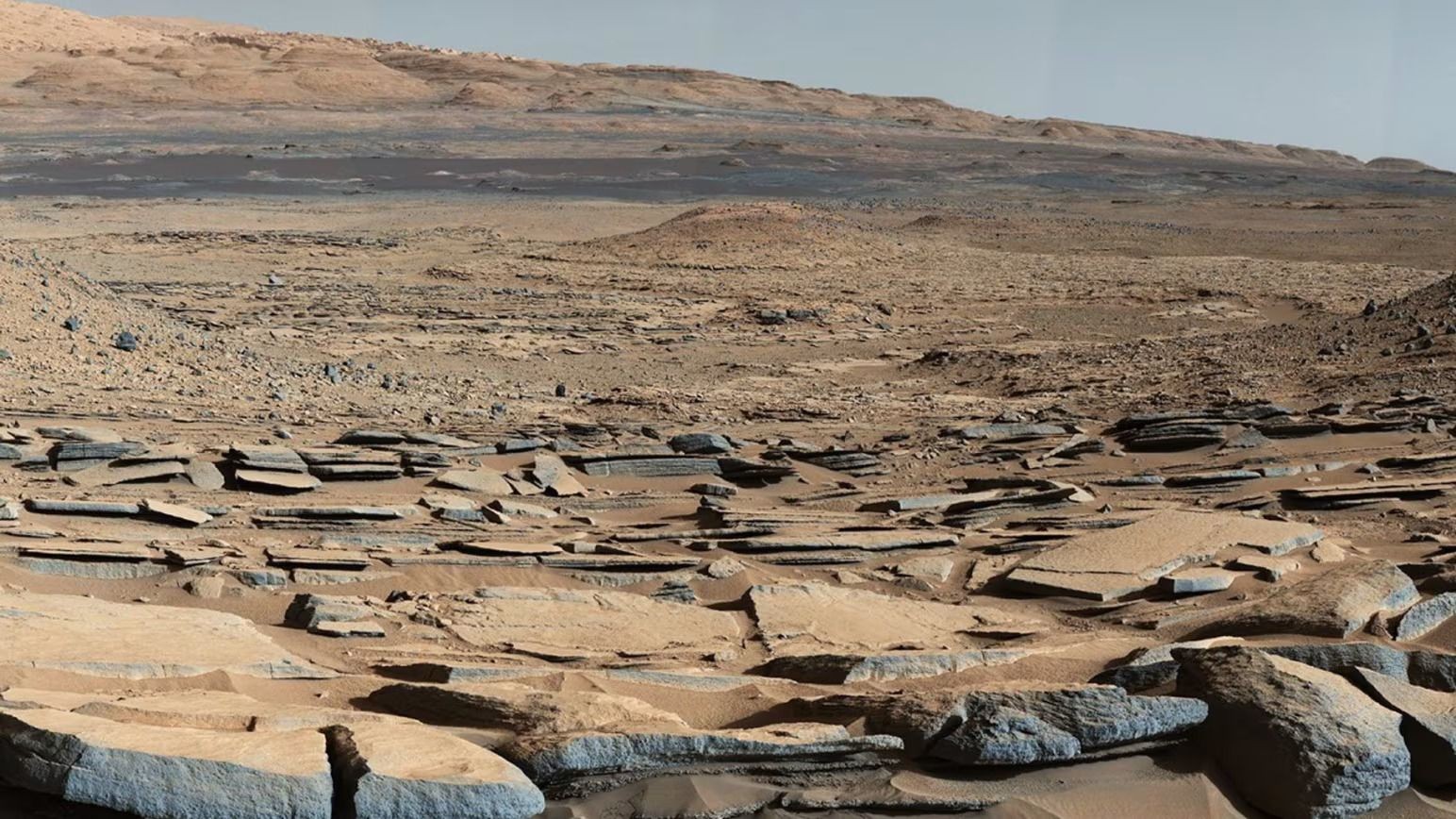
The evidence is supported by the presence of river deltas. On Earth, rivers deposit sediment on triangular plains where they flow into the ocean, and these deltas naturally cluster along continental shelves. Researchers have noticed a similar pattern on Mars: river deltas line up perfectly along a newly discovered coastal shelf.
“The possible existence of an ocean suggests that a huge body of water could persist for a long time. This could be a critical condition for the emergence of life,” says Abdalla Zaki, lead author of the study and a planetary geologist at the University of Texas at Austin.
Why is this important for the search for life?
The discovery of a stable, long-lived ocean changes the idea of Mars’ habitability. Rozlehlý oceán poskytuje víc než jen vodu; it provides a permanent environment in which life could potentially arise and flourish throughout geological epochs.
Moreover, these coastal shelves are priority targets for future research. On Earth, coastal sedimentary rocks are excellent at preserving fossils. If Mars once supported life, sediments within this “bathtub rim” may contain chemical or physical traces of ancient Martian organisms.
Závěr
The discovery of a massive, stable coastal shelf suggests that ancient Mars was home to a vast ocean, rather than just a collection of isolated bodies of water. The discovery identifies a new high-priority target for future missions searching for signs of extraterrestrial life.