It has a label that sounds like a disaster movie title. “Potentially hazardous object”. That is how space agencies categorize anything that comes within roughly 7.5 million kilometers of Earth. It sounds ominous. It isn’t.
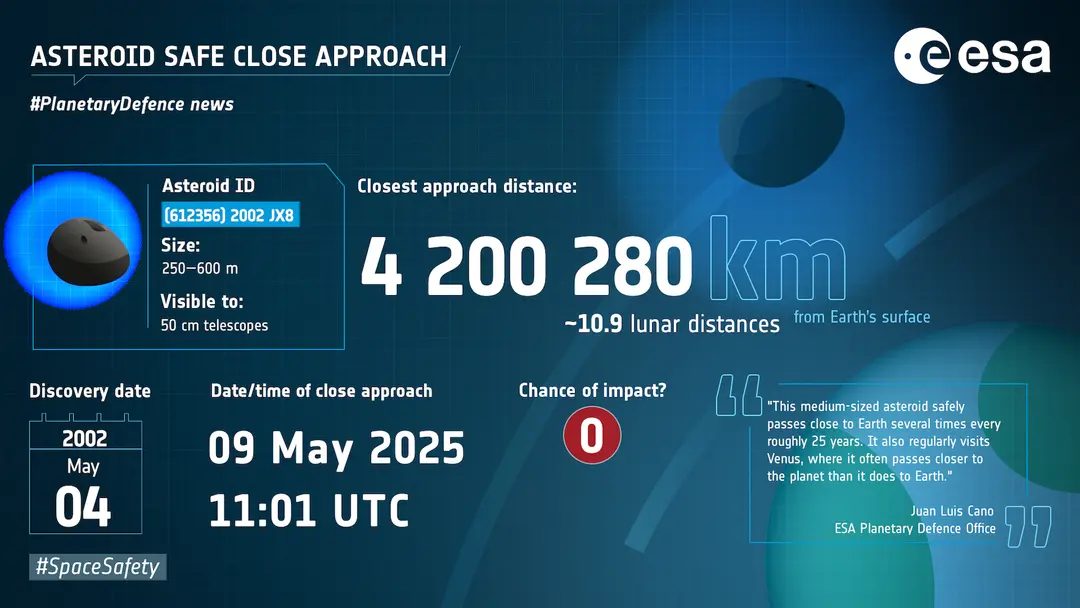
Take (612 356) 2002 JX8. Yes, that is its official number. The name is forgettable. The asteroid is not currently a threat to us. It will not hit the ground. It will not block out the sun. It will simply pass by.
On Friday, May 9, 2025, at exactly 1:01 PM Paris time, we will find out just how close “close” really is. The object will reach its closest approach to our planet. The distance will be about 4.2 million kilometers. That sounds like a lot. It is a huge amount of empty space.
To put it in perspective, think about the Moon. The distance between Earth and our satellite is roughly 384,400 kilometers. Multiply that by 11. The asteroid will be 11 times farther away than the Moon. You cannot see it with the naked eye. You certainly cannot feel its gravity. It is a rock drifting through the void.
“It is simply passing in our vicinity.”
Why does this matter? Because we track these objects. We count them. We assign them labels. The label “potentially dangerous” is a technical term. It describes a trajectory calculation, not an imminent impact. If it were on a collision course, we would not be writing articles about how safe it is. We would be issuing evacuation orders. Or worse, we would be praying.
We are safe. The sky remains clear.

Tracking Near-Earth Asteroid 2002 JX8 in Real Time
ESA data has pinpointed the asteroid (612 356) 2002 JX8 as a significant object to monitor. Its estimated diameter sits between 250 and 600 meters. That is roughly the size of a large sports stadium. The Virtual Telescope Project has already shared images of the rock. They are broadcasting the flyby live. This allows anyone with an internet connection to watch the object pass close to Earth.
The stakes are higher than you might think. NASA statistics show an asteroid around 140 meters wide hits our planet every 20,000 years. These smaller impacts still cause regional damage. A 1,000-meter object is far rarer. It strikes only once every 700,000 years. That scale can trigger global consequences.
“Experts in planetary defense from the European Space Agency (ESA) assure that (612 356) 2002 JX8 will cross Earth’s orbit multiple times in the coming years, but always without collision risk.”
So why track this one? It is not just about the immediate pass. The asteroid will cross Earth’s orbit several times over the next few years. This repeated path gives scientists a chance to study its trajectory. It tests our monitoring capabilities. The ESA planetary defense team confirms there is zero risk of collision. Still, watching it helps refine how we track other space rocks.
This is part of a larger effort to understand near-Earth objects. Knowing where these rocks go matters. It is not just about fear. It is about preparedness. The live feed is a reminder that space is not empty. It is full of moving parts. We just have to keep our eyes on them.


The landscape of consumer electronics is shifting again. You might not see the headlines blasting across every feed, but the groundwork is being laid in labs and boardrooms that dictate how devices function for the next decade. We’ve moved past the era where raw specs alone drove upgrades. Now, it’s about efficiency, privacy, and localized intelligence.
This isn’t just a minor tweak. It’s a structural shift in how computing power is allocated. The days of sending every keystroke and photo to a distant server for processing are drawing to a close. Or at least, they are becoming less necessary.
The Rise of Edge Computing
Edge computing isn’t a new concept, but its adoption has accelerated rapidly. Devices are no longer just dumb terminals. They are becoming processors in their own right. This matters because latency kills user experience. When your phone processes facial recognition or language translation locally, the response is instant. No lag. No waiting for a signal handshake with a cloud server halfway across the world.
The privacy implications are staggering. Data stays on the device. This reduces the attack surface for hackers and minimizes the risk of massive data breaches. Users are becoming more skeptical about what they upload. They want control.
Battery Life and Efficiency
One of the biggest constraints in mobile technology remains energy consumption. Processors designed for edge tasks are incredibly power-efficient. They don’t need to run at full throttle constantly. Instead, they handle specific tasks with specialized circuits that draw minimal power.
This extends battery life. It allows for thinner devices. It also means that older hardware remains viable for longer because software optimizations can leverage local processing capabilities that didn’t exist a few years ago.
AI on Your Phone
Artificial intelligence is no longer confined to corporate data centers. It’s in your pocket. On-device AI models are smaller, faster, and more secure. They can predict your next move, suggest replies, or enhance photos without ever connecting to the internet. This local processing capability is becoming a key differentiator for smartphone manufacturers.
Which phone will offer the best on-device AI experience? That’s the question consumers are asking. The answer lies in the neural processing units (NPUs) built into modern chips. These aren’t just for gaming. They’re for intelligence.
What This Means for You
The next time you unlock your phone or ask for directions, realize that a significant portion of that computation is happening right there. On the silicon in your hand. It’s faster. It’s more private. And it’s changing the game.
The future of technology isn’t about connecting everything to the cloud. It’s about making the devices we already hold smarter. More capable. More independent.
We’re just scratching the surface. The race to optimize local computing is on. And the winners will be the ones who can deliver power without draining your battery. Or sacrificing your privacy.
It’s a delicate balance. But one that manufacturers are increasingly forced to strike. The tools are getting better. The demand is growing. The question is no longer if on-device AI will dominate, but when it will become the standard.
And we’re getting closer to that day every week.