For 27 years, astronomers thought they had a boring rock on their hands.
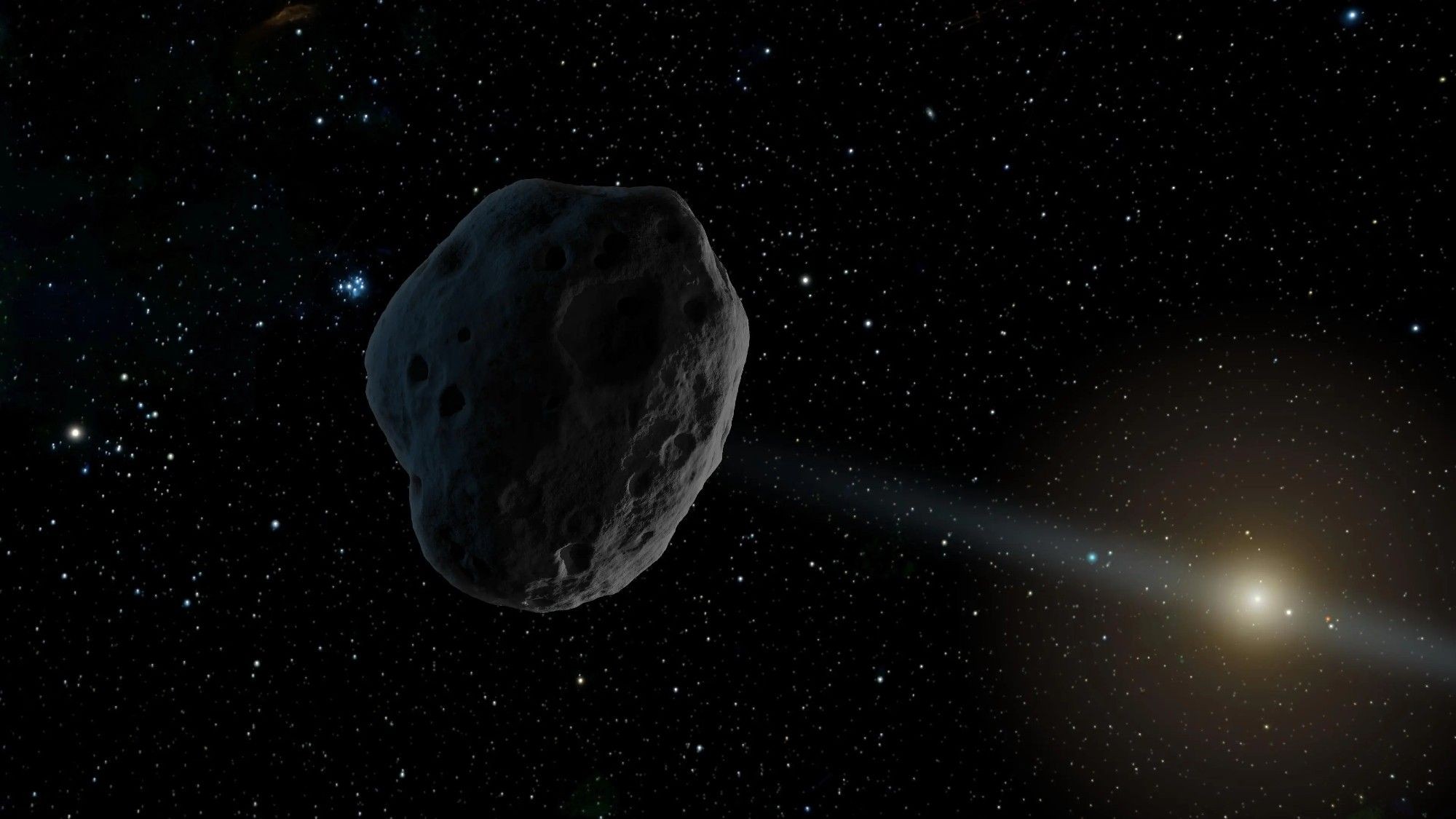
It was just another near-Earth asteroid, designated 1998 SH2. It had been cataloged since 1998. It followed a steady 4.5-year orbit. It looked inert. It showed none of the classic cometary drama: no glowing coma, no streaming tail, no visible evidence of ice vaporizing under solar radiation.
Then, in August 2025, it decided to rewrite the record books.
During a close flyby just 2 million miles from Earth, the Deep Space Network noticed a problem. The object was not where the math said it should be.
That discrepancy wasn’t a glitch. It was a clue.
How Radar and Astrometry Unmasked the Imposter
NASA didn’t just look at it again; they measured it with extreme prejudice.
Researchers combined decades of precision optical astrometry with high-resolution planetary radar. They looked for tiny shifts in the object’s trajectory. Gravity alone could not explain the irregular motion. There was a push, faint but consistent.
What caused it?
Gas jets escaping the surface.
Hidden ice was warming in sunlight, acting like miniature thrusters. This phenomenon, known as non-gravitational perturbation, is the hallmark of a comet, not an asteroid.
“After we measured the non-gravitational perturbations affecting the motion of 1998 SH2 and recognized they weren’t compatible with the object being an asteroid, we suspect[ed] the object could be an active comet,” said Davide Farnocchia. He is the lead author of the study and a navigation engineer with NASA’s Center for Near-Earth Object Studies.
The team needed visual proof.
They turned to the Very Large Telescope in Chile. Then to the Canada-France-Hawaii Telescope on Mauna Kea.
There it was. A faint, dusty tail. The mistake of cosmic proportions was confirmed.
Why Classifying It as P/1998 SH2 Matters for Planetary Defense
The discovery earned the object a second name: P/1998 SH2. The “P” officially designates it as a periodic comet.
But this isn’t just about taxonomic pride. It changes how we keep the planet safe.
Rocky asteroids behave predictably. They obey gravity. Their orbits are relatively stable unless something massive hits them.
Comets are slippery. As gas escapes, they drift. They get pushed. They change course in ways that are hard to predict if you assume they are just dead rocks.
“Because of outgassing, the motion of [comets] is more significantly perturbed than that of [asteroids].” — Davide Farnocchia
If you mistake a comet for an asteroid, you miscalculate its future position. You might miss an impact risk entirely because you failed to account for the subtle thrust of escaping gases.
This case proves that detecting these perturbations is a diagnostic tool for planetary defense. It helps scientists answer critical questions: Is this object going to hit Earth? Is it actually a comet? How will its orbit evolve?
Are There More Hidden Comets Lurking in Our Data?
1998 SH2 probably isn’t alone.
The study suggests that our catalogs are full of impostors. There may be many more “asteroids” out there that are actually quiet, inactive comets. They just don’t have obvious tails. They don’t have glowing comas. They just drift.
By analyzing the motions of near-Earth objects using increasingly precise astrometry, we might uncover a whole new population of these hidden comets.
“Detecting these perturbations can be an important diagnostic tool for planetary defense…”
The lesson here is clear. Subtle orbital changes can be just as revealing as a spectacular tail. We need to keep tracking. We need to look closer.
Because sometimes the thing you’re afraid of is hiding in plain sight. And sometimes, it’s just gas escaping into the void.
The question remains: what else have we been calling an asteroid when it’s actually something else entirely?