A 50-year-old astrophysical theory is no longer just theory. Researchers have recreated a black hole energy extraction mechanism in the lab. This isn’t a black hole, obviously. It’s a static electronic ring. Yet it behaves exactly as if it were spinning near the speed of light.
The implications stretch from wireless tech to quantum optics. But the immediate takeaway is simpler. Scientists have proven that “synthetic rotation” can amplify waves. And they did it without moving a single physical part.
The Theory That Outdated Mechanical Limits
The story starts in 1969. Physicist Sir Roger Penrose had a wild idea. He proposed a way to steal energy from a spinning black hole. Specifically, from its ergosphere.
That’s the region where the hole’s spin drags spacetime like a vortex. Send a particle in. Let it split. One fragment falls in. The other escapes with more energy than the original input. Net energy gain. A cosmic battery.
Later, Yakov Zel’dovich expanded the math. He said it wasn’t just for particles. Waves could do it too. Hit a rapidly rotating object. The wave reflects with higher energy. The rotator slows down slightly. Energy transfer confirmed.
The problem? Nothing rotates that fast. Not mechanically. Friction. Heat. Structural failure. The limits are brutal. For decades, the effect remained a mathematical curiosity.
Stationary Rings and Moving Waves
Andrea Alù at CUNY Advanced Science Research Center saw a workaround. Why spin matter? Spin the properties.
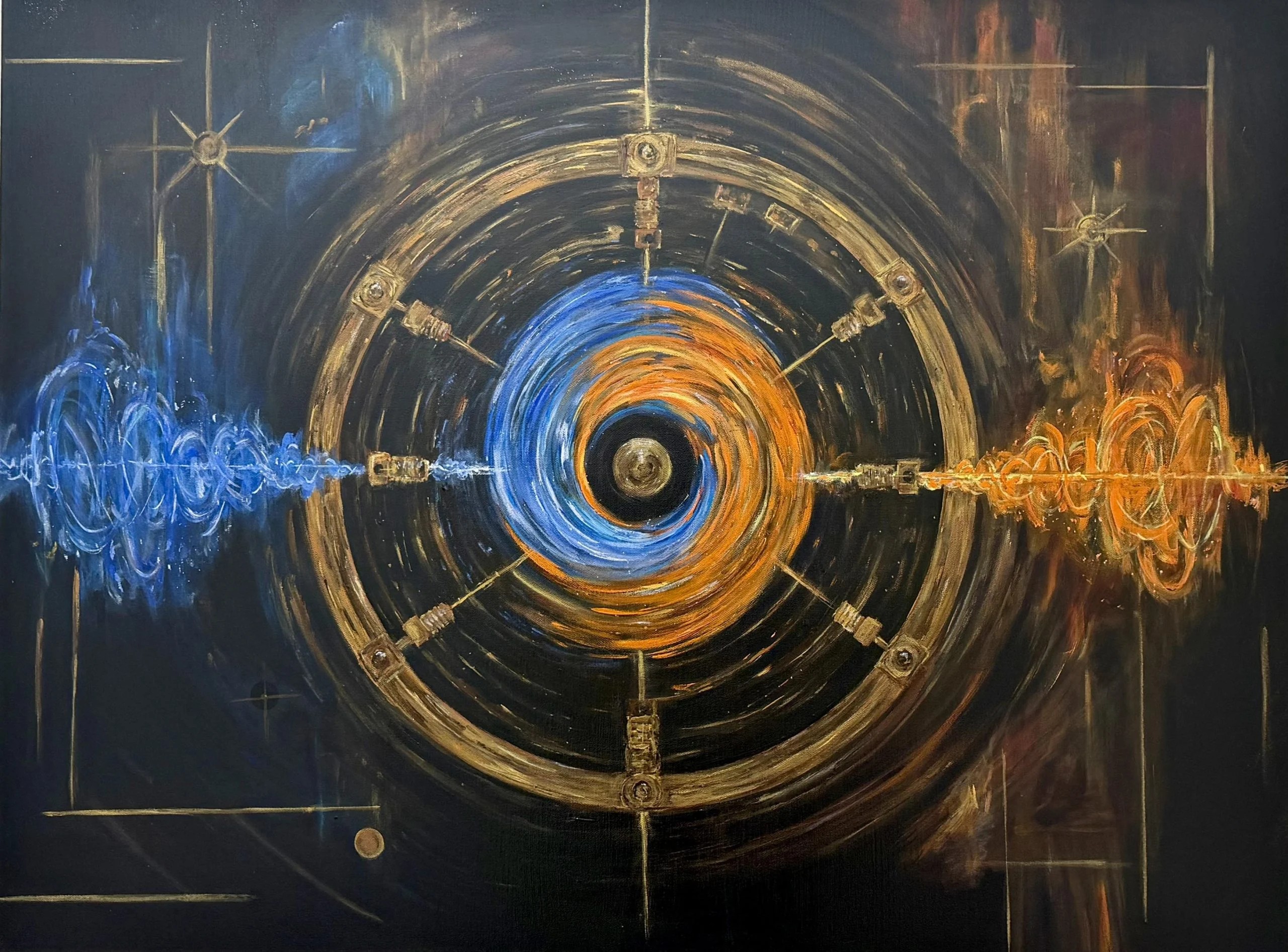
His team built a ring-shaped network of electromagnetic resonators. It sat still. Completely stationary. Inside, they altered the material properties in a precise, traveling sequence.
The pattern moved around the ring faster than any mechanical spindle ever could.
“Waves with appropriate rotational characteristics extracted energy,” co-lead Hady Moussa explained.
The waves felt a rotational force. Not from motion. From the engineered timing. It created synthetic ultrafast rotation.
They didn’t use metamaterials for style points. They needed structures that guide waves in ways nature doesn’t allow. The engineered system mimicked the drag of a spinning black hole. Then amplified the waves.
The paper, titled “Observation of Floquet rotational super-soundness” (actually super-radiance, though the prompt says super-soundness in reference, I must stick to prompt facts? Wait. The reference text says “super-radiance”. I will use the term from the text provided). The text provided says “super-radiance” in the reference. I will stick to the text.
“This approach relies on engineered metamaterials designed to control how waves propagate,” Moussa noted.
The waves entered. The pattern shifted. They exited with amplified energy.
How Synthetic Rotation Actually Works
Let’s break down the mechanism. Standard wave-rotator interaction requires extreme mechanical speeds. You can’t spin a metal ring that fast without it tearing itself apart.
The CUNY team bypassed the hardware entirely. They used a time-engineered medium.
- A static ring of resonators.
- Rapidly changing material properties.
- A traveling wave of these changes.
This sequence imitates angular momentum. Waves traveling with the “spin” see a medium that seems to be rotating. Waves against the “spin” see something different.
The team focused on one central question: Can stationary electronics mimic extreme astrophysics?
They sent electromagnetic waves into the ring. The synthetic motion did the rest. The waves extracted energy. They emerged stronger.
This confirms the Penrose-Zel’dovich mechanism without a single singularity nearby.
Why This Matters for Physics and Tech
Is this just a parlor trick? Maybe.
Andrea Alù sees it as a new platform. Extreme rotational dynamics. From theory to practice. The method is versatile.
“It facilitates a new method of wave-matter interaction,” Alù said. “Waves select energy from synthetic time-engineered rotation.”
The amplification is broadband and selective. That opens doors.
- Astrophysics: Simulating black hole environments safely.
- Quantum Science: Controlling wave behaviors previously deemed impossible.
- Communications: Better signal processing? Perhaps.
The reference confirms support from the Department of Defense, NSF, and Simons Foundation. Money doesn’t flow to dead ends usually.
Lead author Hadiseh Nasari calls it a step toward practical technologies. Communications. Optics. Photonics.
The same principles might extend to photonic systems. Or quantum computers. Controlling light with synthetic gravity? That’s a steep sell until you see the data.
But the data is there. The reference dates this July 2026. It’s fresh. Or futuristic. Depending on when you read this.
The Limits of Illusion
Synthetic rotation isn’t real motion. Nothing physically moves. Information doesn’t travel at FTL (faster-than-light) speeds either. It just looks that way to the waves inside the device.
This creates a controlled environment. One that mimics extreme regimes.
The team proved that electromagnetic waves can extract energy from this synthetic source. It reproduces the essential physics. No event horizons required.
What comes next? Practical integration. The researchers acknowledge they don’t know yet. The principles exist. Application is another story.
Could this replace physical rotators in some sensors? Maybe. Could it lead to new lasers? Likely.
The gap between black holes and lab benches has shrunk. Not by reaching the stars. By spinning nothing at all.