Jupiter won’t last forever.
Not even close.
Billions of years from now our gas giant will face a terrifying reckoning. A dying sun will expand into a monstrous red giant. It will swallow the inner solar system. Mercury is gone. Venus too. Earth likely burns.
But what happens to the outsides? The distant wanderers?
We finally have an answer.
Or at least a very strong guess.
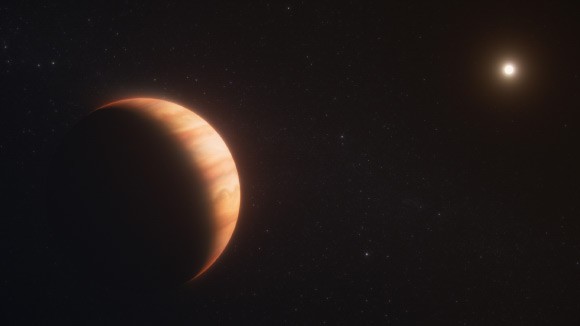
Astronomers looked at WD 1856 b. A massive planet orbiting a white dwarf. This star is a corpse. Once it burned like our sun. Now it’s a cold, dense ember in Draco, 80 light years away. It’s been dead for 10 billion years.
The planet survived.
Barely.
James Webb Space Telescope caught the planet passing in front of the dead star. The team used NIRSpec to dissect its light. They found methane. Aerosols. Small cloud particles hanging in the haze.
It’s the first time anyone has seen an atmosphere around a planet orbiting a stellar corpse.
“It’s like using a time machine to pierce the future.”
That quote is from Dr. Ryan MacDonald. He works at St. Andrews. He’s right. This isn’t history. It’s prophecy.
WD 1856 b is huge.
Massively so.
It weighs between 4.3 and roughly 11 Jupiters. But it’s not the size that’s wild. It’s the proximity. The planet is seven times wider than its host star. A giant circling a marble.
Here is the strange part. The planet shouldn’t be this warm.
Isolated planets that far from heat sources should be cold. Around 160 Kelvin.
This one? 390 to 412 Kelvin.
That’s nearly 400 degrees Fahrenheit. Hotter than you can imagine.
Why?
It heated up recently. Or relatively recently anyway. Sometime between 3 and 5 billion years ago, this world migrated inward.
Dr. Christopher O’Connor from Northwestern thinks it got trapped in gravity well. The white dwarf pulled it closer. Tides stirred its core. The friction boiled the atmosphere.
It has been cooling since then.
But how did it get there?
The star didn’t always live alone. It’s part of a triple system. Companion stars may have shoved it inward with their gravitational elbows. Or maybe it never left.
There are two theories.
1. The planet was swallowed during the red giant phase and fought its way back out from inside the star’s ash.
2. Gravitational nudges from neighbor stars dragged it from the safety of a wide orbit into the killer zone near the white dwarf.
Nobody knows for sure.
Yet.
Dr. Victoria Boehm at Cornell is already planning the next observation. She watched four more transits with Webb. Waiting on the chemistry details.
This feels important.
We always look backward in space. Light takes time to travel. We see stars as they were eons ago. Dust clouds frozen in birth cries.
But this? This looks forward.
The Sun has about five billion years left on its fuse. Then the swell begins. The end times approach. WD 1856 b shows us a survivor. A bloated, heated husk circling silence.
Is that what awaits us?
Probably.
The findings are in Nature this week. MacDonald et al., 2026. Check the citation if you need proof.
I prefer to imagine the methane clouds. Thin, drifting, around a dark star that used to give us light.