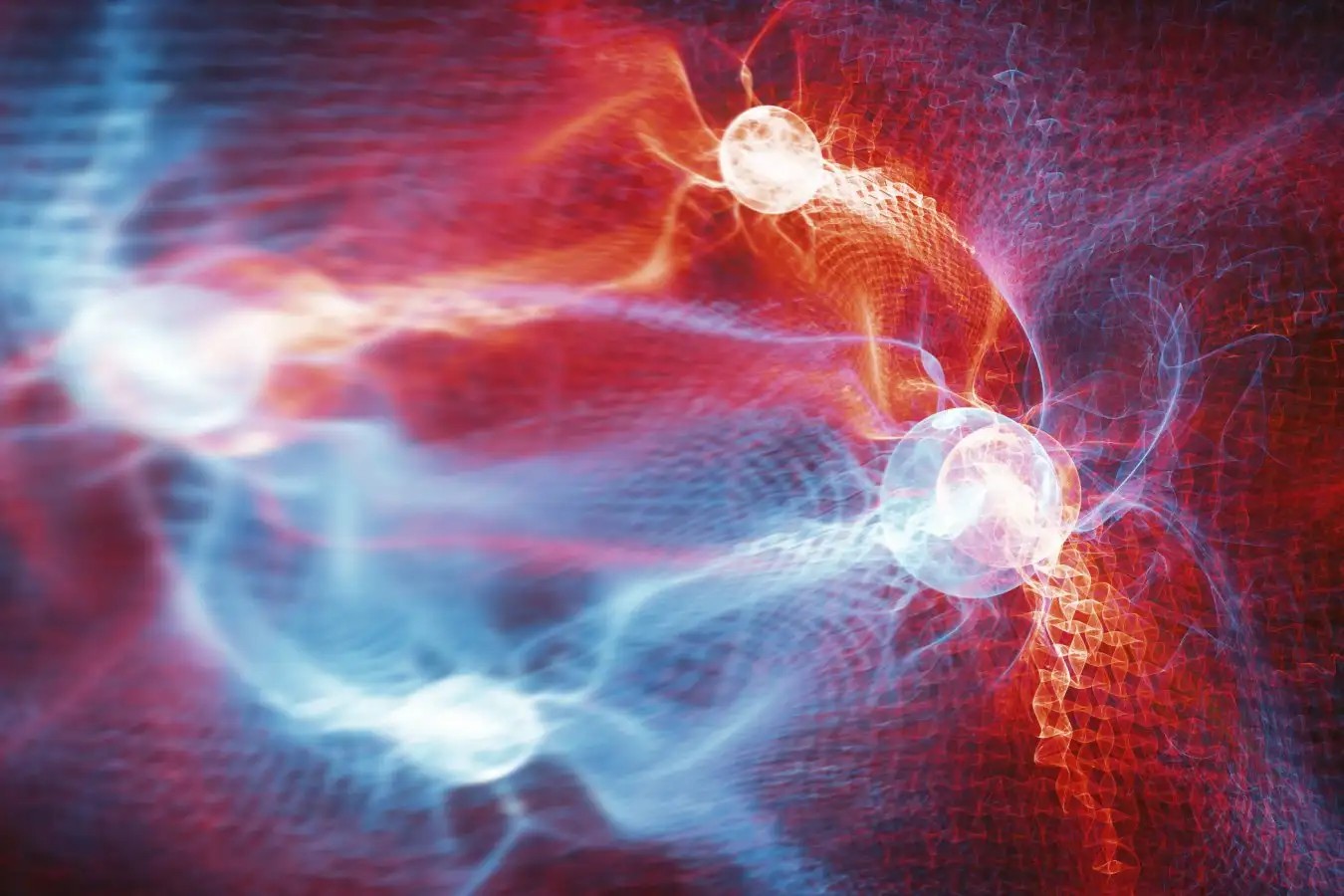
Physicists are currently navigating a profound paradox: while quantum theory explains the behavior of atoms with incredible precision, it fails to account for the massive, gravity-driven scale of the universe. This gap suggests that quantum mechanics is not the final word on reality, but rather a layer of a much deeper, more complex structure.
Researchers are now proposing a theoretical framework known as QBox, a “post-quantum” model that could bridge the divide between the subatomic world and the laws of gravity.
The Search for Quantum Gravity
To understand why QBox matters, one must look at the historical pattern of physics. In the early 20th century, “classical” physics—the predictable laws of motion we see every day—was found to be incomplete. The “holes” in those classical laws revealed the quantum realm, a place where particles behave like ghosts and exist in multiple states at once.
Today, physicists are facing a similar “déjà vu.” Quantum theory is remarkably successful, yet it breaks down when applied to gravity and the cosmos. Solving this requires a theory of quantum gravity, which would essentially be a “post-quantum” theory—a deeper layer of reality from which quantum mechanics emerges.
The Concept of “Hyperdecoherence”
The researchers behind this new model, James Hefford (National Institute for Research in Digital Science and Technology) and Matt Wilson (Paris-Saclay University), based their work on a concept called decoherence.
- Decoherence: The process by which quantum effects “leak away,” making the world appear stable and predictable (the reason we don’t see cats being both dead and alive in real life).
- Hyperdecoherence: The researchers propose that just as decoherence turns the quantum world into the classical world, a process called hyperdecoherence might turn a post-quantum world into the quantum world we currently observe.
For years, mathematical theorems suggested that such a process was impossible. However, Hefford and Wilson identified flaws in the underlying assumptions of those previous proofs, carving out a mathematical path for QBox to exist.
A World Without Fixed Causality
The most striking feature of QBox is its departure from our fundamental understanding of time and cause-and-effect. In our daily lives, causality is linear: Event A causes Event B.
In the QBox realm, however, we encounter causal indefiniteness. In this state, it is impossible to determine if A caused B or if B caused A. This might sound like science fiction, but it aligns with a key requirement for quantum gravity:
“We should care about [causal indefiniteness] if we want to pursue a theory of quantum gravity,” notes Carlo Maria Scandolo of the University of Calgary.
This is because Albert Einstein’s General Relativity implies that different observers in different parts of space-time may perceive the order of events differently. QBox provides a mathematical language to describe this fluidity.
What Lies Beneath?
The theory suggests that the “missing” information in our universe isn’t necessarily a new type of matter (like cosmic strings), but rather hidden dimensions.
Specifically, the researchers suggest these dimensions might be temporal. Hyperdecoherence may act as a filter, cutting off our access to processes that move backward in time, effectively “locking” us into the forward-moving, predictable quantum reality we experience.
The Road Ahead
QBox is currently a mathematical sketch, not a proven law of nature. The next steps for the scientific community include:
1. Physical Validation: Developing a “narrative” or physical mechanism that explains why hyperdecoherence occurs.
2. Mathematical Rigor: Testing the theory against new constraints to ensure it consistently reduces to quantum mechanics.
3. Experimental Testing: Looking for concrete signatures of QBox in experiments involving overlapping quantum waves.
Even if QBox is eventually proven incorrect, it serves as a vital “stepping stone,” helping physicists refine the requirements for whatever the true post-quantum reality may be.
Conclusion: QBox represents a bold attempt to mathematically map the territory beyond quantum mechanics, suggesting that our reality may be a simplified version of a much stranger, causally fluid universe.