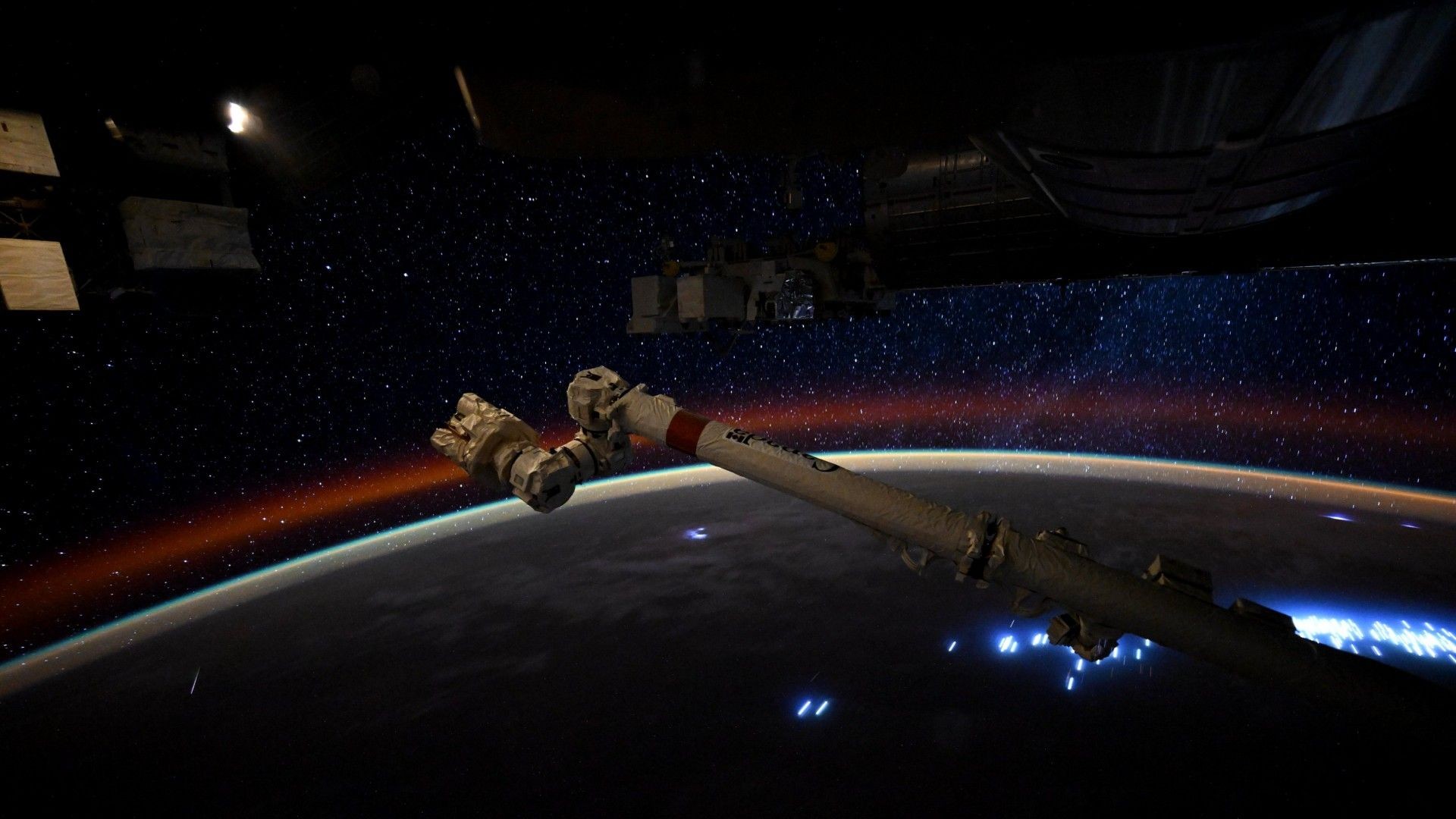
NASA astronaut Jessica Meir has captured a rare perspective of the Lyrid meteor shower, photographing the celestial event from her vantage point aboard the International Space Station (ISS). While observers on Earth watch meteors streak across the night sky, Meir’s photograph offers a unique “top-down” view, showing the meteors as they ignite within the thin veil of Earth’s atmosphere.
The Science Behind the Lyrids
The Lyrid meteor shower is an annual celestial event caused by Earth passing through the debris trail left behind by Comet C/1861 G1 Thatcher. Discovered in 1861, this is a “long-period” comet, meaning it takes hundreds of years to complete a single orbit around the Sun.
As Earth intersects this field of cosmic dust and ice, the particles collide with our atmosphere at high speeds. The friction generated by this collision causes the debris to burn up, creating the bright streaks of light we recognize as meteors.
Viewing the Phenomenon
For those watching from the ground, the shower reaches its peak between the nights of April 21 and April 22. To get the most out of the experience, astronomers recommend the following:
- Timing: Look for the peak viewing window overnight.
- Location: Seek out dark-sky areas away from city light pollution.
- Point of Origin: The meteors appear to radiate from the constellation Lyra, which gives the shower its name.
- Frequency: Under ideal conditions, observers can expect to see between 15 to 20 meteors per hour.
A Perspective on Planetary Protection
Meir’s photograph provides more than just a beautiful image; it serves as a visual demonstration of Earth’s atmospheric structure. By capturing the meteor streaking below the horizon, the image highlights just how incredibly thin our protective atmosphere actually is.
From the perspective of the ISS, the atmosphere is a fragile, glowing layer that acts as a shield, intercepting cosmic debris before it can reach the surface. This view offers a profound connection between the vastness of space and the delicate environment that sustains life on Earth.
The photograph serves as a striking reminder of our planet’s vulnerability and the constant, silent interaction between Earth and the debris of our solar system.
The Lyrid meteor shower offers a yearly opportunity to witness the remnants of an ancient comet, providing both a spectacular light show for Earthbound observers and a vital scientific perspective for those in orbit.