Happy Fourth, Space Fans.
The U.S. turns 250 this week. A quarter-millennium. It feels heavy, doesn’t it? We at Space.com spent a few hours staring at the ceiling wondering how the view has shifted since 1776 back when Benjamin Franklin and Thomas Jefferson were looking up at a very different sky. 🇺🇸
We didn’t just want history. We wanted context. How far have we come? Where are we going in the next century and a half? We even imagined what Space.com might have printed if the medium existed in the 18th century. Paper? Quill? Who knows.
The Podcast
If you prefer listening while you drive or wash dishes, Rod Pyle and Tariqalik covered this ground on This Week In Space episode 217. They broke down American spaceflight from the founding of NASA in 1958. The U.S. has led the charge in almost every metric since the mid-60s.
They talked about missions that launched on July 4th. Relived the hits. Watch it free online.
“Since the mid-1960’s has led in just about any categorythat counts.”
1776: Grounded and Green
Human flight didn’t happen for another seven years. Kites existed. Leonardo had drawn daft sketches of machines that would never fly. But on July 4, 250 years ago our boots stayed dirt-deep. 🦶
Skywatcher Joe Rao explains what the founders saw that night. No ISS twinkling overhead. Just stars. Unchanged by satellites.
Mike Wall, our tech editor, walks through the slow crawl from kites in ancient China to today’s lunar return. The gap is staggering. We went from tethered cloth to orbital velocity.
Playtime: The Estes Liberty Star
Want to launch something yourself? Skip the standard firework.
Get the Estes Liberty Star. It’s blue, red, and white. Assembly is easy for beginners. Our e-commerce writer Harry Bennett found it on Amazon for $38.85.
Is it space travel? No. Is it better than watching fireworks fade? Yes. 🚀
Starlight Time Travel
Anthony Wood suggests a specific way to view the night. Find a star whose light left its surface in 1776 exactly. When you see it, you’re seeing history. The declaration of independence was being signed while those photons started their journey.
There’s also Spica. Rob Lea explains why it qualifies.
Anthony Wood also picked out four other summer sky targets with America 250 vibes. Look up. Ignore the boom boxes.
Telescopes and Misconceptions
We used to think we knew everything. We were wrong.
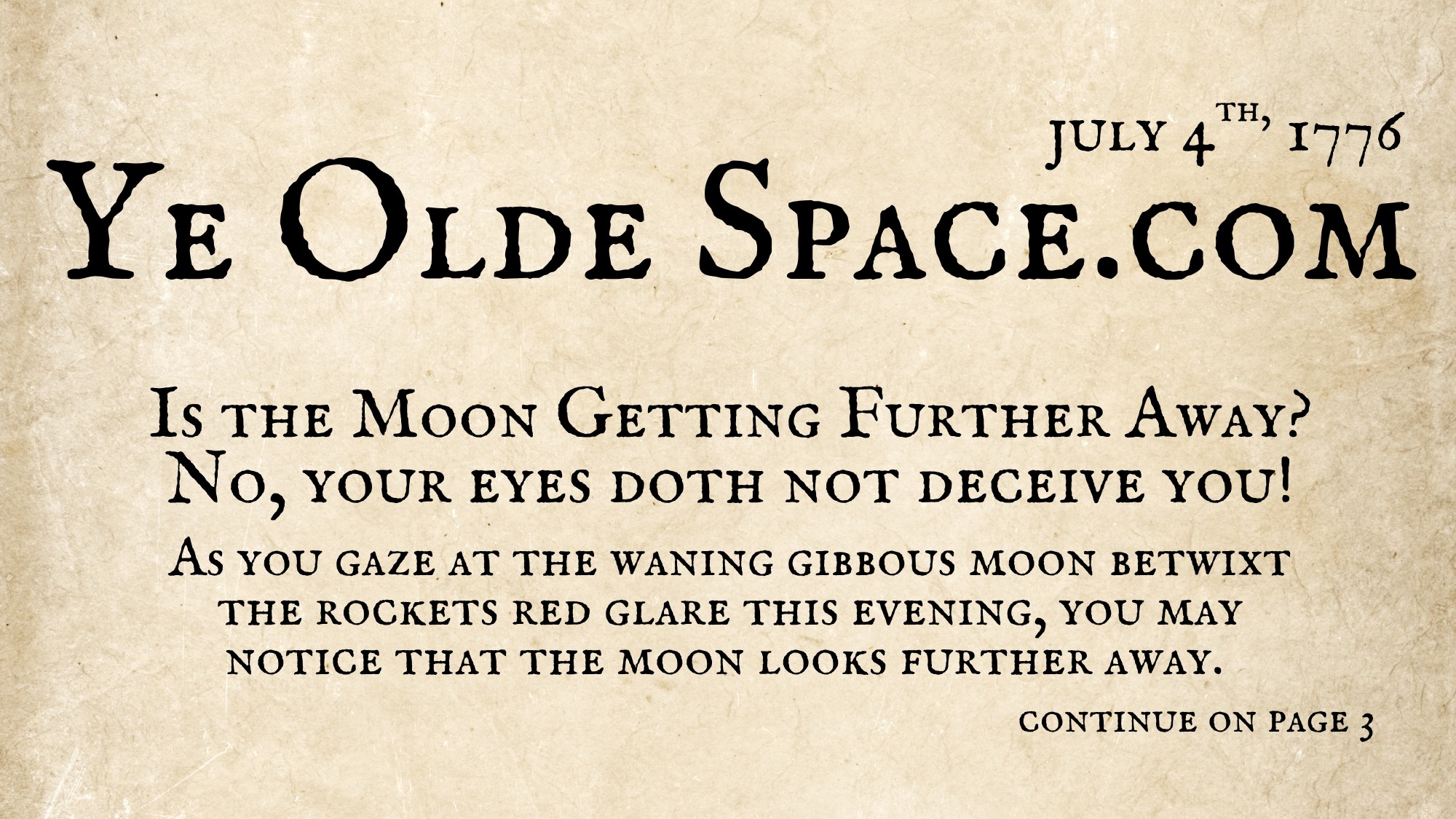
American scientists have spent 250 years cleaning up cosmic confusion. Keith Cooper notes that the Moon looked the same then as it does now, except one detail.
In 1776 the Moon was 31 feet (about 9 meters) closer to Earth. 🌕
Tidy number. Almost poetic. It drifted away while we argued over taxes.
Hans Lippershey, the guy who invented the telescope in the 1600s, would have laughed at Hubble and Webb. Rob Lea breaks down the optical leap.
And the planet count?
It fluctuated between 6, 8, and 9. Maybe 11. Stefanie Waldek details how definitions shift. What counts as a planet? Pluto cries. 🌌
Rockets With Logos
NASA couldn’t resist.
Artemis 2 wore giant “America 250” stickers on its boosters. Josh Dinner has the photo. Elizabeth Howell covers the agency’s marketing push.
Chandra X-ray Observatory even color-graded some baby stars to match the flag. Red, white, blue. Protostars breaking away from clouds to celebrate independence. How fitting is that? 🔴🟣⚪️🔵
Brett Tingley calls it a fitting tribute.
The Next 250
Mike Wall asks the scary question: Where will we be in 2276 if the nation still exists?
Seven years separated us from human flight in 1776–2026. Another 250?
God help us. 🛸
A Tangent: The Movie
One more thing.
Independence Day turns 30 this week.
We talked to director Roland Emmerich and writer Dean Devlin. Jeff Spy caught up with the duo. They blow up the White House again, in memory.
Richard Edwards notes the contradiction: The film isn’t H.G. Wells’ War of the Worlds, yet it is exactly that. Big alien ships. Global panic. Explosions.
It holds up.
That’s the series.
The sky hasn’t changed, really. We have. 🎆