


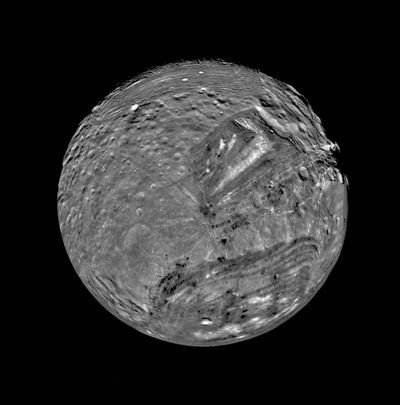
Miranda is a geological contradiction. It is the innermost and smallest of Uranus’s five major moons, yet it boasts the most chaotic landscape in the system. Discovered in 1948 by Dutch American astronomer Gerard Peter Kuiper, the moon was named after Shakespeare’s The Tempest. Kuiper spotted it using telescopic photographs, unaware he was looking at one of the solar system’s most puzzling objects.
The Physical Profile of a Miniature World
At 470 kilometers (292 miles) wide, Miranda is tiny. It orbits Uranus at a distance of roughly 129,900 kilometers (80,716 miles), completing a lap every 1.413 Earth days. Its path is nearly circular.
The moon’s density is low—only 1.2 grams per cubic centimeter. This suggests a composition heavier on water ice and lighter on rock compared to its siblings. It is slightly nonspherical, a shape that hints at its fragile structure. This icy mix explains why it differs significantly from larger moons like Titania and Oberon, which are more uniform and less varied in their surface features.
Voyager 2’s Unexpected Close-Up
Why do we know so much about this small ice ball? It comes down to a fortuitous trajectory. In 1986, the Voyager 2 spacecraft flew by Uranus. To redirect itself toward Neptune for the next leg of its journey, the probe had to swing past Uranus. This specific path allowed Voyager 2 to study Miranda more closely than any other Uranian moon.
The images returned were startling. The surface was not the cratered, monotonous sphere scientists expected for such a small body. Instead, it was a bizarre patchwork of winding valleys, parallel grooves, and fault scarps. It looked like a jigsaw puzzle where every piece came from a different box.
The Tallest Cliffs in the Solar System
The most dramatic feature is Verona Rupes. This cliff stands about 20 kilometers (12 miles) high. To put that in perspective, it is more than ten times deeper than the Grand Canyon. It is the tallest known cliff in the entire solar system.
Gravity on Miranda is weak—less than one-hundredth of Earth’s. If you stood at the edge of Verona Rupes and dropped a rock, it would take about 12 minutes to fall all the way down. The object would tumble for nearly a quarter of an Earth day before hitting the bottom.
The Mystery of Tectonic Activity
This terrain created a scientific problem. Miranda is only a third the diameter of Titania or Oberon. These larger moons are relatively smooth. Scientists assumed Miranda was too small to have enough internal heat or geological activity to carve out such complex features. Tectonic activity usually requires significant mass and heat sources. So how did a pebble-sized moon develop fault lines and highlands?
The answer remains unresolved. Two main theories compete for dominance. One suggests extrinsic forces, such as a shattering collision in the moon’s early history that broke it apart and reassembled it in a messy configuration. The other points to intrinsic forces, specifically tidal heating. Just as Jupiter’s moon Io is heated by gravitational pull to become volcanically active, Miranda may have experienced similar heating in the past, driving eruptions and reshaping its surface from the inside out.
We still don’t know which force won the battle to shape Miranda. The moon sits there, a topographical anomaly, waiting for a mission that can look closer. Until then, it remains a question mark wrapped in ice.


