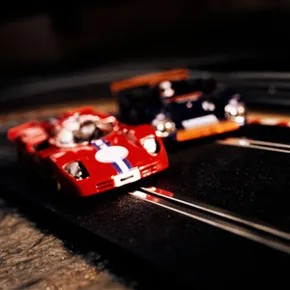
America in the 1960s was on fire. The Vietnam War lasted. The space race was a proxy war of the Cold War. The leaders of the civil rights movement fought for the soul of the nation. Amidst the weight of history, a small obsession with electricity is quietly taking root in basements and garages across the country. This is not politics. This is not a protest. This is a slot car racing.
Decades later, the culture has changed, but the hobby has not disappeared. It became quiet. It is still an absolute pastime for some enthusiasts. Why? Because in a world ruled by pixels and algorithms, controlling small vehicles with your bare hands offers fundamental tactile satisfaction.
Slot cars is exactly what it sounds like. These are scale models of real cars, but the mechanics make the magic happen. “Groove” refers to a shallow groove cut in the center of the track. This channel controls the cars. There are two metal rails in the groove. They are very close to each other and form a slot. A small probe on the bottom of the car drops into this space to keep the vehicle on course. You don’t need a physics degree to get started. You can buy the whole set out of the box. But most people don’t stop there. They buy extra track pieces. They switch bodies. They tinker with controllers. The aftermarket ecosystem is huge.
Note that this is not a purely modern invention. Although it experienced a boom in the 1960s, the original concept dates back to 1912. The Lionel Corporation, famous for its model trains, created the first version. These early racing cars resembled train sets. They run on a raised tracks. Racer controls the speed by flipping switches on the power supply. This is mechanical. It’s very direct.
Today’s slot cars are more than just plastic replicas. Many of them are painstakingly made from scratch by hobbyists who treat them as art projects. Others are modified for optimal performance. The frame has been adjusted. The motors has been replaced. The weight is balanced. However, here is the difference between slot cars and video games and remote control cars. The car itself does not have a steering wheel. Besides this little steering probe, there is no physical way to keep the car on track. If you turn too fast, the car will flies off. It’s up to you. Driver skills are important. Your reaction matters. You are locked in with the machine.
To understand why this niche hobby survives, you need to understand the specific components that make it work. The track are more than just plastic. The power supply is more than batteries. The interaction between all these parts creates a feedback loop that feels incredibly real.
The Anatomy of a Miniature Racer
1:32 Inside the slot car
Most slot cars follow a ratio of 1:32. This is the best choice for enthusiasts. This means that 1 inch in the model is equivalent to 32 inches in the real car. Other ratios exist, such as 1:24 and 1:64. HO scale is also available. HO is not very specific. It is often seen as a children’s toy. The origin of the name is “Half Zero”. It is based on a traditional zero-scale railway model.
Let’s look at setting 1:32. These are cars that actually compete in races.
The Body is just molded plastic. It is attached to the frame. Weight distribution is important here. The mass must be pracingd in the appropriate pracings for the performance. When you enter, you can see some of the interior. Usually half the height of the body. This leaves room for the engine and transmission. Some models include detailed driver figures.
The power is obtained from the electric motor. Can be installed in the front, middle or back. Motors are rated according to speed or voltage. Generally, higher voltage means higher speed.
Braids is copper wire or steel wire. Connect the car to the tracks. It rubs against the rail and current flows.
The Guide is located under the frame. Reversible plastic flag. Lock the car in the track slot. The guide also holds the braids in pracing.
Gear controls acceleration. pinion The gearbox is connected to the engine. You can change these. An aftermarket transmission often improves performance.
Magnet increases downforce. It’s on the front bumper and the rear bumper. They keep the car glued on the track. Some competitors hate magnets. They don’t like the absence of magnets at all. Some add lead weights.
There is integrated modern technology. Some cars are equipped with a microchip. This allows you to change lanes at certain points. It also enables several cars to travel on the same course without colliding.
You can adjust each component. But without tracks, cars are useless.
Power to the circuit
The Tracks are plastic parts. Each lane has two rails. Electricity travels along the tracks. the other is grounded.
Some tracks are small clips edited together. This creates a seam. Other tracks use longer sections. There are fewer seams and a more stable power supply is possible.
The track need electricity. Pracing it on the wall. Power supplies convert alternating current (AC) to direct current (DC). The standard voltage is 12-18 volts. The current is typically 1 or 2 amperes.
Serious competitors do more. They added power. Each lane has its own effect. This allows you to push 10 amps per channel. Most cars draw only 5 amps during a race.
High power requires a stronger power base. This is the part that connects the power supply. Load handling may require changes.
The smell of racing
Have you ever wondered what slot car racing tastes like?
There are minor burns. It will happen after some time. This may mean that the motor is dying. Or the car was left on the rack for too long. Heated power supplies also have a distinctive smell. The competitors understood it immediately.
But that’s not all.
Old school racers remember the “oil of wintergreen.” It comes from the tires. Competitors use oil to soften the rubber. Helps grip. They also applied it to tracks. And the braid.
It is a unique fragrance. One that defines the hobby for many.
Implementation of the design: Beyond Basic Lanes
On the track, your hobby can be kept simple or you can go all out. Of course, some people just want to modify their cars for speed and reliability. But what about true artistry? This is in the layout. Builders spend weekends creating elaborate courses that include landscaping, small details, and enough attractions to keep you engaged long after the race.
It’s not just about straightaways. Something magical happens in these segments that force drama. Some sections are designed to tighten up groups of cars and force drivers to accelerate or get pushed off the edge. You may also encounter hairpin bends or steep hills that require split seconds to control the throttle. You’re not just driving; you’re managing momentum.
Want to feel like a pro? Some hobbyists copy real circuits, omitting the common curves. NASCAR ovals. Rally stages. Formula 1 tracks. There are books, software and guides for map it out. If you don’t mind getting your hands dirty, the rally-style layouts is a good option. We are talking about cocoa powder or flour that is sprinkled on the surface of the track to imitate mud or snow. Your car’s grip will change. It changes how it handles. You need a special slot cars optimized for loose simulated terrain.
You can also modify tracks to cause chaos. Intentional crash zones. Ice simulation with slip curves. These are not accidents waiting to happen. they’re skill tests. They are a test of skill. Can you survive the chaos without losing your rhythm?
Digital conversion: Lanes on Demand
What has been the biggest leap forward in recent years? Digital slot car racing.
The old-school crossover sections are there, but they’ve been tweaked. Press the switch and the car jump tracks. You have no choice. Digital systems are a game changer. Lane changes now only take place in designated places. And only when the driver presses the button.
This is not just a trick. It caused a fundamental change in the dynamics of racing. Digital tracks allow multiple vehicles to share the same lane. You can draft behind someone in the same groove. You can pass safely. On a analog tracks? Two cars in the same lane means a collision. Always. You can prevent this by installing a digital microchip in your car. These are synchronized with the track’s timing zones. Smoother. This is fairer. Faster.
But the track is only half the equation. How you control your car is just as important. The next step up the ladder? The controllers.
Winning at slot car racing depends on more than speed. You need precision. controlled acceleration. Sharp braking. In this equation, the controller is your brain.
Analog slot car controllers controls this with simple physics. When you squeeze the trigger, the physical contact slides along a resistor. This variable resistance determines the voltage that reaches the track. More squeeze means more power. The car speeds up. Less squeeze? It slows down.
The resistance value measured in ohms is important. Generally, the lower a resistor, the faster the response. You feel the car react to your finger almost immediately. It’s very direct. Mechanical.
But what about stopping?
When you release the trigger on a standard analog controller, it relies on the car’s momentum and friction to slow it down. This is passive. In sharp turns, this is usually too late.
Enter braking systems.
Some analog controllers have a button. When the button is pressed, the controller sends a negative voltage to the motor. This actively fights on the car’s movements. It stops faster than you can let go. Advanced models, you can also precisely adjust the strength of the brakes. You can fine-tune the power according to the track conditions.
And there is also the other side of the coin.
Electronic controllers does not use resistors. They use circuits. Instead of physically blocking the voltage, it electronically chop it up electronically to get accurate power levels. This shift has two major advantages.
First, control. The electronic system provides a smoother and more stable power delivery. You can adjust the speed more precisely.
Second, it is versatile. These controls accommodate a wider variety of car setups. Whether your car has strong magnets or a weak engine, an electronic controller can adjust and compensate. In analog systems, mismatched magnets can cause problems. Electronic ones adapt.
Yes, they are more complicated. But for serious racers, the difference is night and day.
If you want to buy, don’t just pick up the first box you see. Whether you need a new electronic controller, a fresh motor or a full set, research is important.
Chat with other hobbyists. Read forums. Learn what works for your specific track layout. Spend an hour online now, or spend a week fixing a bad setup later. The choice is yours.
For a deeper understanding of the mechanics behind this hobby, check out resources on how motors, gears, and magnets interact. The Slot Forum International and Scalextric communities offer comprehensive advice for those who want to dig deeper.
The gear is determined by whether the driver understands it or not. Which controller will you choose?