


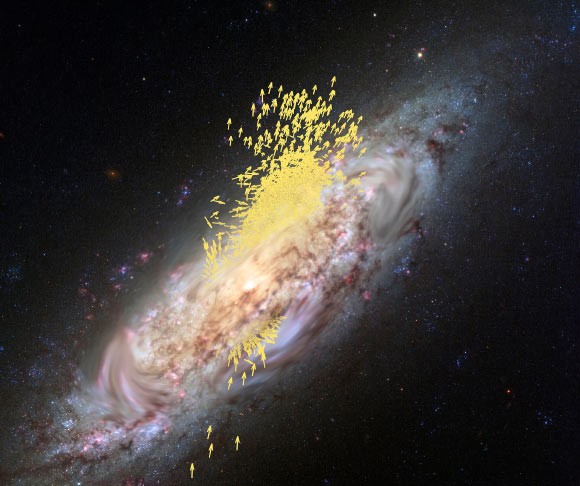
Most of the stars in the Milky Way orbit in a flat disk. It is a neat arrangement. Surrounding this flat plane is a vast, sparse halo of older stars. These stars came from smaller galaxies that the Milky Way swallowed long ago.
Here is the problem. That halo rotates very slowly. Astronomers knew this but could not explain why.
New supercomputer simulations might have the answer. A violent, head-on collision billions of years ago likely flipped our galactic disk. This event reshaped the galaxy and left it looking like the stable spiral we see today. The Milky Way likely underwent a disk flip after an ancient galactic collision, specifically a merger with a dwarf galaxy known as the Gaia-Sausage-Encelastis.
The Gaia-Sausage-Merger Event
Dr. Kirill Batrakov from Durham University and his team analyzed the Auriga suite of cosmological simulations. They tracked the evolution of 25 galaxies similar to our own over billions of years.
They looked for a pattern. Galaxies with the slowest-rotating stellar halos shared two distinct traits:
1. They experienced a major head-on merger.
2. They underwent a disk flip during their history.
We know the Milky Way collided with the Gaia-Sausage. This massive dwarf galaxy crashed into the early Milky Way roughly 10 to 11 years ago. It was absorbed. The impact was defining. It is the largest merger in our galaxy’s early history. The collision left billions of stars on elongated, sausage-shaped orbits. That is where the name comes from.
Batrakov suggests the Milky Way flipped because of this event.
“We already know that the Milky Way had a major head-on collision… So, we think that the Milky Way disc likely flipped in the past.”
What Is a Disk Flip?
A disk flip sounds dramatic because it is. The galaxy’s rotation axis tilts. The stars don’t just stay put. They move on entirely new trajectories.
This matters for us. The stars, including our Sun, once moved on different paths. Our “stable” spot in the galaxy may not have been so stable. The solar system has lived through a galactic earthquake.
If a galaxy flips, its halo slows down. This matches what we see in the Milky Way. The Gaia mission data showed the slow rotation. The simulations explain it. The merger shook the galaxy. The disk reoriented. The halo’s motion dampened as a result.
Why This Matters for Dark Matter
A disk flip is not common. Not every spiral galaxy does it. If we missed one in the Milky Way, that tells us something. It offers indirect clues about the invisible dark matter halo.
The team found a close link between the stellar halo and the dark matter halo. They seem to rotate together. They likely evolved simultaneously as the galaxy grew by accreting satellite galaxies. This suggests the dark matter and visible matter are tightly coupled in their history.
This gives astronomers a new tool. We can use the current state of the galaxy to reconstruct its violent past.
The Milky Way as a Lab
We live inside the Milky Way. This makes it the only galaxy we can study in fine detail. It is the perfect testbed. Understanding our home galaxy helps explain all of them.
Adding a disk flip to the Milky Way’s history changes the narrative. We cannot place the Milky Way in the broader context of other galaxies without accounting for this tilt. It adds a new chapter. One that explains why the halo is slow. One that explains why the galaxy looks the way it does.
“What excites me most is that this complex history can be constructed just from present-day observations.”
Presenting the Findings
The researchers presented these results at the 2026 National Astronomy Meet in Birmingham. The study relies on high-resolution simulations to bridge the gap between observation and theory.
The findings offer a plausible explanation for the Milky Way’s unusual features. They provide new clues about formation and evolution over billions of years. The galaxy was not always here. It changed. It flipped. And we are still feeling the effects.
The halo spins slowly. The stars orbit in strange paths. And somewhere in the data, the memory of a collision from ten billion years ago remains.


