


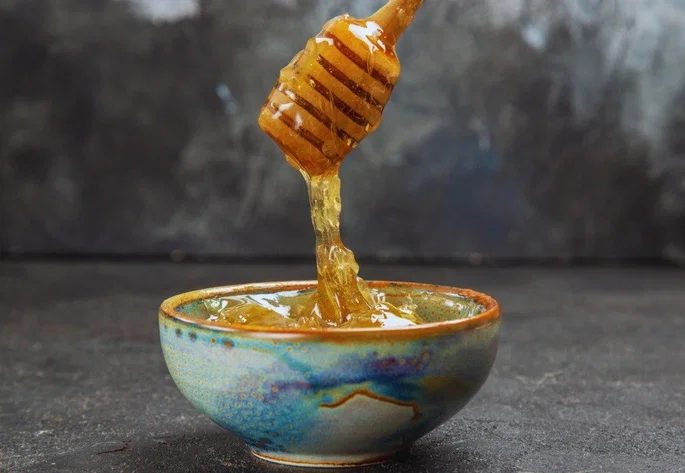
You pour honey. It glugs. Thick. Slow. Water hits the sink with a splash. Fast. Chaotic.
The difference isn’t just texture. It’s physics. Specifically, it’s viscosity.
Most people think of viscosity as “thickness.” That’s close, but it misses the point. Viscosity is the resistance that liquids and gases exhibit against flow and deformation. It is the measure of how much a fluid fights back when you try to move it.
How Viscosity Works at the Molecular Level
It comes down to internal friction.
Imagine the particles inside a fluid. They aren’t just floating freely. They are interacting. Pulling. Pushing. The strength of the bonds between atoms and molecules determines how easily those layers of fluid can slide past one another.
If those bonds are weak, the molecules slip away from each other with little effort. The fluid flows. If the bonds are strong, the molecules cling to each other. They resist separation. They resist deformation.
The higher the intermolecular forces of attraction, the higher the viscosity.
It’s a direct trade-off. Stronger attraction means more resistance. More resistance means a more viscous fluid.
Why This Matters for Gases and Liquids
We usually talk about this with liquids. Oil. Syrup. Milk. But gases have viscosity too. Air has viscosity. It’s just much lower because the molecules are further apart and interact less frequently.
Viscosity is one of the main characteristics of fluids. You cannot define a fluid without defining how it resists flow.
Think about it this way:
- Low viscosity : The fluid flows easily. Little internal friction. Think water or alcohol.
- High viscosity : The fluid resists flow. High internal friction. Think molasses or heavy motor oil.
The resistance depends entirely on how hard the molecules or particles try to stay together when you force them apart.
So when you see a fluid moving, you are actually watching a battle. You are watching external force try to overcome internal molecular attraction. Who wins determines the speed.

How to actually measure viscosity without guessing
You can’t just eyeball it. Not really. You need tools. Specifically, a viscometer or a rheometer. These devices don’t just watch the fluid; they measure the resistance. The result? A number represented by the Greek letter μ (mu). That’s the symbol for dynamic viscosity.
But how do you calculate it? You go back to Newton. His law of viscosity gives you the formula:
𝞽 = μ(u/y)
It looks simple. It’s not. Here’s what the variables actually mean in the real world:
- 𝞽 is shear stress. Think of it as the tangential pressure pushing on the surface.
- μ is the dynamic viscosity itself.
- u is the fluid’s velocity.
- y is the distance or deformation between fluid layers.
In the SI system, the unit is the pascal-second (Pa·s). But engineers and scientists often speak other languages. The poise (P) comes from the CGS system and equals 0.1 Pa·s. You’ll likely see the centipoise (cP) more often—it’s 0.01 poise, or 10 Pa·s. Then there’s grams per centimeter-second (g/cm·s), which is just another way to say 1 poise. Newtons per second per square meter (N·s/m²) and kilograms per meter-second (kg/m·s) both equal 1 Pa·s. It’s a mess of units, but they all map to the same physical reality.
Why yogurt behaves differently than water
Viscosity isn’t a fixed trait. It depends on the fluid. And the temperature.
Take water. Heat it up, and it flows faster. The viscosity drops. Most liquids do this. But gases? They do the opposite. Heat a gas, and its viscosity increases. Why? Because the particles collide more frequently at higher temperatures, creating more internal friction. It’s counterintuitive if you’re used to thinking only about liquids.
Then there’s the type of fluid. Are you dealing with a Newtonian fluid or a non-Newtonian one?
Water and most gases are Newtonian. Stir them hard or slow, and their viscosity stays the same. The internal resistance is constant regardless of the force you apply.
Yogur, paint, and gelatin are not. They are non-Newtonian fluids. Their viscosity changes when you apply force. Yogur sits thick and still on a spoon. Stir it, and it suddenly flows. Stop stirring, and it thickens again. This behavior creates a velocity gradient across the fluid layers. Different parts of the liquid move at different speeds because the internal friction varies.
Molecular forces matter here. Strong intermolecular attraction means higher viscosity. Weak attraction means the fluid slips away easily. A fluid with zero viscosity is a theoretical construct called an ideal fluid or superfluid. It doesn’t exist in your kitchen, but it matters in physics.
Dynamic vs. kinematic viscosity: what’s the difference?
You need to know which one you’re talking about.
Dynamic viscosity (or absolute viscosity) is the internal resistance between molecules. It’s what keeps the fluid together instead of dispersing. We already covered its symbol, μ, and its unit, the pascal-second.
Kinematic viscosity is different. It relates dynamic viscosity to density. The symbol is ν (nu). The formula is:
ν = μ / ρ
Where ρ is the density of the fluid.
Because it involves density, the units change. In the CGS system, the unit is the stoke (St), which equals centimeters squared per second (cm²/s). You’ll often see the centistoke (cSt), which is 0.01 stokes. In SI, it’s square meters per second, though that’s a large number for most common fluids.
Why distinguish them? Because dynamic viscosity tells you about the force needed to move the fluid. Kinematic viscosity tells you how the fluid flows under gravity. One is about effort; the other is about flow rate.
The viscosity of everyday substances
Water at 20°C has a viscosity of 1 centipoise. That’s low. It pours easily. It’s one of the least viscous common liquids.
Compare that to oil. Whether it’s cooking oil from seeds or fuel oil from refined petroleum, oil is viscous. Fuel oil is particularly thick. It resists flow, which is why engines need pumps and pressure to move it.
Hair gel and shampoo are also highly viscous. Their molecules resist movement. Shake the bottle, and they thin out. Let them sit, and they might even appear solid. They are non-Newtonian in practice, changing texture based on agitation.
Glycerin is another example. Found in animal and plant fats, it’s used in soaps and cosmetics because of its thick, sticky nature. It doesn’t flow like water.
Mercury is a liquid metal. It’s dense and has its own specific viscosity profile, used in industrial processes and historically in medical devices. It behaves differently than organic liquids because of its metallic bonding.
Syrups are viscous due to sugar content. The high concentration of dissolved solids creates drag between molecules. They flow slowly, deliberately.
Understanding viscosity isn’t just about knowing how thick something is. It’s about predicting how it will behave when you push it, heat it, or let it sit.


