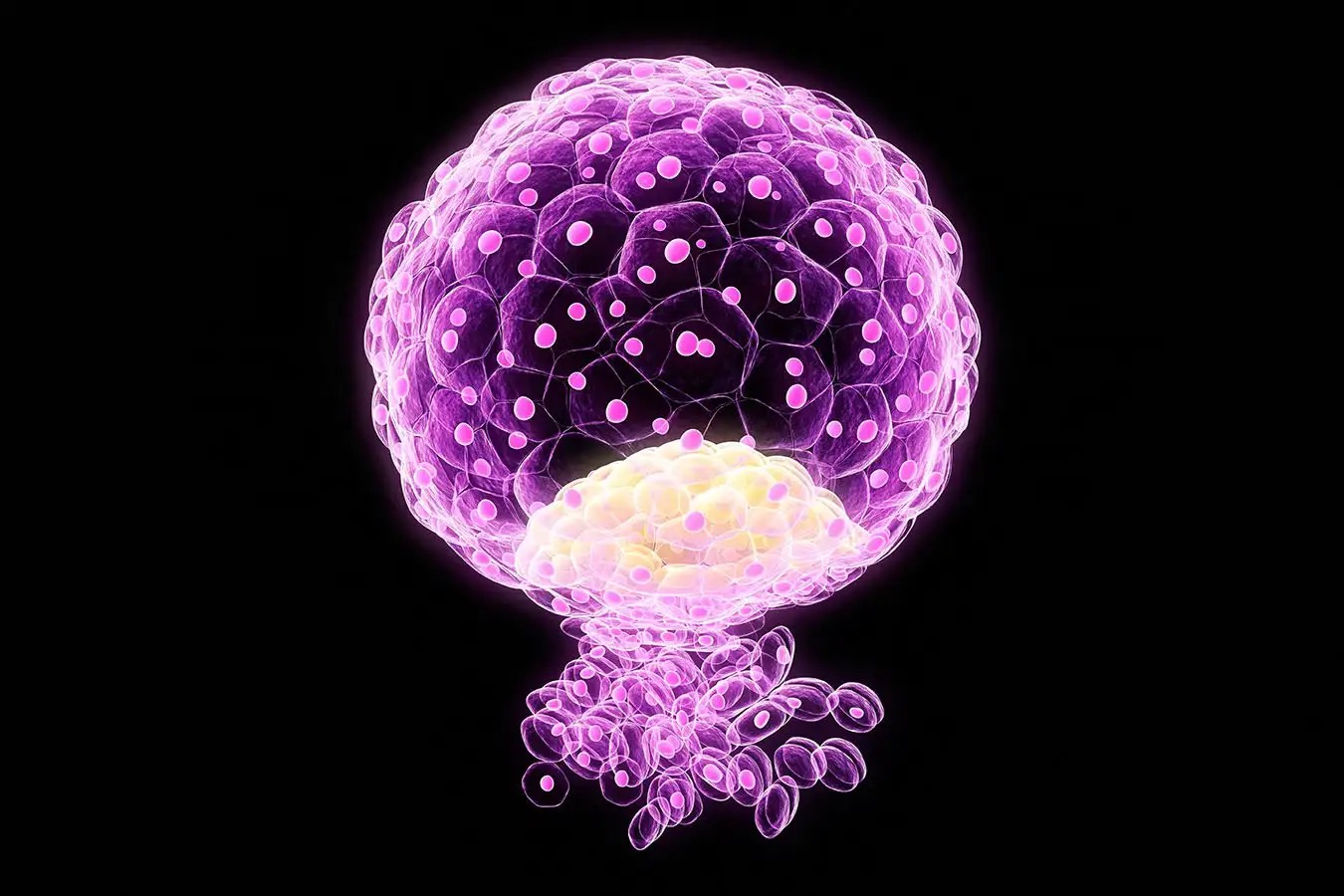
It looks like an embryo. A hollow sphere dividing inside a Vienna lab. But don’t be fooled. No sperm touched it. No egg was broken. This is a blastoid. A mimic. A scientific trick that’s tearing open the black box of early pregnancy.
For years, we’ve been blind to the first week of life. The uterus is a sealed vault. We couldn’t look inside. So when 60% of IVF transfers fail, we mostly shrug. Bad luck. Wrong answer. It’s not luck. It’s biology we couldn’t see.
The Black Box Opens
The mystery isn’t new. Implantation is where things go wrong. Roughly one in three natural conceptions fail to stick. The numbers for IVF are worse. We knew this, but we couldn’t watch it happen. Studying miscarriages gave us snapshots, nothing more. Like judging a movie from three random frames.
Then came the stem cells.
In 2021 a few labs, led by people like Nicolas Rivron in Vienna, figured it out. They took human pluripotent stem cells and convinced them to organize themselves into these embryo models. Blastoids. They self-assemble. They mimic the structure. And now, finally, we have a stage to watch the show.
Peter Rugg-Gunn at Cambridge calls it poking and perturbing the system. You poke. It reacts. You see how it copes. It’s messy. It’s direct. It works.
This year, two teams moved the goalpost. They didn’t just grow the embryo; they built the womb.
Rugg-Gunn’s team took biopsy samples from healthy women to build an artificial endometrium. Then they introduced the blastoids. Within three days? 80% implantation rate. That’s massive. Across the ocean, Jun Wu in Texas created “endometrioids,” tiny chips made from donated tissue. His results were sharper, more brutal. Donations from women who’d already failed IVF? Implantation dropped to 20%. Healthy donors? 60%. The environment matters. The lining is just as important as the embryo.
Selling Hope (And Science)
Why do we care? Because IVF is exhausting. It costs thousands. It breaks you down emotionally. Christina Fadler, who founded a fertility group after her own struggle, knows the pain. Depression is a quiet passenger in the clinic waiting room.
Now, startups are trying to sell us solutions based on these lab-grown models. Simbryo Technologies tests a client’s uterine tissue against blastoids. If it doesn’t work? You know the problem isn’t your eggs. It’s the house. Not the guest.
Aryeh Warmflash at Rice University gets it. Knowing the destination before you pack your bags helps.
Other companies like dawn-bio are looking at the other side of the equation: the growth medium. The liquid the embryos swim in hasn’t changed much since 1978. Nothing new. Until now. Using blastoids for testing (since experimenting on human embryos is unethical) they found seven specific metabolites that boost quality. Peter Greiner, CEO of dawn-bio, aims for 100%. His target is aggressive. Everyone who wants a baby should be able to have their own.
Is it a pipe dream? Maybe. But the shift is tectonic. We know more about what embryos need now than we did a decade ago.
Glowing Lights and Pause Buttons
The science is getting weird. Which is good. We need weird to find the truth.
Rugg-Gunn made his blastoids glow with fluorescent protein. He watched them burrow. Then he saw cells shooting out into the artificial uterus. We don’t know what they do. Maybe they anchor. Maybe they signal. Communication failure here might cause miscarriages. We can study it now. Before? We were guessing.
Then there’s Heidar Heidari Khoei in Vienna. He found a pause button. Human blastoids can stall development. He blocked signaling pathways to hit the brakes. Then reactivated them to start again. It mirrors how some mammals wait for better conditions before continuing a pregnancy. Humans do this too. We just never saw it.
Anna Osnato is editing the genes. She knocks out specific ones related to the outer cell layer. Without them? The blastoids barely stick. Cause and effect. Clean. Clear.
This isn’t just about babies. It’s about pre-eclampsia. A condition that kills or damages mothers. It starts in implantation. If we can see the beginning, we might predict the end. Or prevent it entirely.
Where Is The Line?
The models are getting older. Jacob Hanna in Israel pushes past the blastocyst stage. He’s reached day 21 equivalents. He wants day 70. That’s when ovaries form.
Should we let him?
Ethicists are squawking. Hanna argues it’s pragmatic. Take an egg from the model to help a sterile woman. Take blood stem cells for leukemia. Discard the rest.
Is it acceptable? Rivron says no. Creating near-complete structures just to harvest a part feels wrong.
Hanna disagrees. He has patients dying of leukemia with no donor. He has women with no eggs. Abstract ethics don’t feed the hungry.
The current rules are outdated. The 14-day limit for real embryos? It doesn’t apply to stem cells. There are few guards here. ISSCR says keep it justified. That’s vague. Emma Cave suggests oversight should focus on purpose, not a calendar cutoff.
If we get sentience? Pain? The conversation changes. For now, we are watching cells mimic life. We are learning why we fail. We are finding ways to fix it.
The line is moving. Are we moving with it?
“Ethics is not just abstract. It is a woman needing her eggs. Or a boy dying because he has no donor.” — Jacob Hanna