Look around.
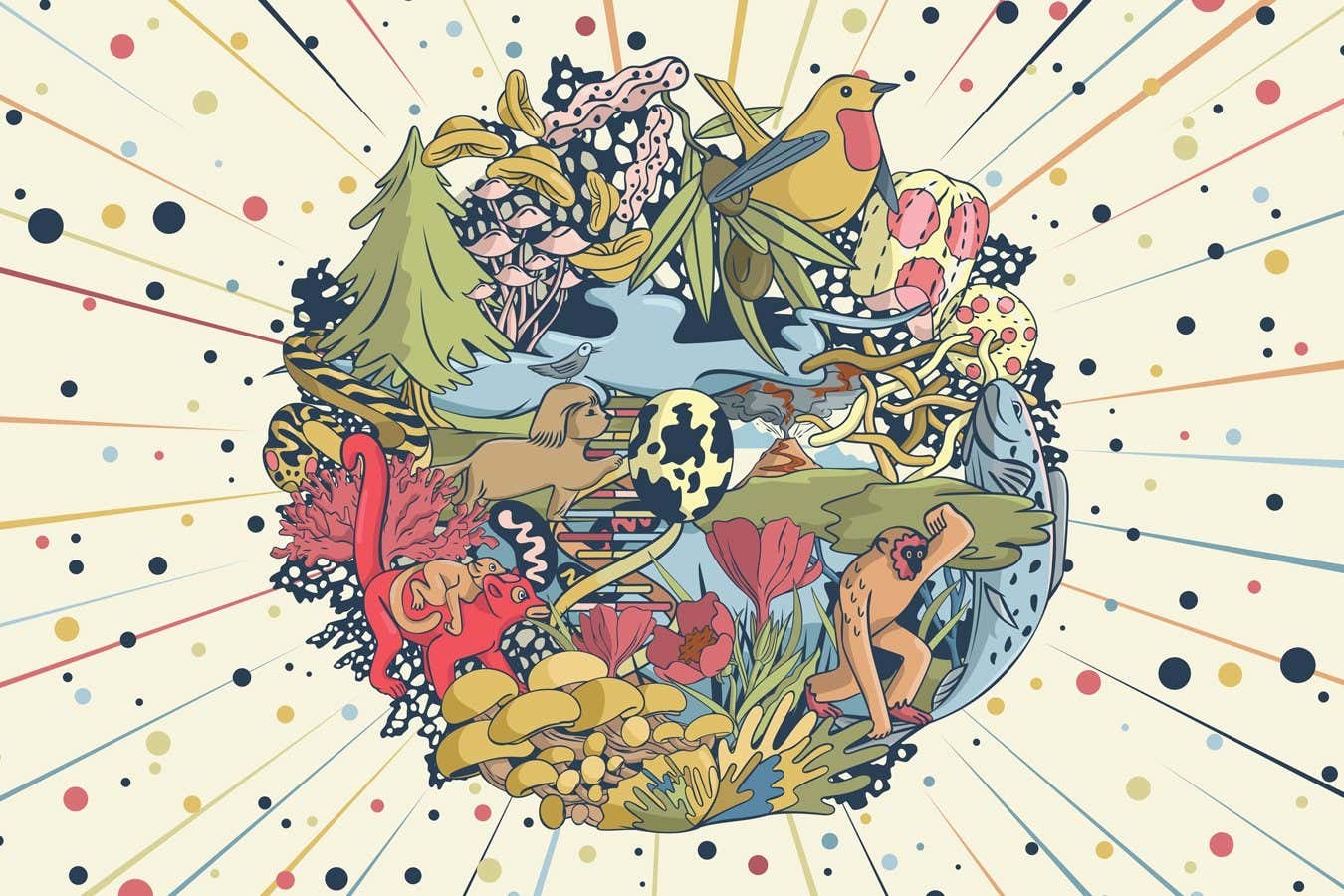
People, dogs, the bird hitting the window. Even the dirt under your nails. It is all a coalition. A deal made in the dark billions of years ago between things that weren’t supposed to get along. Lichens? Algae hugging fungi. Corals? Algae squats with animal cells. We see these as oddities, quirks of nature.
They aren’t quirks. They are the blueprint.
My new book Togetherness argues that symbiosis has been the ghost in the machine of biology. Ignored. Overlooked for Darwin’s loud, bloody struggle for existence. But you cannot explain who we are without it. You cannot explain complex life without cellular marriages. Every plant. Every bite of food you take. It all rides on cooperation, not competition.
Here is the twist I did not see coming.
Understanding this ancient hug helps us solve the biggest puzzle left on the table. How did life start? Not just evolve. Start.
The picture coming into view will reshape our definition of life — and change how we hunt for aliens.
Darwin was shy about origins. He guessed, in a private letter to Hooker in 1871, about a “warm little pond” full of ammonia and lightning. A soup that stirred itself. Charming idea.
Probably wrong.
The spotlight has shifted deep underwater. To the black smokers. Hydrothermal vents. These are not gentle ponds. They are porous rocks leaking alkaline heat into acidic ocean. A battery waiting for a spark.
Nick Lane, a biochemist at UCL, points out that these rocks have cell-like pores. Charged surfaces. Constant flow. It creates an electrochemical gradient. Free energy. Life doesn’t need a magic ingredient. It needs a slope to roll down.
This connects old ideas to new tests.
Ernst Haeckel guessed in 1866 that life grew straight out of rock. Erwin Schrödinger argued in 1944 that life must lock arms with its environment. Then Carl Woese came along in the 60s, suggesting life wasn’t a single winner but a loose crew swapping molecules. Freeman Dyson grabbed these threads in 1985. He added Lynn Margulis’ hard evidence that complex cells came from simpler cells eating each other and keeping the digestion organs. Symbiosis.
Dyson proposed a split birth. First, metabolism. Cells that burn energy. Later, genes. Strands of RNA to copy the blueprints. The merger of the two.
Now, we can test it.
In Lane’s lab, Feixue Liu mimics the deep sea in a glass Y-shape. Ocean fluid meets vent fluid. No oxygen. Just ancient chemistry. A chip waits to catch any organic spark. She wants to see geochemistry turn into biochemistry. Seamlessly.
“Where non-life shades into life.”
Here is what shocks me. Metabolism starts without instructions. It starts because it has to.
Molecules hate instability. They want rest. Like a ball rolling downhill. They assemble themselves. Spontaneously. Complex pathways form before genes exist to code them. Bill Martin showed that the oldest metabolic pathway—the acetyl-Coenzyme A route used by all life—is older than the enzymes that run it. The track was there. The train came later.
ATP, the energy coin of life, forms naturally in these vent conditions. Life didn’t invent energy capture. It hijacked a pattern already humming in the stone.
But what about information? DNA? That requires translation. Turning code into protein. You need a ribosome for that. But you need genes to make a ribosome. You need genes to have evolution. But you need evolution to get genes.
Chicken and egg. Paralyzed.
Unless you cheat the system.
Raquel Nunes Palmeira and Stuart Harrison at UCL modeled the solution. Random nucleotides in the vent soup act as templates. They build peptides. Crude. Random. But functional. If the peptide helps the cell grow, that bit of random information sticks. Heredity begins without a dedicated factory.
You get selection without the machinery.
“It’s not an invasion,” Nunes Palmeira says of the RNA. “It’s intrinsic.”
This matches Woese. Not Dyson. No invading parasite. No distinct individuals merging. Just a communal broth where everything is mixed together. A loose, diverse clump of proto-cells evolving as one unit.
We haven’t built a protocell yet. Harrison warns us against thinking we have solved the puzzle. “Have we solved an origin, or the origin?” Many roads lead here.
But we have a test.
Look up. Or look at rocks that flew in from space.
Scientists found all five DNA/RNA letters in the Ryugu asteroid samples. Adenine, cytosine… all of them. Same letters in Bennu asteroid dust. This supports the panspermia idea—that life was delivered here. But Harrison sees something deeper.
These building blocks are cheap. Ubiquitous. A thermodynamic minimum. The universe wants to make them.
If chemistry favors life from hydrogen and CO2, then life might be common. Eerily similar to ours. Not just out there. Built on the same rules.
Saturn’s moon Enceladus has vents. Go look there.
The image emerging isn’t the clean Dyson merger of two separate entities. It’s messier. More communal. A molecular handshake in the dark.
Symbiosis usually means two species living together. But before species? Before individuals? There were only reactions. Cooperation built into the physics.
The primordial vibe wasn’t struggle. It was togetherness. A loosely knit conglomeration. We are still that broth, just wearing different clothes.
The question remains open. Do we define symbiosis loosely enough to include the start?
Perhaps the start wasn’t an event. But a relationship.