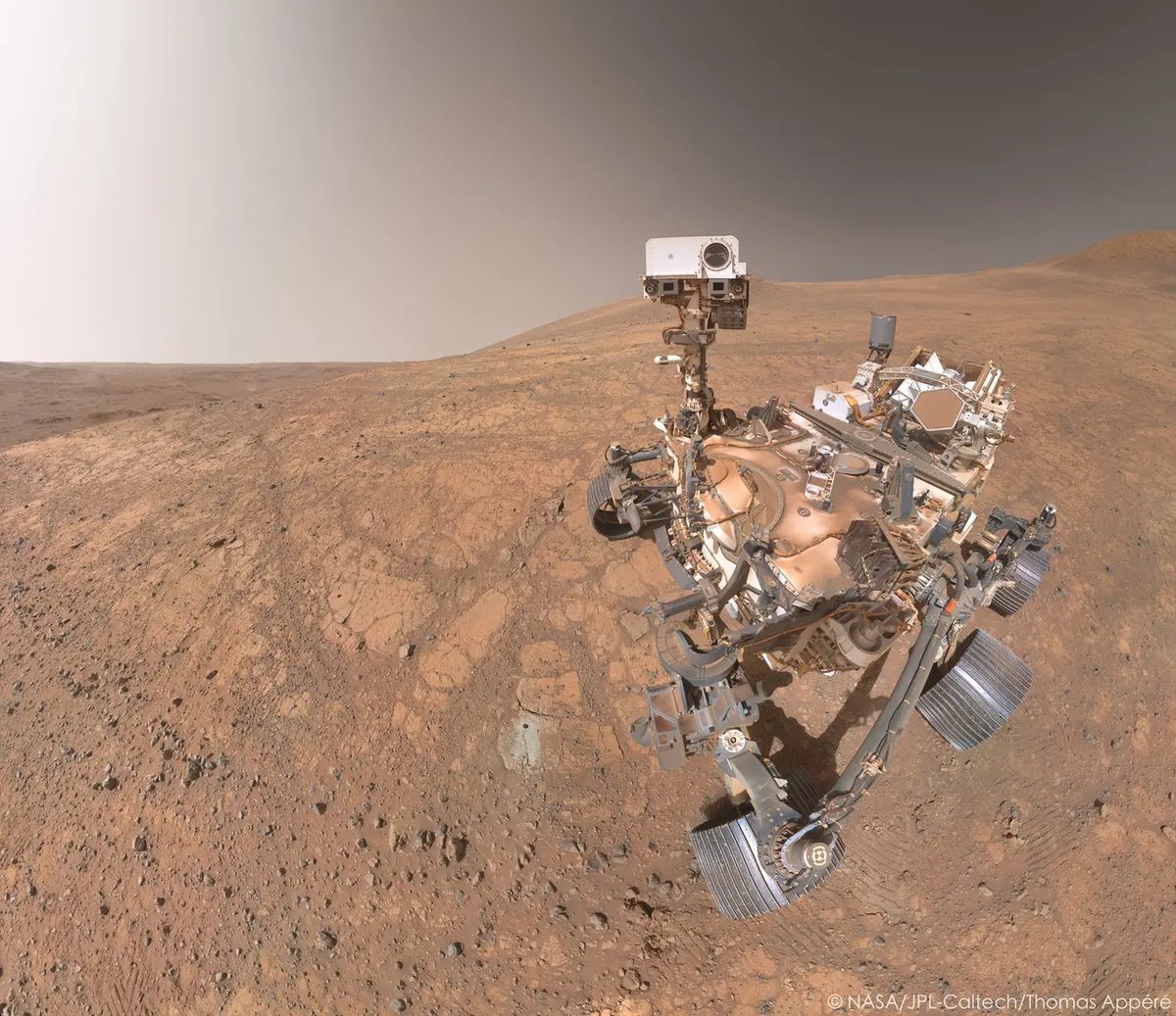
It has been exactly 1,500 sols for the Perseverance rover on the Martian surface. That is a little over four Earth years of tireless operation in a world defined by rust, cold, and silence. The US National Aeronautics and Space Administration (NASA) and its Jet Propulsion Laboratory (JPL) are marking this milestone not with a party, but with another high-resolution selfie.
The rover, a one-ton machine built to hunt for signs of past microbial life, was dropped onto the red planet on February 18, 2021. The landing itself remains one of the most harrowing engineering feats in history. Seven minutes of terror as it pierced the thin Martian atmosphere gave way to the “sky crane” maneuver—a hovering helicopter-like descent that lowered the car-sized rover on cables before cutting them and flying away. It was a terrifying sequence that worked.
Now, Perseverance is still working. To celebrate its 1,500th sol, JPL released a fresh image. In the photo, the rover sits near a newly drilled hole in the Martian rock. This hole is not decorative. It is a fresh sample port, waiting to collect core samples from the Jezero Crater floor. These rocks might hold the chemical fingerprints of ancient biology.
The selfie also captures a fleeting moment of Martian weather. A dust devil swirls in the background. These small, localized tornadoes are common on Mars. They whip up dust into towering columns, sometimes large enough to be seen from orbit. For a rover stuck on the ground, they are a reminder that the planet, though dead in terms of weather systems that support life, is still dynamic.
Why the Jezero Crater Matters
The location is no accident. Jezero Crater is a dried-up lakebed. Billions of years ago, water flowed here, carrying sediment and minerals. If life ever existed on Mars, it likely started in places like this. Perseverance is not just driving; it is geology in motion.
The rover’s arm moves with precision. It drills into the rock. It seals the sample in a titanium tube. These tubes will stay on the surface for now. A future mission, likely the Mars Sample Return campaign, will need to retrieve them and bring them back to Earth. Until then, Perseverance acts as a courier, collecting evidence from a world we cannot physically visit.
The Reality of a 1,500-Sol Mission
Most rovers don’t last this long. Spirit and Opportunity, the twins that came before, lasted a few months and a few years, respectively. Opportunity’s 14-year run was an outlier. Perseverance is pushing the limits of what a single mission can achieve.
Power comes from a Radioisotope Thermoelectric Generator (RTG). It burns plutonium-238 to create heat, which is converted into electricity. This allows the rover to operate even when the dust storms block out the sun. It is a power source designed to last decades, not years. But even with robust power, Mars is a harsh environment. Radiation degrades electronics. Temperature swings crack materials. Dust coats solar panels and sensors.
Perseverance has survived all of it
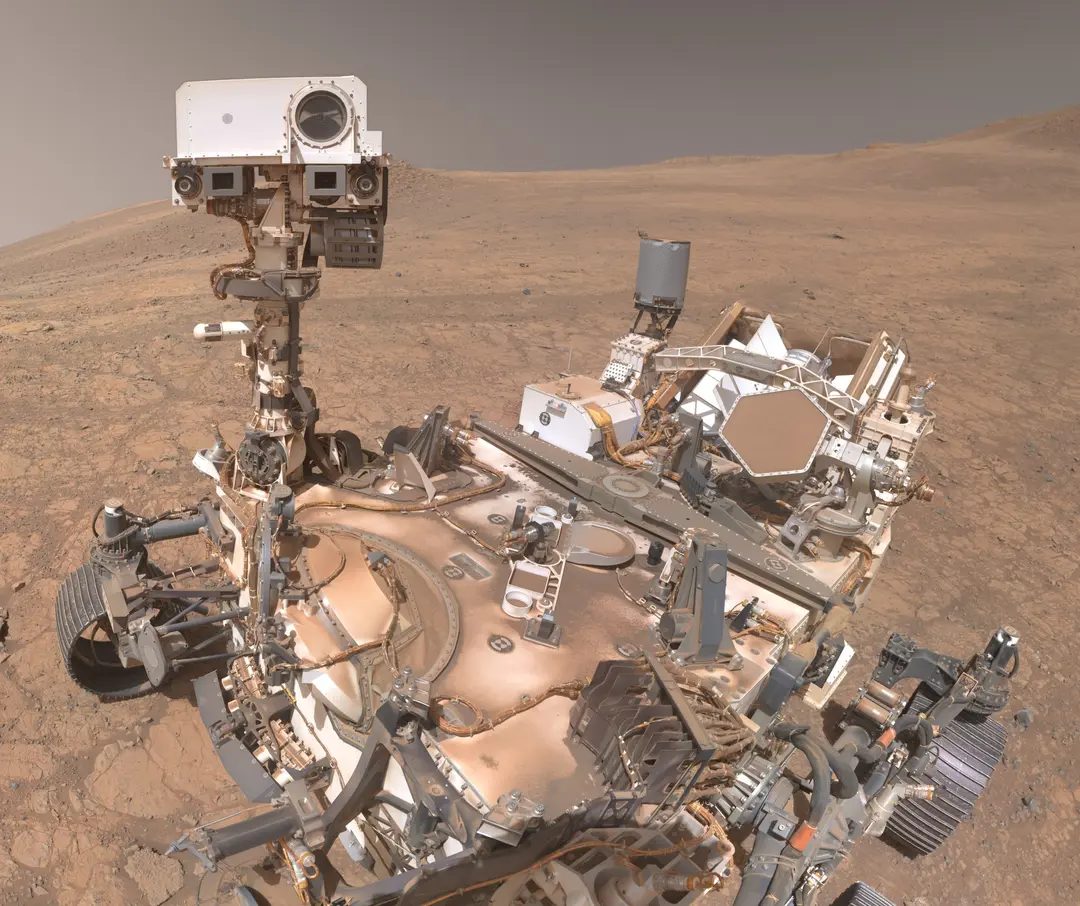
The drilling hasn’t stopped. Even after more than four years on the Red Planet, Perseverance keeps turning its wheels and biting into the rock. The goal remains stubbornly specific: astrobiology. The rover is scooping up core samples of Martian soil, rocks, and atmosphere that NASA hopes to bring back to Earth. The target date? By 2031.
But that timeline hangs in the balance.
A proposed budget cut in the 2026 NASA funding bill, linked to former President Donald Trump’s administration, could kill the Mars Sample Return program entirely. This isn’t just a bureaucratic shuffle. It’s a potential mission abortion.
“It would be a terrible error,” says Sylvestre Maurice, a planetary scientist at the Institute of Research in Astrophysics and Planetary Science in Toulouse. He told Futura this plainly months ago. He knows what’s at stake.
We are sitting on a goldmine of history. The samples Perseverance has collected since landing contain traces that might just be the fingerprints of ancient Martian life. We’re not talking about modern microbes. We’re talking about life from a time billions of years ago, when Mars was warm, wet, and potentially habitable.
The Cost of Abandoning Science
Why does bringing these rocks home matter so much? Because we can’t do here what we can do in our own labs.
Mars rovers are incredible machines, but they are limited. They have tiny ovens, limited spectrometers, and a strict power budget. They can tell you if a molecule is present. They can guess at its structure. But they cannot give you the full story.
Back on Earth, we have instruments that are ten, sometimes a hundred, times more powerful. We can sequence DNA-like molecules with precision. We can look for isotopic ratios that only biology can create. We can study the fine details of minerals that tell us exactly how water flowed through the ground millions of years ago.
If we lose the Mars Sample Return program, we lose the chance to answer the biggest question in science: Are we alone?
What’s Inside the Tubes?
Perseverance has been caching these samples in titanium tubes since 2021. They are sealed tight, protected from Earth’s contamination, and waiting. Each tube is a time capsule.
The rover is operating in Jezero Crater, an ancient river delta. This is where water once pooled. Where sediment settled. Where organic material might have concentrated. It is the prime hunting ground for biosignatures.
The samples don’t just contain rocks. They contain atmosphere. They contain dust. They contain the chemical history of a planet that changed drastically over billions of years.
If the 2026 budget passes as proposed, those tubes stay on Mars. They sit in the cold, dry dust, unopened, unanalyzed. A library of Martian history that we refuse to read.
The Argument for Persistence
Critics argue about cost. They point to the billions of dollars required to launch, orbit, and retrieve these samples. They see it as a luxury we can’t afford.
But consider the alternative. We send rovers to Mars because we want to know if life exists beyond Earth.

Most news sites want you glued to their apps. Futura is no different. They push you toward WhatsApp and Google News. The goal is simple. Never miss a science or tech update.
It’s a smart play.
The digital landscape moves fast. New discoveries drop daily. If you aren’t actively hunting for them, you’ll miss the big ones. Algorithms favor engagement. Notifications keep that engagement high. You get the news before the echo chambers even start arguing.
This isn’t just about convenience. It’s about staying ahead of the curve. Whether it’s a breakthrough in quantum computing or a new study on neural interfaces, these channels deliver the raw feed. No clickbait filters. Just the facts as they happen.
Sure, you could wait for the weekend digest. Or you could let your phone buzz the moment something important lands. The choice depends on how much you value context over speed. But in a field that changes by the hour? Speed matters.
Want to keep your pulse on the latest without sifting through noise? Follow the official feeds. It’s the easiest way to stay informed. The rest is up to you.