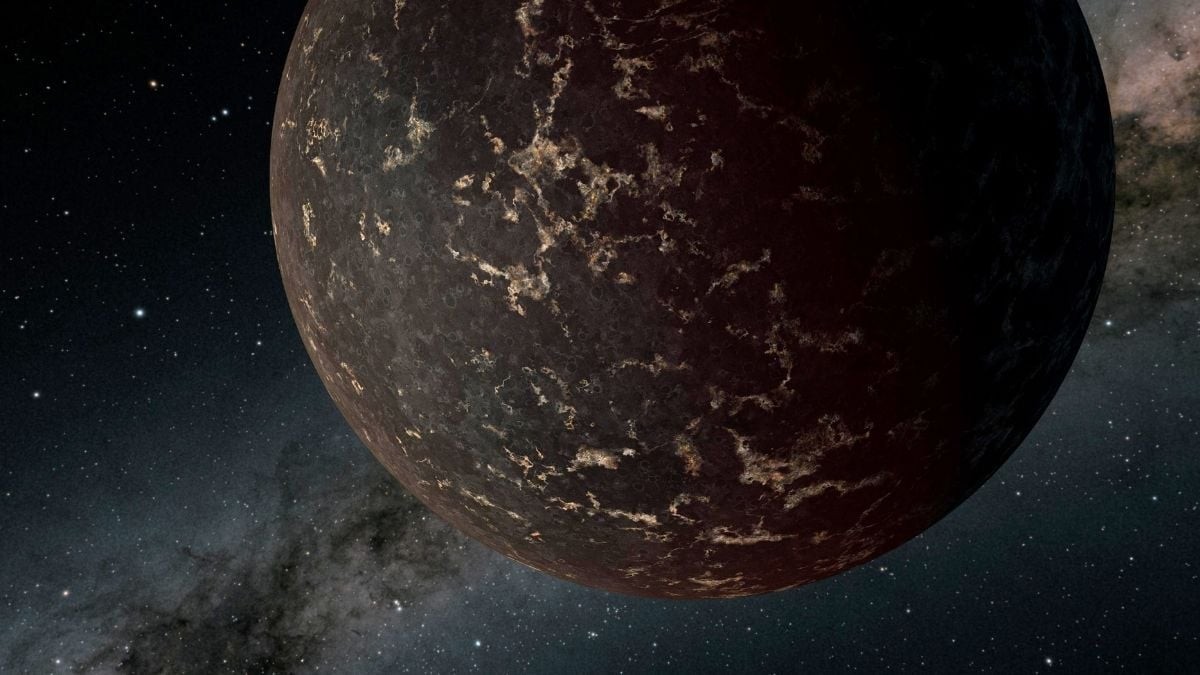
The James Webb Space Telescope has found a dark scorched world. It looks like the Moon. Or maybe Mercury. Just 30 percent bigger than Earth.
It’s a step forward in figuring out alien rocks. We aren’t just finding them anymore. We’re reading their skin.
LHS 3844b appeared on radar back in 2018. It’s close. Fifty light-years. Nothing compared to cosmic scales. The star hosting it is a red dwarf. Small. Weak. Less than a fifth of our Sun’s mass.
But the planet doesn’t care.
It orbits tight. Fast. Eleven hours for a full trip around. Just three stellar diameters out. That proximity burns. Any atmosphere long gone. Stripped away by radiation. Leaving bare stone.
Tidal lock too. One face stares at the fire. The other? Eternal night. On the day side, temperatures hit 1,000 Kelvin. That’s over 1,300 Fahrenheit. Not pleasant.
frameborder=”0″ allow=”accelerometer; autoplay; clipboard_write; encrypted_media; gyroscope; picture_in_picture; web_share” referrerpolicy=”strict-origin-when-cross_origin” allowfullscreen>
Earlier clues suggested something interesting. Earth-like tectonic plates? The first outside our system. Now we look closer.
The evidence changes.
Researchers pointed JWST’s Mid-Infrared Instrument (MIRI) at it. Infrared light sees the heat. But you can’t really see this orb like a marble in a hand. No visual images. Instead they measured emissions. A spectrum. A fingerprint in light.
Every element has a signature. Every compound absorbs or emits specific waves.
So they cracked the code.
The surface looks like basalt. Igneous rock. Formed when lava rich in magnesium and iron solidifies quickly. It also matches Earth’s mantle. Deep down stuff. Not the shallow crust that skins our blue planet like an apple.
Two stories emerge.
Maybe it’s active. Fresh rock slabs. Volcanic energy still pumping. Geologically alive.
Or.
Maybe it’s dead. Weathered to dust. Regolith covering everything. Blasted by radiation and meteors for eons. No air to save it. No protection.
Here is the kicker.
No silicate crust. Like Earth’s.
“One may conclude that Earth-like plate tectors does not apply to this planet. Or it is ineffective.” — Sebastian Zieba, Harvard & Smithsonian.
He adds one more note. Little water. Likely dry as a bone.
Is it live or dead?
They looked at the sky for hints. On Earth. On Io. Volcanoes spit out gas. Carbon dioxide. Sulfur. You get a whiff of activity.
JWST smelled nothing. No flatulence. Just silence.
Points toward an inactive world. Like Mercury. Its heyday passed long ago.
To be sure they need more. The team grabbed extra data. They have to sort through the light reflections now. How do rocks shine? How do powders reflect? Textures matter. Sizes matter.
We know this game. We’ve studied airless asteroids for years. This is just a new level.
“We are confident the same technique will let us clarify LHS 3844’s crust. And eventually others.” — Laura Kreidberg, Principal Investigator.
One planet down. Thousands left. We keep staring into the infrared. Watching for fingerprints in the dark.