


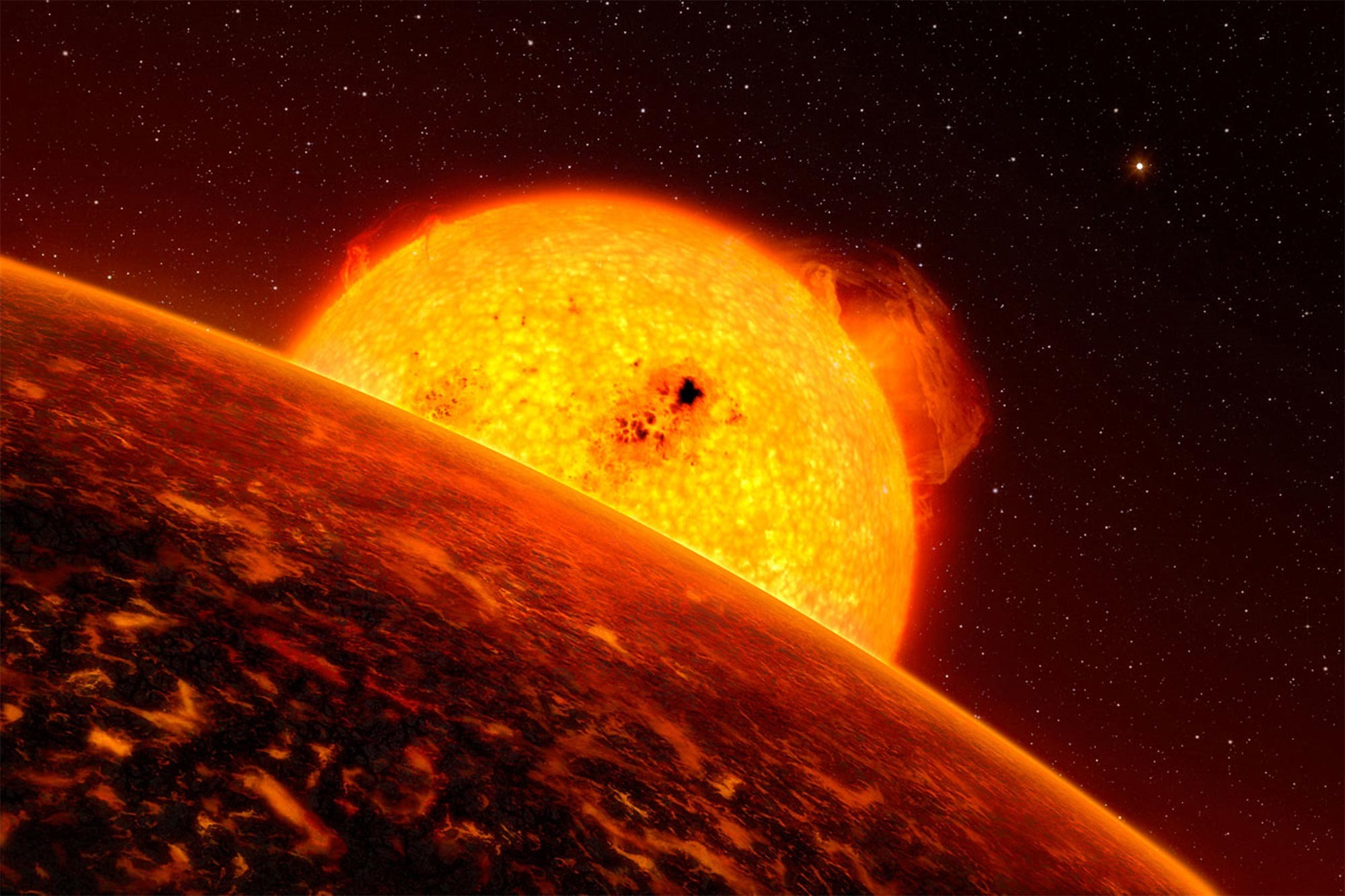
JWST looks inside a lava planet’s atmosphere. Finds hydrogen. Lots of it.
Picture this. The year is 2158. You’re on Mars. PhD in Planetary Volcanology. You’re broke. Always broke. Eating freeze-dried ramen because the university stipend buys air. You finished Jupiter’s moon Io. Too easy. Io runs on tidal heating. Squishy gravity from Jupiter stretches the moon until it leaks rock. Boring now.
You need something hotter. Something cooked by its own star. Not pulled apart by moons. Burned alive by light.
The Exoplanet Research Institute hands you a ticket. A fast ship. One rule: find a world within 50 light years. You have your target. It has been staring at us all along.
Webb targets the hot zone
Enter 55 Cancri e.
It is a super-Earth. Heavy. Eight times the mass of our home. Nearly twice the size. It lives close. Too close. Locked to a sun-like star. It laps that star once every 0.7 days. Roughly sixteen hours. For comparison. Mercury takes 88 days. 55 Cancri e has no shade.
Scientists used the James Webb Space Telescope. They watched the planet hide behind its star. Five eclipses. Five snapshots of the edge of the world.
Standard models said it should be a carbon monster. High carbon monoxide. High carbon dioxide. A hazy, choking sky of burnt rock vapors.
JWST saw something else.
There is carbon monoxide. Some carbon dioxide. But also? Hydrogen. Abundant. Rich. Unexpected.
“The preference for hydrogen-rich models… suggests an interior with relatively low oxygen.”
The differences in those five eclipse observations aren’t noise. They might be the planet breathing. Outgassing. Clouds of vapor rising up to cool the crust just enough. Then cleared away. A cycle. A rhythm. The surface breathes fire and gas.
Chemistry from the deep
Here is the trick.
The atmosphere doesn’t come from thin air. Literally. On rocky planets. The air is a leak from the inside.
Redox state. A mouthful. It is the balance between oxygen and other things like hydrogen or iron inside the mantle. On 55 Cancri e? Oxygen is low. Hydrogen is high.
Think of the core. Reduced. Starved of oxygen. When magma oozes out under those extreme surface temperatures. It doesn’t make CO2. It makes a hydrogen-rich mist.
It changes the story. We assumed lava planets would be dry carbon furnaces. This one is a wet hydrogen bath. Literally raining gas into a boiling sky.
More worlds burning
We are not alone in the lava department.
55 Cancri e was found in 2004. Pioneer. But now? They keep popping up. Like dandelions in a scorched yard.
- K2-141b
- L 98-59d
- TOI-561b
- HD 63433d
- CoRoT-7b
Some orbit in 6.7 hours. Others take four days. All locked. All hot. All tidally bound to their stars like prisoners.
But not all burn the same.
L 98-59b has magma oceans everywhere. Whole world. Liquid rock soup from side to side. 55 Cancri? Just the face. The sun-side sweats. The back stays… relatively. Dark. Cold. Silent.
Heat vs. Squeeze
Back to Io.
Io burns because Jupiter pulls it. Squeezes it. Tears it slightly every orbit. The friction cooks the rock from the inside out.
Exoplanets burn differently. They bake. External heat. Radiation. Proximity.
The mechanism changes everything. On Io. The whole moon heats. On these worlds. Just one side glows. The terminator line? That might be hell.
What comes next?
New telescopes. Better resolution. More worlds to weigh. Maybe we find another hydrogen world. Maybe we find a water vapor cloud layer riding on top of the magma. Or maybe we just find more rock.
Only time tells. And we keep looking up. Because if we stop. We might miss the next breath of the planet next door.
Reference : Snellen et al. (2026). “Strong and variable stratospheric CO emissions from lava planet 55 Cnc e…” arXiv:2606.11901. Nature Astronomy.


