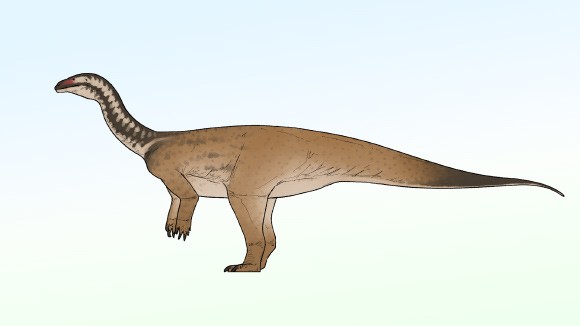
A remarkable fossil discovery in southwestern China has shed new light on the evolutionary journey of the world’s largest land animals. Paleontologists have identified a new genus and species of early dinosaur, Xiangyunloong fengming, which challenges conventional assumptions about how giant sauropods developed their iconic long necks.
Unearthed in Yunnan province, this creature lived approximately 190 million years ago during the Early Jurassic period. Its anatomy reveals a unique evolutionary strategy: rather than prioritizing neck length, Xiangyunloong evolved an exceptionally robust and elongated tail. This finding suggests that the path to becoming a colossal herbivore was not a single, linear progression, but a diverse array of experimental body plans.
A Bridge Between Eras
Xiangyunloong fengming belongs to the massopodan sauropodomorphs, a group of plant-eating dinosaurs that thrived from the Late Triassic to the Late Cretaceous. These animals are critical to understanding dinosaur history because they represent the transitional forms between early, bipedal ancestors and the massive, four-legged sauropods that would later dominate global ecosystems.
Standing between 9 and 10 meters (30–33 feet) long, Xiangyunloong is one of the largest known early-diverging sauropodomorphs found in China. The partial skeleton, discovered in the Fengjiahe Formation near Luming town, includes vertebrae from the neck, back, and tail, as well as parts of the hip.
Why this matters: The Early Jurassic was a pivotal moment in evolutionary history. It was during this time that sauropodomorphs began to diversify and rise to dominance on land. By studying animals like Xiangyunloong, scientists can decipher the specific anatomical changes that allowed dinosaurs to achieve gigantic sizes—a feat of engineering unmatched by any other terrestrial vertebrate.
An Alternative Evolutionary Pathway
What sets Xiangyunloong fengming apart is its unusual combination of physical traits. While modern popular culture often associates giant dinosaurs with elongated necks, this species possessed a relatively short neck for its body size. Instead, it featured a remarkably heavy and long tail.
Researchers believe this tail served a crucial functional purpose: counterbalance. This anatomy would have allowed Xiangyunloong to rear up on its hind legs, accessing higher vegetation without the need for an extended neck. This suggests an “alternative evolutionary pathway” where stability and vertical reach were achieved through tail mass rather than cervical vertebrae.
“Within this group, non-sauropodan massopodan sauropodomorphs played a crucial role in the evolutionary pathways leading to the gigantic body plans characteristic of sauropods,” explained Dr. Ya-Ming Wang of the Geological Museum of China and his colleagues.
Filling the Gaps in the Fossil Record
The discovery of Xiangyunloong significantly enriches our understanding of Early Jurassic dinosaur fauna in southwestern China. Phylogenetic analysis places this species in a key position between earlier, simpler sauropodomorphs and more derived forms that are closer to true sauropods.
This specimen provides critical new data on morphological disparity —the variety of body shapes and structures present within a group. It highlights that the evolution of giant dinosaurs was not a uniform process but involved diverse experimental adaptations. Understanding these variations is fundamental to mapping the paleobiogeography and success of one of the most dominant dinosaur clades in history.
The findings, published in Royal Society Open Science on March 25, underscore the importance of continued excavation in regions like Yunnan. Each new fossil helps complete the puzzle of how life scaled up to unprecedented sizes during the Mesozoic era.
In conclusion, Xiangyunloong fengming offers a vital piece of the evolutionary puzzle, demonstrating that the road to becoming a giant was paved with diverse anatomical experiments. Its heavy-tailed design provides a clearer picture of the adaptive strategies early sauropodomorphs used to survive and thrive before the rise of the classic long-necked giants.