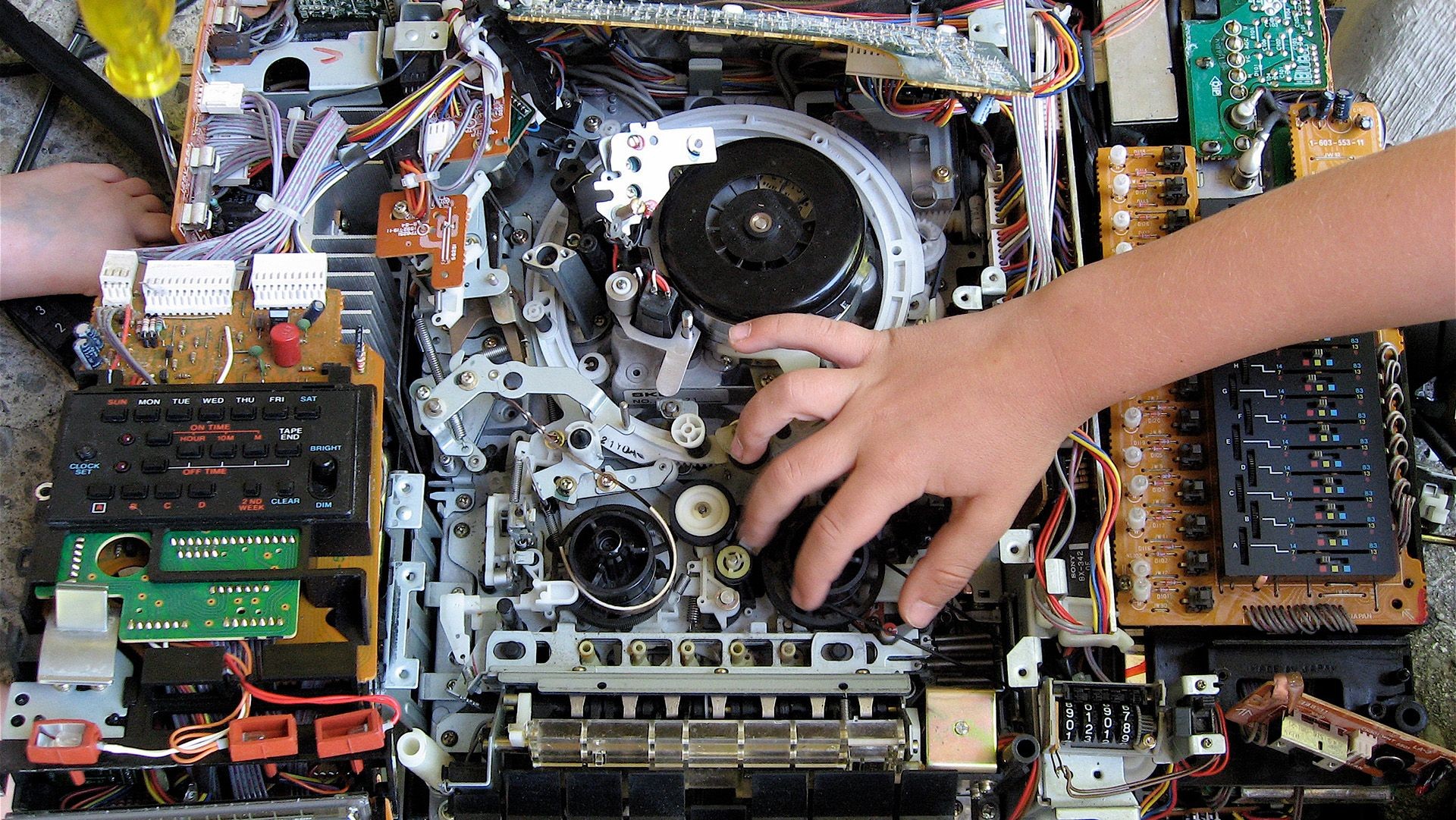
Have you ever tried to fix something? Maybe you opened it up, looked at the guts, and decided buying a new one was cheaper or just easier. You are not crazy. You are not alone.
It has not really been an option for decades. At least not in the U.S. Especially not when that toaster has a brain inside it.
We live in a world of absurd economics. A printer costs less to replace than its own ink cartridge sounds ridiculous. But it’s real. The U.S. military buys weapons they cannot legally repair. Why? Because the IP rights stay with the builder. John Deere farmers face the same wall. They own the tractor. They do not own the software running the tractor.
There is a cost to this convenience. Or lack of it.
The U.S. throws away roughly 43 lbs of electronic garbage per person every year. That makes us the second biggest producer of e-waste on the planet, right behind China. And what happens to all that junk?
Only 25% gets recycled.
The Right to Tinker
So the “right to repair” movement happened.
The idea is simple. If you buy it, you should be able to fix it. Or hire a third party to fix it. No legal roadblocks. No hidden codes. No extortion fees.
Congress actually agrees on this. Rare, but true. There is a Democratic bill, the Warrior Right to Repair Act from 2025. There is a Republican one, the Repair Act. Both want a federal framework. Both want it to be cheap and easy to fix stuff.
Industry hates them. Naturally.
To understand why we are stuck in this mess, we have to go back. Way back. Before smart phones. Before tablets. Back to when the only digital threat was a box that looked like a microwave.
Hollywood and the VCR
Video cassette recorders arrived in the late 70s. Suddenly movies weren’t just moments you experienced at the theater. They were physical goods you owned in your living room.
Hollywood panicked.
They made good money, sure. But now people could copy films. On their own terms. Studios tried to ban the technology entirely. The repair bans we see today are basically the legacy of that fight.
American copyright law started in 1790. It had a balance then. Protect the creator, sure, but let society progress by sharing info.
Fair use was the shield. Judges used it to protect public libraries. Book clubs. Universities. The press. The 1976 Copyright Act wrote it into law.
But in 1976 the studios sued Sony.
They argued selling VCRs was basically encouraging piracy. The Supreme Court said no in 1984. Recording TV for yourself was legal. Fair use won.
Hollywood was angry.
So they shifted tactics. No more lawsuits. Let’s build better locks.
Digital Doors
They chose the DVD. It started as read-only. No copying allowed. Eventually, recording became possible. But it was harder. More complex than VHS.
By 1997, just a year after the disc launched, every major studio was onboard. The era of easy video tape copies was dying.
Then came DRM.
Digital Rights Management. It is not one tool. It is a battery of them. Encryption. Authentication. Code that asks “do you own this?” and then locks the door if the answer isn’t “yes, I do.”
The Digital Millennium Copyright Act passed in 1998. Clinton signed it. It was a hand-hold between entertainment and software.
It made penalties heavier for online infringement. More importantly, it criminalized the bypass. If a tech lock exists, breaking it is a crime. Even if you bought the device.
Critics warned this would stifle innovation. They were right. Nobody listened.
Since then, chips have moved into everything. Toys. Dishwashers. Tractors. All of them run proprietary code protected by copyright.
If you want to fix that John Deere combine, you need the code. John Deere has it. You do not.
If a third-party mechanic tries to bypass that software to diagnose a problem, they are violating copyright. Legally liable. Some devices are even physically designed so you can’t open them without destroying the whole unit.
Manufacturers say only they can fix these things. Authorized technicians.
Those repairs are expensive. Often more expensive than a new machine. So what do you do?
You toss it.
Resentment Grows
Technology always outruns the law. It always does.
Right now, over 80% of American people support the right to repair. They are tired of paying for privilege they bought.
The laws meant to protect artists? They are bleeding consumers dry now.
Whether Congress actually fixes it remains to be seen. The industry fights hard. The laws are sticky. But the resentment is louder than ever.
Will you repair that printer? Or just throw it away?
It shouldn’t matter which choice you make. It should matter what choice is available to you.