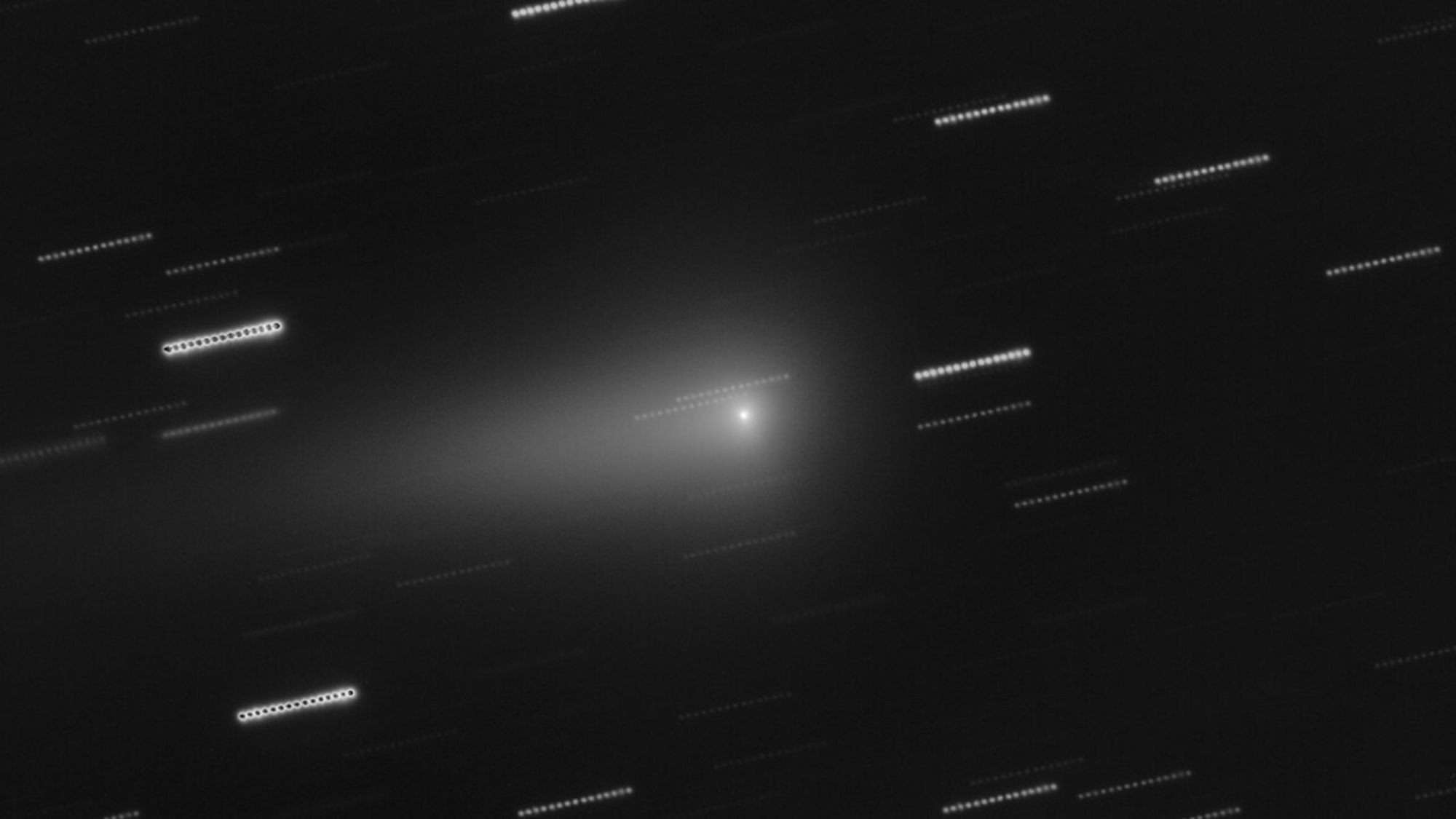
More evidence keeps popping up. It’s getting harder to argue that the interstellar comet 31/ATLAS isn’t an ancient relic. Specifically, a fossil from before our sun even lit up.
Earlier this year, NASA researcher Martin Cordiner and his team pointed at data from the James Webb Space telescope. The isotope ratios of carbon and deuterium told a specific story: this comet is between 10 and 20 billion years old. That makes it twice as old as our 4.6 billion-year-old neighborhood.
Now, independent observers are backing that up.
Researchers using the Ultraviolet and Visual Echelle spectrograph (UVES on the Very large Telescope) confirmed those carbon readings. But they went further, measuring nitrogen isotopes too.
Here’s how that works. Elements like carbon or nitrogen can have different weights depending on their neutron count. Carbon-12 has six protons, six neutrons. Carbon-13 has one more neutron. Nitrogen-14 is seven and seven. Nitrogen-15 adds one extra neutron.
These variations aren’t random. They form differently, in different places, at different cosmic epochs. As the comet heats up near the sun, it spills its secrets into gas and tail. The ratio tells you where and when it started.
“Interstellar objects are sort of fossils from a planetary formationprocess that happened very far away.” — Cyrielle Opitom
Opitom, an astronomer at the University of Edinburgh, led the VLT observations. Her team found something striking about the carbon. The ratio of Carbon-12 to Carbon-13 was higher than anything seen in local comets.
Why does that matter? Because red giant stars produce Carbon-13 over time. If this comet formed recently, it should have more of the heavier stuff. It doesn’t. It’s rich in the lighter variant.
So it formed long ago. Before the galaxy had time to enrich itself with heavier isotopes. The JWST data gets its ally.
The nitrogen results were even weirder. The team, co-led by Jean Manfroud and Damien hutsemekers from the University of liege, measured nitrogen-14 versus nitrogen-15.
The ratio is more than double what we find in comets native to solar system.
That high ratio isn’t random. It’s the signature of the outer edge of planet-forming disks around young stars. Far away. cold. Quiet. Like a kuiper belt but alien.
“unlike comets from our solar System, this interstellar Visitor carries unusually High carbon and nitrogen Isotopic Ratios.” — Aravind krishnakumar
This helps solve the mystery of how it ended up alone in deep space.
Models say giant planets migrating inward can kick small rocks into the void. But if 3i/atlas formed on the far outskirts, those planets probably weren’t involved. It was likely born far from any action.
Maybe it was just snatched.
A passing star could have pulled it in, ripped it free, and hurled it into the galactic night. That’s a simpler explanation for an object that spends billions of years wandering alone.
The chemistry backs this up. Jwst already showed us 3i/atlas is heavy on carbon monoxide and dioxide. Light on water. It’s packed with nickel, iron, and way more methanol than you’d expect compared to hydrogen cyanide.
Alien conditions. Alien history.
We haven’t gotten this kind of clarity before. 1i/oumuamua didn’t outgas, so we had no spectral data to play with. 2i/borisov was too faint to measure accurately.
3i/atlas gave us a gift. It shows what’s possible when an interloper stays bright and cooperative just long enough.
Rosemary dorsey from the university of helmski put it best. This is a chance to probe another planetary system. One that existed long before our sun.
We’re just scratching the surface of what these travelers can teach us about the milkway’s deep past.
The next one might be right around the corner.